
Lieferung heute & morgen

Qualitätsgarantie

Willkommens-Angebote freischalten: KOSTENLOSE Lieferung | Bis zu 80 % RABATT | Kostenlose 30-Tage-JoyPlus-Testphase
App herunterladen
A cooker hood should reliably remove or filter cooking vapours, grease particles and odours from your cooking area. In practice, however, a high extraction rate alone won’t tell you which model is right for you. The design, connection type, noise level and filter maintenance all need to suit your kitchen and the way you cook.
Figures such as 400, 564 or 650 m³/h describe the maximum airflow under specific conditions. A long, twisting extraction duct, a narrow diameter or several bends can reduce the actual performance. If you’re buying a cooker hood with both recirculation and extraction, first check which operating mode is practical for your kitchen.
A cooker hood with a carbon filter traps odours when used in recirculation mode. The grease filter is also important and needs regular cleaning. Carbon filters are consumable parts and need replacing at intervals, depending on how often you use the hood. If you don’t factor in these costs, you won’t be comparing the prices of different models on a like-for-like basis.
The noise rating often relates to a specific operating condition. At a high setting or with the boost function on, noise levels can be considerably higher. When choosing a quiet cooker hood, check the stated maximum noise level, the available settings and how you plan to use it.
A wall-mounted cooker hood is installed visibly on the wall and is suitable for hobs with clear wall space above them. An angled cooker hood is usually sloped, which can make it easier to reach the hob. A built-in cooker hood, on the other hand, fits inside a wall unit or kitchen cabinet.
The hood should be at least as wide as your hob. For a standard 60 cm hob, a 60 cm cooker hood is a natural choice. If you have a wider hob or cook frequently, a 90 cm cooker hood may be a better option, provided there’s enough space and clearance for installation.
The extraction rate is measured in m³/h. A higher maximum rate can be useful when frying at high heat or cooking with several pans at once, but only if your extraction duct is suitable. In recirculation mode, air passes through grease and carbon filters before being returned to the room.
For an extraction system, check the installation requirements, the existing wall vent and whether air can be safely vented outside. Recirculation is often easier to install in flats. If you have an open fire or gas appliances, make sure the room is adequately ventilated to prevent dangerous negative pressure.
The energy efficiency rating provides a standardised basis for comparison. Models rated A++ or A+++ may have lower annual energy consumption, according to the product details. Your running costs will also depend on how often you use the hood and which setting you choose.
Useful features include touch controls, a timer or app control. A cooker hood with LED lighting can illuminate the hob precisely. However, it’s still important that the grease filters are easy to remove and clean regularly. Multi-layer aluminium filters that are dishwasher-safe can make maintenance easier; always follow the manufacturer’s instructions.
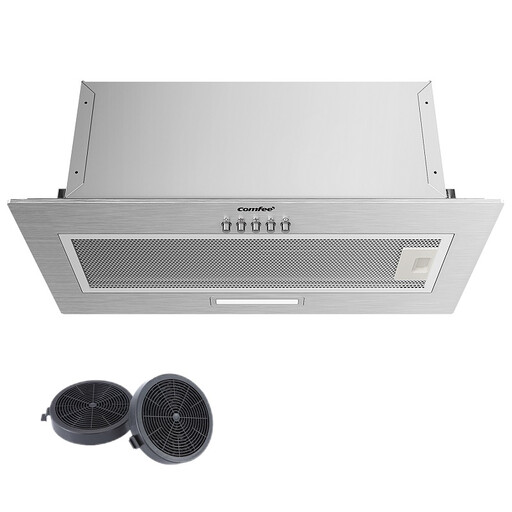
Why it suits this kitchen: At 52 cm wide, this built-in hood is designed for compact kitchens and limited wall-unit space. It offers three speed settings, LED lighting and an extraction rate of 400 m³/h, according to the product details.
Its design and stated dimensions make it easier to check that it will fit before installation. The five-layer filter is designed for regular cleaning.
Built-in design, three speed settings, LED lighting, and recirculation or extraction mode according to the product description.
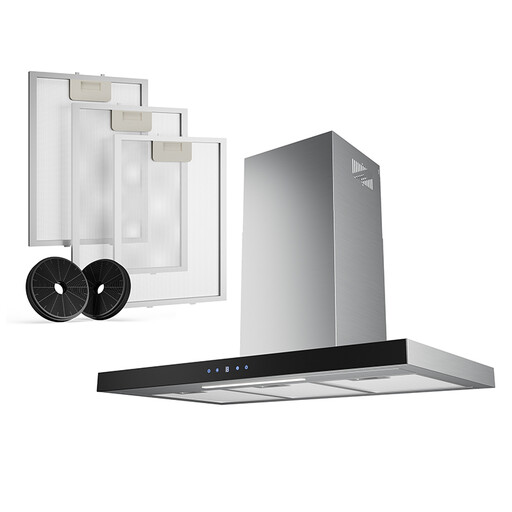
Why it suits this kitchen: This 90 cm wall-mounted hood is designed for wide hobs and visible installation. It has a stated extraction rate of 564 m³/h, touch controls, a digital display and an A++ energy efficiency rating.
It can be used in extraction or recirculation mode. According to the product information, a carbon filter set and installation materials are included.
90 cm width, touch controls, digital display, LED lighting and a dishwasher-safe five-layer aluminium filter.
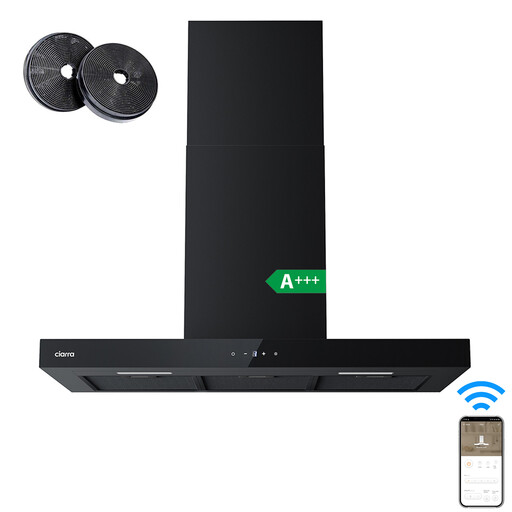
Why it suits this kitchen: This model combines a 90 cm width with Wi-Fi, app and touch controls, four speed settings and a boost function. Its stated maximum extraction rate is 650 m³/h.
The maximum noise level is stated as 59 dB. Carbon filters are used for recirculation, and an extraction option is also listed.
A+++ according to the product details, annual energy consumption of 12 kWh according to the specifications, 650 m³/h, app control and boost function.

Why it suits this kitchen: This 60 cm wall-mounted hood suits many standard hobs. It offers app control, SensorTouch, four settings with boost, and both recirculation and extraction modes.
The product specifications state a maximum noise level of 59 dB and list washable aluminium filters. This helps you assess noise and maintenance before you buy.
60 cm width, 650 m³/h, A+++ rating according to the product details, Wi-Fi app, LED lighting and two carbon filters for recirculation.
We’ve put together a complete, regularly updated list of products that meet these strict selection criteria and comply fully with the safety regulations in force in the EU.
Before you buy, check the installation width, the clearance above the hob and the position of the extraction outlet. For an extraction installation, you’ll also need to check the duct diameter and length, as well as the number of bends. A qualified professional should handle electrical connections and installation near open fires or other appliances that use combustion.
Clean grease filters regularly, depending on how often you use the hood. If you use recirculation mode, you’ll also need to replace the carbon filter at the recommended intervals. Disconnect the appliance from the mains before cleaning or maintenance. Avoid naked flames beneath the hood, for example when flambéing, as they increase the risk of fire.
Extraction vents cooking vapours outside and needs a suitable wall or roof outlet. Recirculation is more flexible in rented homes and kitchens without an extraction duct, but it requires regular cleaning of the grease filters and replacement of the carbon filter.
Your hood should be at least as wide as your hob. A 60 cm cooker hood is often a good fit for standard hobs. For a 90 cm hob or particularly intensive cooking, a 90 cm cooker hood can provide wider coverage.
With recirculation, you’ll need to factor in the regular cost of replacing carbon filters, as well as electricity use. Actual energy consumption depends on the efficiency rating, the setting you use and how long the hood is switched on. Washable grease filters can help keep maintenance costs down, but they still need to be cleaned regularly.