
Lieferung heute & morgen

Qualitätsgarantie

Willkommens-Angebote freischalten: KOSTENLOSE Lieferung | Bis zu 80 % RABATT | Kostenlose 30-Tage-JoyPlus-Testphase
App herunterladen
A cooker hood is designed to extract or filter cooking vapours, grease particles and odours from your kitchen. However, when buying one, it’s not just about design and maximum airflow. What really matters is whether the style, width, operating mode and filters suit your kitchen. Rented properties also come with different requirements compared to a newly planned kitchen with a ducted extraction system.
Figures like 650 m³/h might sound straightforward. In practice, the actual airflow you achieve also depends on duct length, duct diameter, bends and a non-return valve. With extraction systems, a poorly routed duct can reduce performance. With recirculation, the air is additionally passed through grease and charcoal filters.
The stated airflow is therefore a technical benchmark, but not the sole measure of suitability.
A cooker hood with recirculation and extraction offers more installation flexibility. However, for extraction you need a suitable external vent. In rented properties, you must also get permission from your landlord or building management.
With recirculation, the cleaned air is returned to the room. This requires a cooker hood with a charcoal filter. The filter needs regular replacement and incurs ongoing costs. A charcoal filter is not the same as a washable metal grease filter.
A 60 cm cooker hood usually suits standard hobs. For larger cooking surfaces, a 90 cm cooker hood can be a good idea, as it covers a wider area of steam. A hood that is too narrow may allow steam to escape around the sides.
Before buying, you should also check the dimensions of your wall cabinet, the depth of the hood and the distance to the hob. The installation height depends on the instruction manual and the type of hob you have.
An under-cabinet cooker hood is fitted beneath a wall cabinet and is ideal for compact kitchens. Telescopic models can be partially pushed back in when not in use. An integrated cooker hood is built into a cabinet and blends discreetly into your kitchen front.
A wall-mounted hood is fixed visibly to the wall. Angled or flat models can offer more headroom. Before installation, consider the wall type, chimney cover and the available space above the hob.
For occasional cooking, a lower airflow may be sufficient. If you frequently fry, grill or cook with multiple pans, you should compare the power levels and maximum airflow more closely. A cooker hood with 650 m³/h offers more reserve on paper than a model with 250 or 300 m³/h.
Equally important is the stated noise level in decibels. The values vary depending on the power level. A unit with 59 dB on the highest setting is not automatically quieter in every use than another model. For open-plan kitchens, a quiet cooker hood with a low noise level on the settings you use most often can be beneficial.
Washable aluminium grease filters can be cleaned by hand or in the dishwasher, depending on the manufacturer’s instructions. They should be checked regularly, as grease build-up can impair airflow and pose a safety risk.
In recirculation mode, charcoal filters must be replaced according to the manufacturer’s instructions. The energy efficiency class and annual energy consumption help you estimate ongoing electricity costs. An energy-efficient cooker hood is particularly appealing if you use it daily. Product ratings such as A+, A++ or A+++ should be checked against the relevant product data sheet.
Additional features like a cooker hood with LED lighting, touch control, gesture control or app connectivity are convenience extras. They do not replace checking the width, filter costs and installation options.
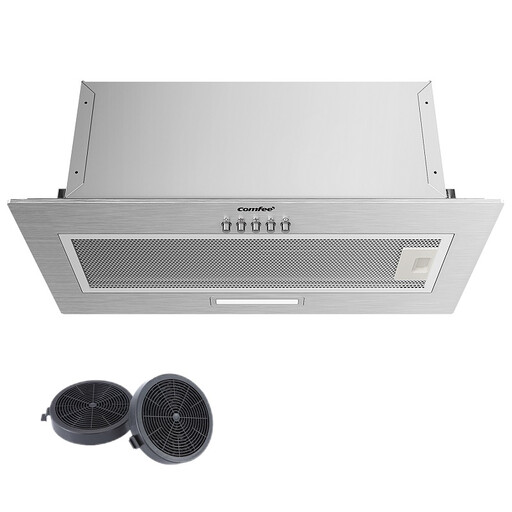
Why this product fits the profile: This 52 cm integrated unit is designed for compact kitchens and smaller hobs. It offers three power levels, LED lighting and 400 m³/h airflow.
The product details explicitly mention recirculation and extraction modes. This allows you to check the installation option against your existing kitchen before buying.
Compact design, five-part filter and integrated LED lighting; energy efficiency class B according to product data.
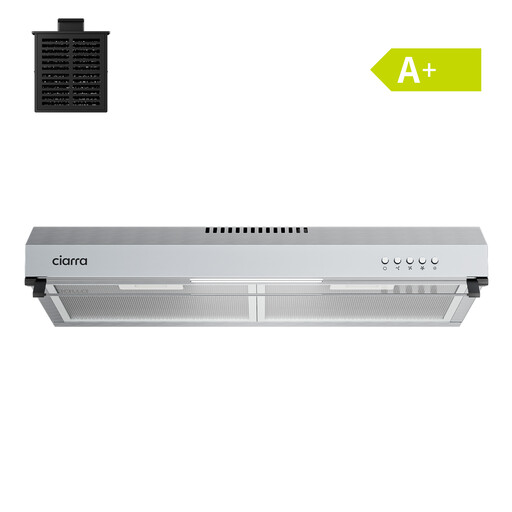
Why this product fits the profile: This integrated stainless steel model suits a 60 cm kitchen and combines a glass front, three power levels and a discreet built-in look.
The details include concrete values for airflow, noise level, filter type and annual consumption. This allows you to compare the model more objectively with other integrated hoods.
Washable aluminium filters, 61 dB maximum noise level and energy efficiency class A+ according to product data.
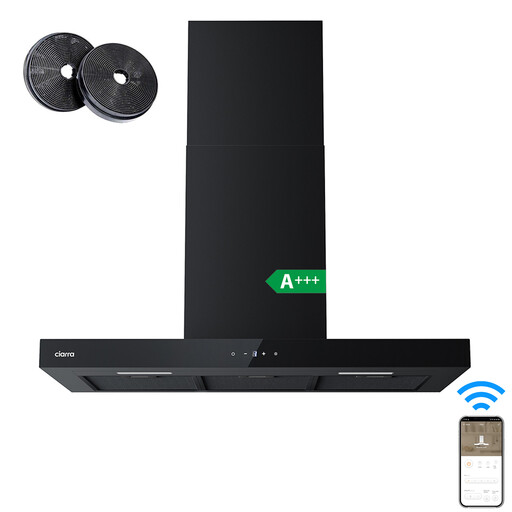
Why this product fits the profile: This 90 cm wall-mounted hood is designed for wider cooking areas and offers four speed levels, a booster, app control and up to 650 m³/h airflow.
The product description mentions both recirculation and extraction modes and highlights the necessary filter maintenance. This reduces the risk of discovering the operating mode only after installation.
650 m³/h maximum airflow, 59 dB maximum noise level, two washable aluminium filters and energy efficiency class A+++ according to product data.
We have put together a full, regularly updated list of products that fully meet these strict selection criteria and the safety regulations in force in the EU.
A cooker hood should be at least as wide as your hob. For a 60 cm hob, a 60 cm cooker hood is usually chosen. For wider cooking surfaces or heavy frying, a 90 cm hood can offer more coverage.
Extraction removes moisture and odours to the outside, but requires a suitable vent. Recirculation is more flexible in rented properties and for retrofitting, but needs a suitable charcoal filter and regular filter changes. The structural conditions of your home are therefore more decisive than a general recommendation.
Washable grease filters should be cleaned regularly depending on usage. Charcoal filters are consumable items and must be replaced according to the manufacturer’s instructions. Frequent frying and deep-frying may require shorter intervals.