
Lieferung heute & morgen

Qualitätsgarantie

Willkommens-Angebote freischalten: KOSTENLOSE Lieferung | Bis zu 80 % RABATT | Kostenlose 30-Tage-JoyPlus-Testphase
App herunterladen
A cooker hood needs to reliably capture cooking vapours, grease particles and odours. In practice, however, the choice often fails not because of the design, but due to incorrectly estimated dimensions, unsuitable filters or unrealistic performance figures. This is especially true in rented flats, small kitchens and open-plan living areas, where a careful comparison is well worth the effort.
Figures such as 400 or 650 m³/h usually refer to the maximum airflow under specific conditions. With an extractor cooker hood, the actual achievable performance is affected by the duct length, diameter, bends and non-return flap. In recirculation mode, the air is additionally passed through a charcoal filter, which can reduce the airflow.
So don't just focus on the maximum figure. For everyday use, several power levels, a suitable hood width and the shortest possible duct run are what really matter.
A recirculation cooker hood doesn't require a wall duct and is therefore suitable for many rented flats. However, it returns the filtered air back into the room. The metal grease filter needs regular cleaning; the charcoal filter is a consumable item and must be replaced as needed, depending on usage.
A cooker hood with a charcoal filter is therefore practical, but it does incur ongoing running costs. Before you buy, check whether the appropriate filter is included in the delivery or whether it needs to be ordered separately.
The noise level is given in decibels and usually increases with the selected power setting. A hood advertised as a "quiet cooker hood" can be noticeably louder on the highest setting than on level one. For open-plan kitchen-diners, the noise levels across several power settings are therefore more important than a single maximum or minimum value.
The hood should be at least as wide as your hob. A 60 cm cooker hood often suits standard hobs and compact kitchens. A 90 cm cooker hood offers a larger capture area and makes sense for wider hobs or more intensive use.
Depending on your kitchen cabinets and installation position, different designs may be suitable:
Measure the available width, depth, cabinet height and the distance to your hob before ordering. The prescribed installation clearances from the relevant instruction manual must be observed. In the product specifications provided, 65 cm above an electric hob and 75 cm above a gas hob are commonly stated.
An extraction system transports kitchen air to the outside. For this you need a suitable wall vent or an existing extraction connection. With gas appliances, wood-burning stoves or other room-air-dependent heating appliances, the air supply must be professionally considered to prevent a dangerous negative pressure.
A recirculation system is more flexible to install. It doesn't require a duct, but it binds odours using charcoal. Also check whether the hood supports both operating modes. Several models in our selection are designed for extraction and recirculation.
A removable metal grease filter makes regular cleaning easier. On selected models, the multi-layer aluminium filter is dishwasher-safe according to the product specifications. Use a suitable programme with a low temperature and follow the instructions.
A cooker hood with LED lighting illuminates the cooking surface directly. Touch control, timer, booster and app connectivity can increase convenience, but aren't necessary for every kitchen. A cooker hood with Wi-Fi and app is particularly interesting if you want to use timed operation or remote control. If you prefer straightforward mechanical controls, you'll find models with push buttons or rocker switches.
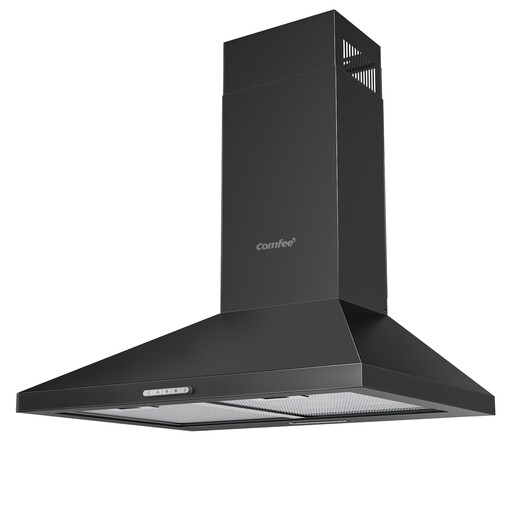
Why this product fits the profile: This 60 cm wall-mounted hood offers three power levels, LED lighting and both extraction and recirculation modes. That makes it suitable for standard hobs and smaller households.
The product specifications mention both operating modes and a washable grease filter. This means you can check before installation whether a charcoal filter or an extraction connection is needed.
According to the product specifications, up to 400 m³/h airflow, three settings, LED light and a 60 cm format.
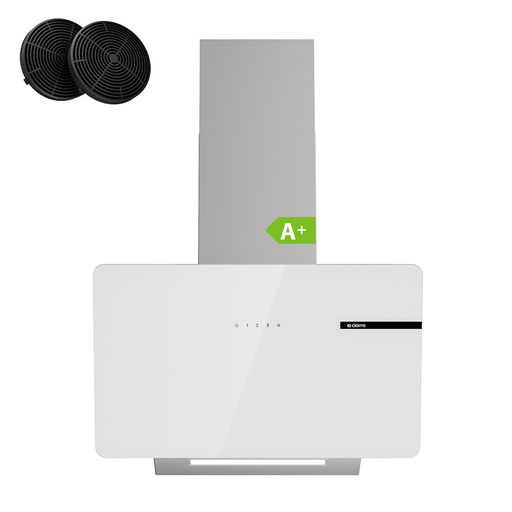
Why this product fits the profile: The angled hood made from glass and stainless steel creates more headroom in front of the hob and combines touch control with three power levels.
The product specifications mention a washable, five-layer aluminium grease filter unit. This reduces the need for disposable grease filters; the charcoal filter remains a separate maintenance item for recirculation.
According to the product specifications, approximately 580 m³/h, energy efficiency class A+, LED lighting and a dishwasher-safe grease filter.
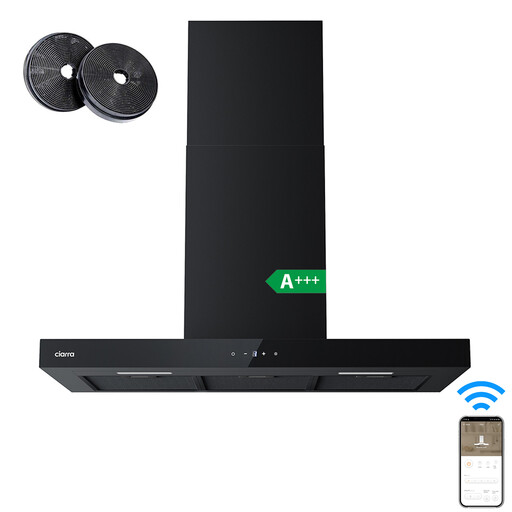
Why this product fits the profile: This wide wall-mounted hood is aimed at open-plan kitchen-diners and households that frequently fry or use multiple cooking zones.
The product specifications explicitly mention recirculation and extraction modes, four speeds and automatic return from boost mode. This makes it easier to adapt to different cooking situations.
According to the product specifications, up to 650 m³/h, 59 dB at maximum stated level, LED light, touch control and app connectivity.
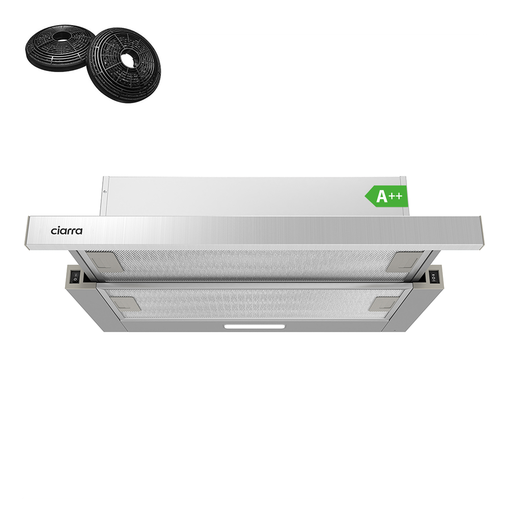
Why this product fits the profile: The pull-out design makes use of the available space under a wall cabinet and supports both extraction and recirculation.
The compact dimensions and retractable slide-out section help to avoid space issues before purchase. The metal grease filter is washable according to the product specifications.
According to the product specifications, up to 370 m³/h, energy efficiency class A++, LED lighting and two washable aluminium filters.
We've put together a complete, regularly updated list of products that fully meet these strict selection criteria and the safety regulations in force in the EU.
The exact distance depends on the design, hob and installation instructions. In the product specifications provided, at least 65 cm for electric hobs and 75 cm for gas hobs are commonly stated. The instruction manual for the specific model and the applicable installation requirements are decisive.
The lifespan depends on usage, cleaning, motor load and filter maintenance. Regularly cleaned grease filters help maintain an unobstructed airflow. With recirculation units, charcoal filters should be replaced in good time, as a clogged filter can impair air circulation.
The ongoing costs consist of electricity consumption, possible charcoal filters and maintenance effort. Compare the stated annual energy consumption, the energy efficiency class and the price of the appropriate replacement filters. With an extractor cooker hood, charcoal filters are usually not needed, but a suitable extraction connection must be available.