
Lieferung heute & morgen

Qualitätsgarantie

Willkommens-Angebote freischalten: KOSTENLOSE Lieferung | Bis zu 80 % RABATT | Kostenlose 30-Tage-JoyPlus-Testphase
App herunterladen
A cooker hood is a central element of any functional kitchen. It not only ensures fresh air while cooking but also protects furniture and walls from grease deposits and moisture. However, the market can be overwhelming, and many buyers fall into common traps that lead to frustration and unnecessary costs. Before you make a decision, you should know the three most common purchasing mistakes to make an informed choice that perfectly suits your needs.
Mistake 1: Choosing the Wrong Operating Mode Many buyers purchase a powerful extraction hood without checking if a wall opening for the exhaust duct is even possible. This is often not permitted, especially in rented apartments. The result is an expensive appliance that cannot be operated according to regulations.
Mistake 2: Ignoring the Noise Level A high airflow rate (measured in m?/h) is tempting, but it often comes with a high noise level. In open-plan kitchens, a loud cooker hood quickly becomes a nuisance and is rarely used in everyday life. The outcome: despite a significant investment, cooking odours linger in the room.
Mistake 3: Misjudging the Type and Size A stylish angled hood in a kitchen with a low ceiling can paradoxically restrict headroom. A hood that is too small won't capture all the rising steam, while a model that is too large will look oversized in a compact kitchen and take up valuable space.
To avoid these mistakes, it's important to understand the technical basics. Focus on the following three aspects to find the right model for your kitchen.
Choosing the operating mode is the most fundamental decision. Your structural conditions will determine which option is right for you.
Many modern appliances offer both operating modes and can be configured as needed.
The performance of a cooker hood is measured in cubic metres per hour (m?/h). A simple rule of thumb for calculating the required performance is:
Room Volume (Length × Width × Height in m) × 10 = Recommended Airflow Rate in m?/h
For a 15 m? kitchen with a 2.5 m ceiling height, a performance of around 375 m?/h would be a good benchmark. However, don't just look at the maximum performance, but also at the associated noise level, specified in decibels (dB). In practice, a quiet cooker hood operates at under 60 dB on a medium setting. Models with multiple power levels allow for flexible adjustment to the specific cooking situation.
The type of hood determines how it integrates into your kitchen. Common types include:
Also, pay attention to the energy efficiency class. An A+++ or A++ rated cooker hood consumes significantly less electricity than models in classes A or B, which affects your long-term operating costs.
Here are some models tailored to specific user profiles and their requirements.
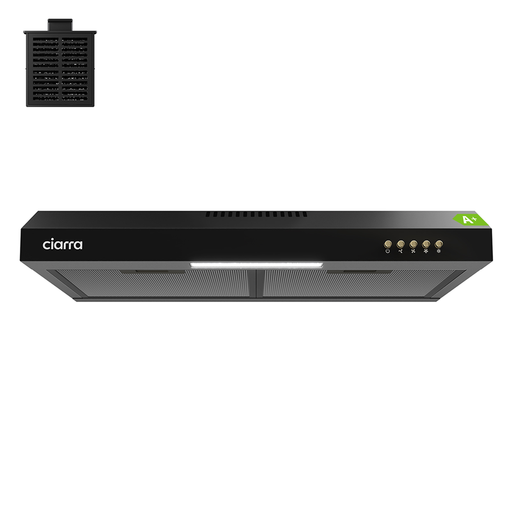
Why This Fits Their Persona: Ideal for renters with limited space. Designed as an under-cabinet hood, it can be discreetly mounted beneath a wall unit without sacrificing valuable storage. The standard 60 cm width fits most kitchen layouts.
This model offers both extraction and recirculation modes. This avoids the "Wrong Operating Mode" mistake, as it can be adapted to the apartment's conditions without requiring any structural changes.
Compact design for small kitchens; flexible installation options (extraction/recirculation); washable metal grease filter for easy maintenance.
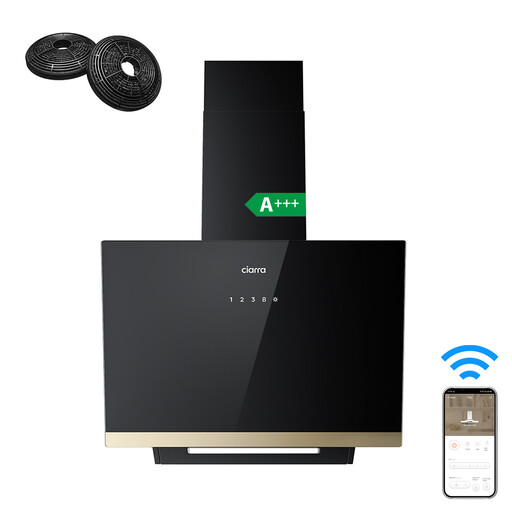
Why This Fits Their Persona: For homeowners creating a modern kitchen with an aesthetic statement. This angled hood in black glass not only offers an attractive design and more freedom of movement but also advanced features like app control.
Despite its high airflow rate of 650 m?/h, the maximum noise level is 58 dB according to the manufacturer. This addresses the "Performance vs. Noise" conflict, making it suitable even for open-plan kitchens.
Energy efficiency class A+++ for low running costs; high extraction power at a moderate noise level; smart control via app.
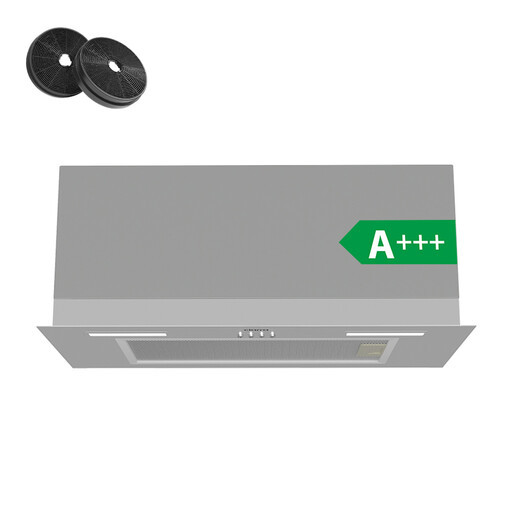
Why This Fits Their Persona: Perfect for anyone who wants a seamless kitchen look without compromising on performance. As an integrated cooker hood, it disappears completely into the wall cabinet, preserving a clean, minimalist kitchen design.
This model debunks the myth that integrated hoods are weak. With an airflow rate of up to 640 m?/h, it offers powerful extraction usually only found in larger wall-mounted hoods, thus avoiding the "Wrong Type" mistake.
Outstanding energy efficiency class A+++; very high performance for a built-in unit; invisible design for a continuous kitchen aesthetic.
We have compiled a complete, up-to-date list of products that fully meet these strict selection criteria and UK safety regulations.
1. How often do you need to change the activated charcoal filter in a recirculation cooker hood? Generally, a replacement is recommended every 3 to 6 months. The exact frequency depends heavily on your cooking habits. If you frequently fry or cook strong-smelling foods, an earlier change may be advisable to ensure optimal odour neutralisation.
2. Can I install a cooker hood myself? The installation of a simple under-cabinet hood or a free-hanging recirculation model can often be done by experienced DIYers. However, for wall-mounted hoods, integrated cooker hoods, or any type of extraction installation, professional fitting is recommended. This ensures that all safety clearances are met, electrical connections are made correctly, and the exhaust ducts are sealed and laid out efficiently. Joybuy also offers installation and disposal services for selected models.
3. Is it a good idea for a cooker hood to be wider than the hob? Yes, that is actually recommended. Ideally, the cooker hood should be about 10-15 cm wider than the hob on each side. For example, a 90 cm hood over a 60 cm hob can more effectively capture rising steam and grease vapours that spread out sideways as they rise. This is particularly true for gas hobs, where the heat disperses the steam more widely.