
Lieferung heute & morgen

Qualitätsgarantie

Willkommens-Angebote freischalten: KOSTENLOSE Lieferung | Bis zu 80 % RABATT | Kostenlose 30-Tage-JoyPlus-Testphase
App herunterladen
A cooker hood is designed to remove or filter cooking vapours, grease particles and odours from your kitchen. However, choosing the right one involves more than just design and motor power. Incorrect dimensions, missing accessories or an unsuitable operating mode can mean that the hood performs poorly in everyday use.
Figures such as 600 or 650 m³/h usually refer to a specific operating condition. In an installed kitchen, the extraction duct, bends, backdraught flap and filters can all affect airflow. A high maximum figure alone therefore does not guarantee suitable extraction performance.
You should also consider:
A 60 cm cooker hood will often fit standard hobs. For a wider hob, a 90 cm cooker hood may be a sensible choice, as it provides more generous coverage of the steam area. The key factor is not just the external width, but also the position of the hood above the cooking zones.
Before buying, check the installation recess, wall area, depth and the space available for the chimney.
Extraction and recirculation are two different installation methods:
You should therefore check whether activated carbon filters are included or need to be purchased separately.
A wall-mounted hood is visibly attached to the wall. It is suitable for hobs positioned against a clear wall. An integrated cooker hood, on the other hand, is partially or completely concealed inside a wall unit and is suitable for compact kitchens.
A sloping-front cooker hood can provide more room to move. For a kitchen island, however, you will need an island hood or a model specifically designed for ceiling or island installation. Not every appliance with a similar appearance is suitable for this purpose.
Airflow is measured in m³/h. A lower figure may be sufficient for small kitchens and occasional cooking. For open-plan kitchens, frequent frying or intensive use, higher power settings are practical.
Noise levels are measured in dB. Wherever possible, compare figures at similar power settings. An appliance rated at 59 dB at maximum power cannot be directly compared with one whose noise level is only stated for a lower setting.
An aluminium grease filter is washable and, depending on the model, may be suitable for cleaning in a dishwasher. It should be cleaned regularly, approximately every two to four weeks, depending on usage. Grease deposits can reduce airflow and pose a safety risk when heavily soiled.
With recirculation, the activated carbon filter must also be checked and replaced according to the manufacturer's instructions. Before buying, check the availability and ongoing cost of suitable replacement filters.
A cooker hood with LED lighting can illuminate the hob precisely. Touch or gesture controls make operation easier, while push-button or slider switches offer a straightforward alternative.
The stated energy efficiency class and annual consumption should be assessed using the product data sheet. An energy-efficient cooker hood can help limit electricity consumption with regular use. However, actual costs depend on operating time, power setting and lighting.
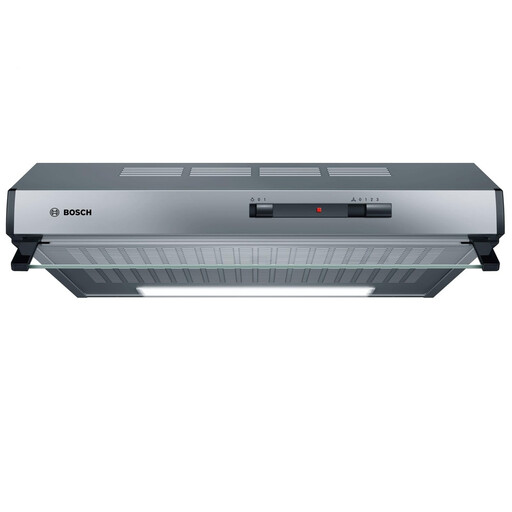
Why this product suits this profile: Its compact design, three power settings and straightforward slider controls make it suitable for smaller kitchens and everyday cooking.
The product data specifies 250 m³/h and 68 dB at maximum power. This makes it easier to assess the airflow and noise level realistically before buying.
60 cm width, LED lighting and support for both extraction and recirculation. The recirculation kit is available separately.
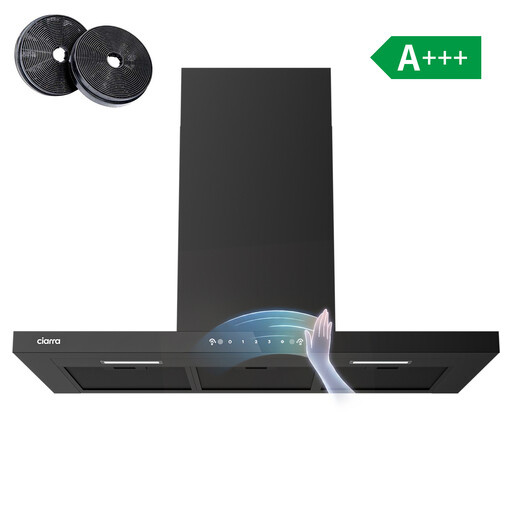
Why this product suits this profile: The 90 cm design, black glass finish and touch and wave controls will appeal to users looking for a combination of functionality and visual style.
The specifications list the operating modes, filters and noise level separately: 650 m³/h, up to 59 dB, three washable aluminium grease filters and two activated carbon filters for recirculation.
Wall mounting, height-adjustable chimney from 527 to 1005 mm, LED lighting and energy efficiency class A+++ according to the product information.
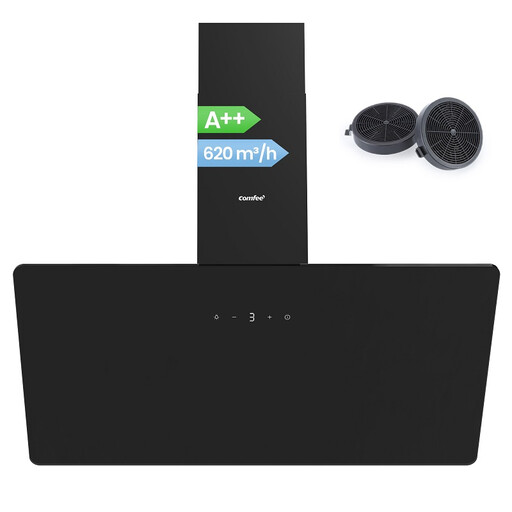
Why this product suits this profile: The sloping front creates extra space above the hob. With 620 m³/h, four speed settings and two operating modes, it is well suited to frequent cooking in larger kitchens.
The product description specifies 59 dB, a five-layer aluminium filter and both extraction and recirculation modes. Before installation, check that the specifications suit your actual installation situation.
Touch controls, four power settings, 90 cm width and energy efficiency class A++ according to the product information.
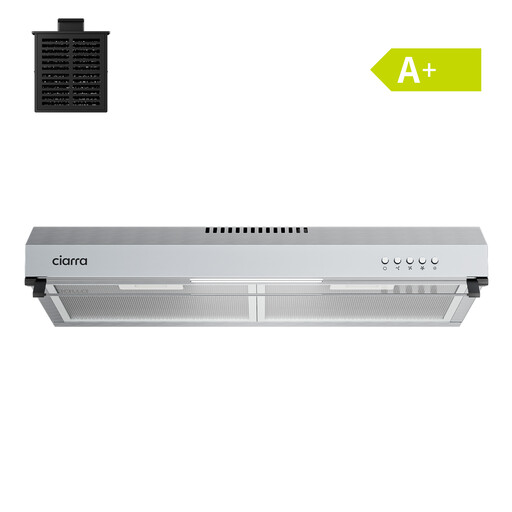
Why this product suits this profile: With a width of 596 mm and a height of 85 mm, the integrated design is suitable for kitchens where the hood should be concealed as discreetly as possible inside a cupboard.
The dimensions, three power settings and maximum noise level of 61 dB are specified. This allows you to check the available installation space and intended use in advance.
Washable aluminium grease filters, extraction and recirculation options, and energy efficiency class A+ according to the product information.
We have put together a complete, regularly updated list of products that fully meet these strict selection criteria and the safety regulations applicable in the EU.
Before placing your order, check the installation instructions and the distances from the hob. Different minimum clearances may apply to gas and electric hobs. If you are unsure, the electrical connection and extraction duct should be installed by a qualified professional.
For efficient operation, we recommend:
The hood should be at least as wide as the hob. For a 60 cm hob, a 60 cm cooker hood is the usual choice. A 90 cm hood can provide greater coverage for larger cooking areas or intensive use, but it requires sufficient wall or cupboard space.
Extraction directs moisture and odours outside, but requires a suitable wall connection. Recirculation is more flexible for homes without an extraction duct, but requires a compatible activated carbon filter and regular replacement purchases. The structural conditions of your home are therefore a key factor.
With regular use, cleaning approximately every two to four weeks is a sensible guideline. The exact interval depends on how often you fry or cook at high temperatures. Washable aluminium filters should be cleaned according to the manufacturer's instructions and allowed to dry completely before being refitted.