
Lieferung heute & morgen

Qualitätsgarantie

Willkommens-Angebote freischalten: KOSTENLOSE Lieferung | Bis zu 80 % RABATT | Kostenlose 30-Tage-JoyPlus-Testphase
App herunterladen
A cooker hood should remove cooking vapour, grease particles and odours in a way that suits your kitchen. However, striking design features or high performance figures do not automatically make a hood the right choice. The key factors are the installation situation, operating mode and technical specifications at the power level you actually need.
As a Joybuy Product Recommendation Officer, I filter the most important product details and explain what households in Germany should consider before buying.
A specification such as 650 m³/h generally refers to the maximum airflow, often in booster or intensive mode. In everyday use, a cooker hood is usually operated at a lower setting. That is why the available power levels, noise level and extraction ducting are also important when comparing models.
A more powerful model may be useful in an open-plan kitchen and living space. In a small kitchen, however, a 60 cm cooker hood with a moderate extraction rate may be sufficient. The important thing is that the hood matches the width of the hob and the size of the room.
A recirculating cooker hood does not vent air outside. It filters grease through a metal or aluminium filter and reduces odours using an activated carbon filter before returning the air to the room. The activated carbon filter is a consumable component and must be replaced regularly, depending on usage and cooking habits.
A cooker hood with an activated carbon filter is therefore particularly suitable for rented homes without an extraction duct. Before buying, check whether the compatible filters are included or need to be purchased separately.
In addition to width, you need to consider depth, chimney height, mounting points and the distance from the hob. As a guide, product specifications often state a minimum of 65 cm for electric hobs and 75 cm for gas hobs. The installation instructions for the specific model are the deciding factor.
There must also be enough space above the hob for a wall-mounted hood. An under-cabinet or integrated hood, on the other hand, requires suitable cabinet dimensions. With an angled glass-fronted hood, check whether the sloping front will obstruct cupboards or windows when opened.
A 60 cm cooker hood often fits standard hobs and compact kitchens. A 90 cm cooker hood can cover more area when you have a wider hob or an open-plan kitchen and living space. The hood should not be significantly narrower than the hob; a little extra width is practical if you cook intensively.
With extraction mode, the ducting should be planned to be as short as possible, with as few bends as possible. In rooms with fireplaces or gas-powered appliances, the necessary supply of fresh air must be taken into account. If you are unsure, installation should be carried out by a qualified professional.
The maximum noise level is specified in dB. Several available models have values of around 58 to 64 dB at the highest setting. However, a quiet cooker hood should not be judged on the basis of a single figure alone. The operating setting, extraction duct and installation also affect the perceived noise level.
For an energy-efficient cooker hood, the energy efficiency class and annual energy consumption are relevant. According to the respective product data sheets, stated consumption figures for selected models range, for example, from 9 to 16 kWh per year. These figures are intended for comparison under the specified test conditions and are not a substitute for an individual consumption forecast.
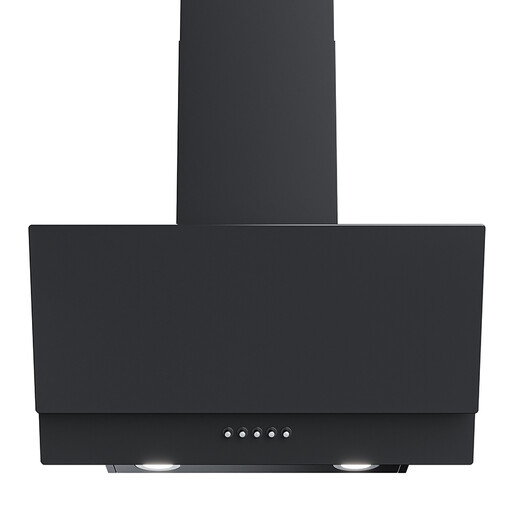
Why this product suits this profile: This 60 cm wall-mounted hood offers a compact solution with recirculation and extraction modes. It is well suited to smaller kitchens and households that prefer straightforward controls.
The operating mode can be adapted to suit the existing kitchen. According to the product specification, an activated carbon filter is included; the maximum airflow is 300 m³/h.
60 cm width, five-part aluminium grease filter, LED lighting and push-button controls.
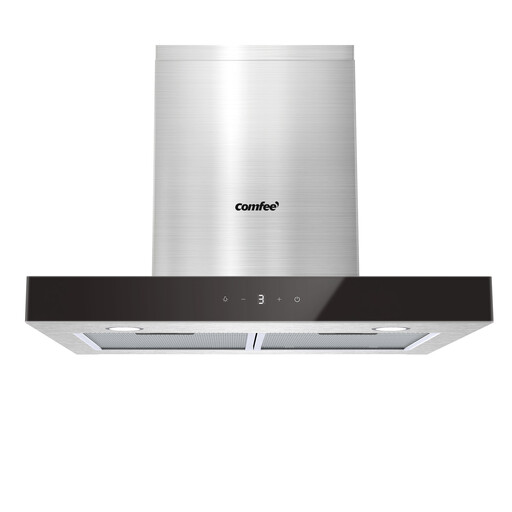
Why this product suits this profile: This model combines a stated extraction rate of 650 m³/h with several control options and a stainless steel construction.
The maximum performance figure is complemented by four speed settings. This allows the extraction rate to be adjusted for everyday use rather than relying exclusively on intensive mode.
According to the product data sheet: A+++ energy efficiency class, 650 m³/h, gesture and touch controls, plus a washable five-layer aluminium filter.
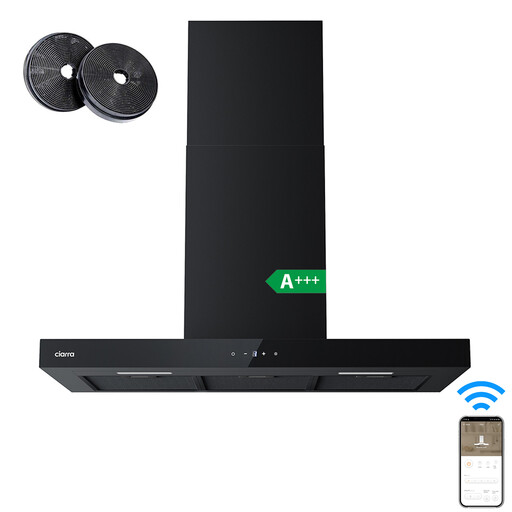
Why this product suits this profile: This 90 cm wall-mounted hood is aimed at open-plan kitchens and living spaces and larger hobs. App control complements the controls on the appliance.
The product specifications list four settings and a boost function. Both recirculation and extraction modes are also available, allowing installation to be adapted to the home.
According to the product data sheet: up to 650 m³/h, maximum 59 dB, A+++ and control via sensor touch, Wi-Fi and app.
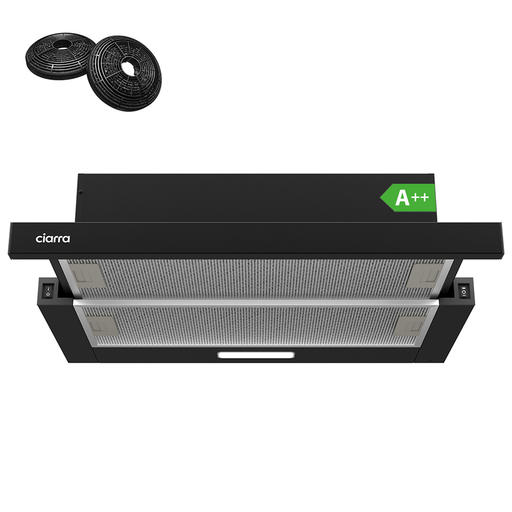
Why this product suits this profile: The telescopic design takes up little space and can be tucked largely out of sight in the wall cabinet when not in use.
The filter options are clearly specified: recirculation with the supplied CBCF002X2 activated carbon filters or extraction with the included extraction pipe.
According to the product data sheet: 370 m³/h, A++ energy efficiency class, LED lighting and washable aluminium grease filters.
We have put together a complete, regularly updated list of products that fully meet these strict selection criteria and the safety regulations applicable in the EU.
This depends on the size of the room, cooking habits, operating mode and extraction ducting. Maximum extraction rate alone is not enough to make a reliable choice. Higher figures may be useful if you frequently fry food or have an open-plan kitchen and living space; in a smaller room, an appropriate operating noise level is just as important.
A recirculating hood is usually easier to retrofit because no opening through the wall or extraction duct is required. However, it involves ongoing costs for activated carbon filters. An extraction hood can vent odours and moisture outside, but requires suitable structural conditions.
The service life depends on factors including the motor, materials, intensity of use, filter maintenance and installation. Regular cleaning prevents grease deposits and maintains effective airflow. Before buying, warranty cover, replacement filters and available spare parts are important points to check.