
Lieferung heute & morgen

Qualitätsgarantie

Willkommens-Angebote freischalten: KOSTENLOSE Lieferung | Bis zu 80 % RABATT | Kostenlose 30-Tage-JoyPlus-Testphase
App herunterladen
A 60 cm cooker hood fits many standard hobs, making it a practical choice for small to medium-sized kitchens. But choosing one involves more than just width or colour. A black cooker hood can look right at home in a modern kitchen, while a stainless steel cooker hood is easy to maintain and works well with a range of styles. What really matters, though, is the installation type, extraction rate, operating mode and maintenance required.
Manufacturers often quote the maximum airflow in m³/h. This usually refers to the highest setting under specific conditions. A long or kinked extraction duct, a narrow opening in the wall or dirty filters can all reduce performance in practice. So check the figures for each setting, as well as the noise level.
A cooker hood with extraction and recirculation gives you flexibility. In extraction mode, cooking fumes are carried outside, which requires a suitable wall connection and the right structural conditions. In recirculation mode, air passes through grease and charcoal filters before being returned to the room. A cooker hood with a charcoal filter needs regular filter replacements, so remember to factor in these ongoing costs before you buy.
A width of 60 cm does not automatically mean that every model will fit every kitchen. With an under-cabinet cooker hood, you also need to consider its depth and height, and the space available beneath your wall unit. A built-in cooker hood needs to fit your cabinet dimensions. With a 60 cm wall-mounted cooker hood, you’ll also need to take the chimney height, distance from the wall and fixing points into account. A 60 cm angled cooker hood can give you more room to move, but depending on the model, it may project further into the room.
A lower extraction rate may be enough for a compact kitchen, while frequent frying, open-plan kitchens or intensive cooking can make extra power useful. Don’t just compare the maximum figure. Check:
You can’t tell whether a quiet cooker hood is right for you from a marketing claim alone. The actual decibel figure is what matters. In an open-plan kitchen, even a difference of a few dB can make a noticeable difference day to day.
Grease filters should be removable and easy to clean regularly. Depending on the model, multi-layer aluminium filters may be dishwasher-safe. Recirculation mode also requires charcoal filters, which need replacing periodically. Always follow the manufacturer’s cleaning instructions. Grease filters are often recommended for cleaning every two to four weeks, depending on how often you cook.
You can compare an energy-efficient cooker hood by checking its EU energy label and annual energy consumption. But don’t look at the energy efficiency rating in isolation: extraction rate, noise level and lighting are all worth considering too.
You can choose between a cooker hood with touch controls and a cooker hood with push buttons. Touch controls are easy to wipe clean and sit flush with the surface. Push buttons or mechanical switches give you direct, tactile feedback. A cooker hood with LED lighting can also illuminate your hob; check the position of the lights and the stated brightness.
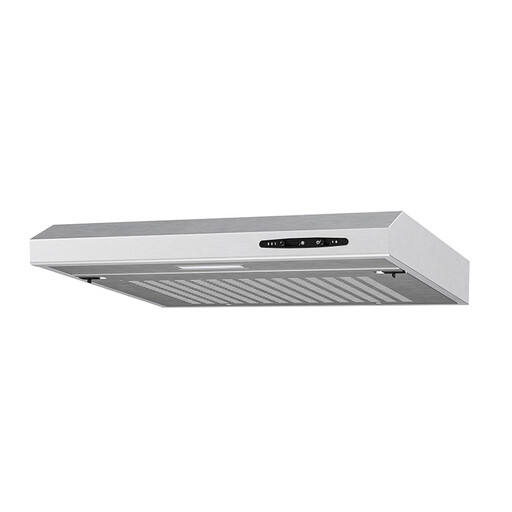
Why it’s a good fit: This under-cabinet cooker hood is designed for kitchens where space is limited. It has three speed settings, LED lighting and a charcoal filter.
The specifications state an airflow of 212 m³/h and clearly identify it as an under-cabinet model. This makes it easier to check whether the hood will suit your available space.
60 cm wide, stainless steel housing, LED lighting, three speed settings and a charcoal filter included.
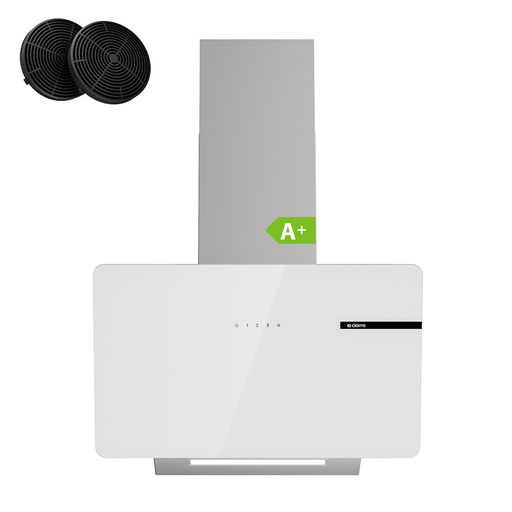
Why it’s a good fit: This angled wall-mounted hood combines a 60 cm width with glass and stainless steel finishes, touch controls and two operating modes.
The stated airflow of around 580 m³/h is accompanied by a maximum noise level of around 64 dB. This makes it easier to weigh up performance against noise.
Three speed settings, a dishwasher-safe five-layer aluminium filter, LED lighting and extraction or recirculation mode.
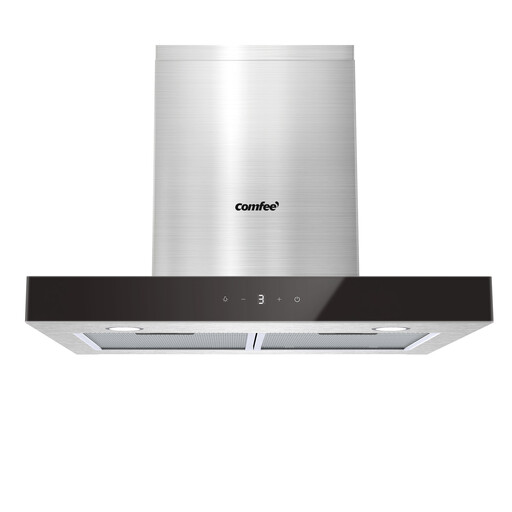
Why it’s a good fit: Designed for frequent cooking, this model has four speed settings, a stated extraction rate of up to 650 m³/h, and touch and gesture controls.
Alongside the maximum figure, the specifications list four speed settings, a noise level of around 59 to 60 dB and a reusable five-layer aluminium filter.
A+++ energy efficiency rating according to the product listing, LED lighting, touch and gesture controls, and extraction and recirculation options.
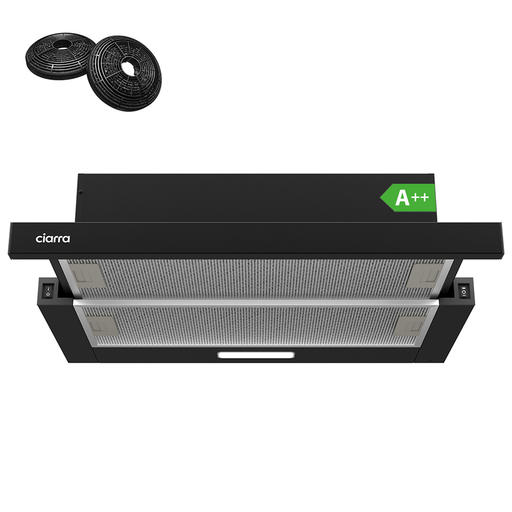
Why it’s a good fit: Its pull-out design makes good use of the available space and can be pushed back almost completely when not in use.
The product specifications list two speed settings, a maximum airflow of 355 m³/h and a maximum noise level of 61 dB. This gives you a realistic idea of where it’s best suited.
60 cm wide, A++ energy efficiency rating according to the product listing, LED lighting, washable metal grease filters and a charcoal filter.
We’ve put together a complete, regularly updated list of products that meet these strict selection criteria and fully comply with the safety regulations in force in the EU.
Before ordering, check the installation dimensions against the specifications in the product sheet. For wall-mounted hoods, the height above the hob is also important. Follow the instructions and specified safety clearances; minimum distances may differ for gas and electric hobs. The electrical connection and fixing should be carried out correctly.
In extraction mode, keep the duct as short and straight as possible. In recirculation mode, make sure the correct charcoal filters are fitted. Clean the grease filters regularly and disconnect the appliance from the mains before carrying out any maintenance.
A recirculating hood is often the simpler option for a rental home, as it doesn’t require a hole in the wall for an extraction duct. Check that compatible charcoal filters are included or available, and that the hood can be fitted to your existing wall units or wall.
It depends on your personal preference and the layout of your kitchen. Specific dB figures are particularly important for open-plan kitchens. Compare the noise level at the setting you’re most likely to use, not just the maximum figure. Bear in mind that a lower noise level may also mean lower airflow.
Clean metal grease filters regularly, depending on how often you cook. If you cook every day, cleaning them every two to four weeks may be a sensible routine. Charcoal filters used in recirculation mode need to be replaced according to the manufacturer’s instructions, as their capacity is limited. Before you buy, check that replacement filters are available and clearly listed as compatible with your model.