
Lieferung heute & morgen

Qualitätsgarantie

Willkommens-Angebote freischalten: KOSTENLOSE Lieferung | Bis zu 80 % RABATT | Kostenlose 30-Tage-JoyPlus-Testphase
App herunterladen
The selection of cooking oils on the supermarket shelf can be overwhelming. Between different origins, quality grades, and production methods, it's difficult to keep track and make an informed decision. As a result, many consumers end up buying products that are not ideal for their intended use. This guide will help you avoid common purchasing pitfalls and identify the perfect cooking oil for your needs.
Before we dive into the crucial quality characteristics, let's clear up three widespread misunderstandings that often lead to poor choices.
To buy the right cooking oil, three technical characteristics are essential. These will help you objectively assess an oil's suitability for your purpose.
The smoke point is the temperature at which an oil begins to visibly smoke and break down. This is the most important criterion for choosing the right oil for a specific cooking method.
The production method directly influences taste, nutrients, and heat stability.
Look for official seals to ensure quality and origin.
Here are some recommendations from our range, tailored to specific needs.
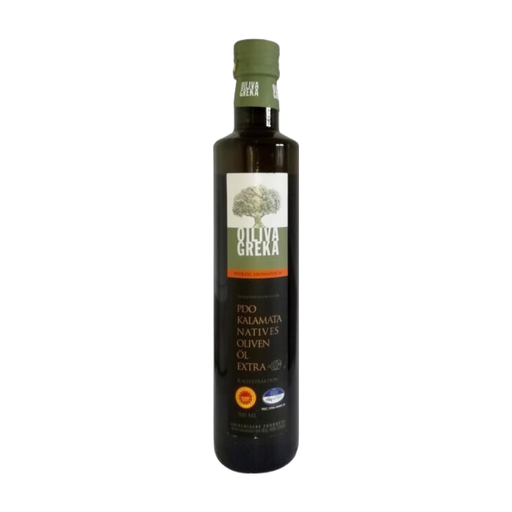
Why This Fits Their Persona: Ideal for lovers of authentic Mediterranean flavours who want an oil for salads, dipping bread, or finishing dishes. The focus is on origin and taste.
The PDO (Kalamata) seal bypasses the trap of unclear origin. It guarantees that the olives come from the Kalamata region and were processed there.
Protected Designation of Origin for guaranteed provenance and quality. Distinctive, authentic flavour profile.

Why This Fits Their Persona: For home cooks who need a reliable oil for searing meat, fish, or vegetables at high temperatures without sacrificing the fundamental olive flavour.
This product solves the problem of using the wrong oil for high temperatures. It is explicitly designed and marketed as a heat-resistant frying oil.
High smoke point (up to 195°C / 383°F according to the manufacturer). Specifically developed for frying, grilling, and baking.

Why This Fits Their Persona: Perfect for daily use in a health-conscious kitchen. Its nutty aroma pairs well with salads and dips, but it's also suitable for gently sautéing vegetables.
The product description clearly states that this virgin oil should not be used for high-heat searing. This prevents the typical misuse of cold-pressed oils.
Sourced from organic farming. Versatile for cold dishes and gentle cooking methods.
We've compiled a complete, up-to-date list of products that fully meet these strict selection criteria and German regulations.
For high-temperature frying, the best options are refined oils with a high smoke point (above 200°C / 392°F). These include refined rapeseed oil, sunflower oil, peanut oil, or special high-heat frying oils. Solid coconut fat is also a good option. You should avoid using cold-pressed oils for this purpose.
Olive oil is sensitive to light, heat, and oxygen. Therefore, always store it tightly sealed in a cool, dark place, such as a kitchen cabinet, but not in the refrigerator. If stored too cold, the oil can become cloudy and solidify, but this does not affect its quality and will resolve at room temperature. Once opened, it should be consumed within a few months.
"Cold-pressed" (or "virgin") means that the oil was extracted from fruits or seeds purely by mechanical means, without the application of heat. This gentle process preserves the natural flavour and valuable nutrients. Cold-pressed oils are excellent for cold dishes: for salads, dips, pesto, or for finishing already cooked meals. Due to their generally low smoke point, they are unsuitable for high-heat searing.