
Lieferung heute & morgen

Qualitätsgarantie

Willkommens-Angebote freischalten: KOSTENLOSE Lieferung | Bis zu 80 % RABATT | Kostenlose 30-Tage-JoyPlus-Testphase
App herunterladen
If you're searching for a reliable red PLA 1.75mm 1kg filament for your next 3D printing project, you're faced with a vast selection. Choosing the right material is crucial for the print quality, reliability, and success of your endeavour. This guide provides an objective overview of key purchasing criteria and presents a selection of filaments to help you make an informed decision.
The right filament choice depends on your printer, your project, and your quality standards. Here are three key aspects to consider.
Dimensional accuracy, the consistency of the filament's diameter, is a critical factor for a smooth printing process. A filament with a tight diameter tolerance, ideally ±0.02 mm, ensures uniform extrusion. This minimises the risk of nozzle clogging and results in a visibly better surface quality and dimensional accuracy of the final printed object. For projects that require high-precision PLA, such as technical prototypes or precision-fit parts, this value is especially important.
Modern 3D printers are achieving ever-higher speeds. If you own such a printer, you should look for High-Speed PLA. This material is specially formulated to melt and cool faster and more uniformly at high speeds (e.g., up to 600 mm/s). Standard PLA can lead to poor layer adhesion or messy extrusion at excessive speeds. For beginners and printers with standard speeds, classic red 1.75mm PLA is a proven and straightforward choice, making it an ideal PLA for beginners.
PLA (Polylactic Acid) is a biodegradable filament made from renewable resources like corn starch. It is virtually odourless during printing and is considered user-friendly. Another aspect is the spool itself. More and more manufacturers are opting for cardboard spools instead of plastic ones to reduce their ecological footprint. A 1kg filament spool is the common standard, offering a good balance between quantity and manageability.
Here is a selection of products that cover different requirements and applications.
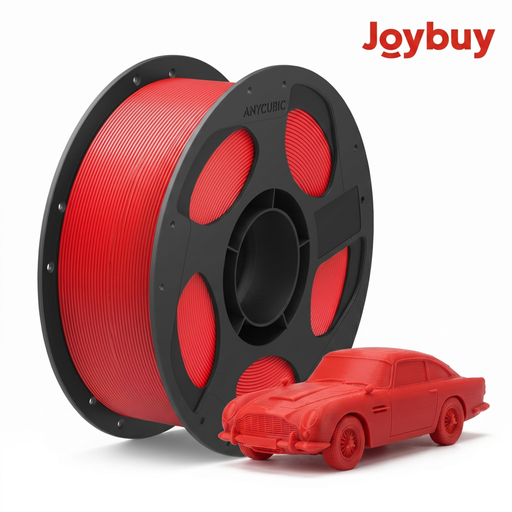
Why It Stands Out: This filament combines high dimensional accuracy with ease of use. The tight tolerance of ±0.02 mm ensures consistent and reliable extrusion, which reduces the risk of print failures.
Pros:
Who Is It For? Ideal for beginners and advanced users looking for a reliable all-round filament for a wide range of applications, from prototypes to decorative models.
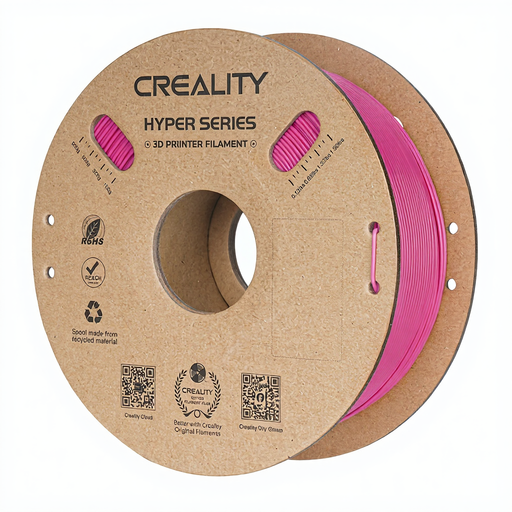
Why It Stands Out: Creality's Hyper PLA is specifically designed for high-speed printing. It allows for print speeds of up to 600 mm/s without sacrificing quality, making it an excellent choice for users of modern, fast FDM printers.
Pros:
Who Is It For? Perfect for makers and professionals who want to fully leverage the speed of their 3D printers to produce prototypes and parts in less time.
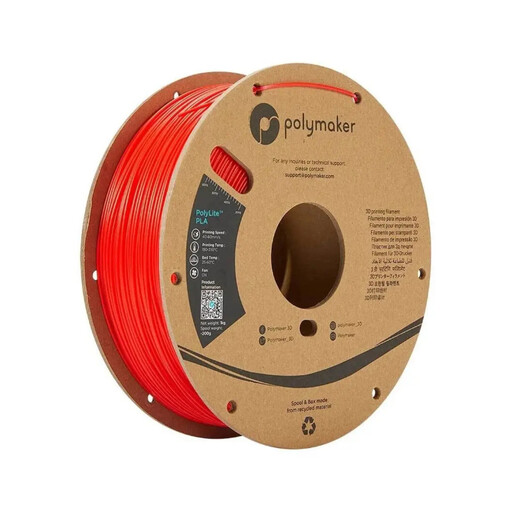
Why It Stands Out: Polymaker uses its patented Jam-Free technology in this filament. According to the manufacturer, this increases the filament's heat resistance before it enters the melt zone, which helps prevent heat creep and hotend clogs.
Pros:
Who Is It For? An excellent choice for users who prioritise maximum print reliability and want to avoid issues like heat creep during long print jobs.
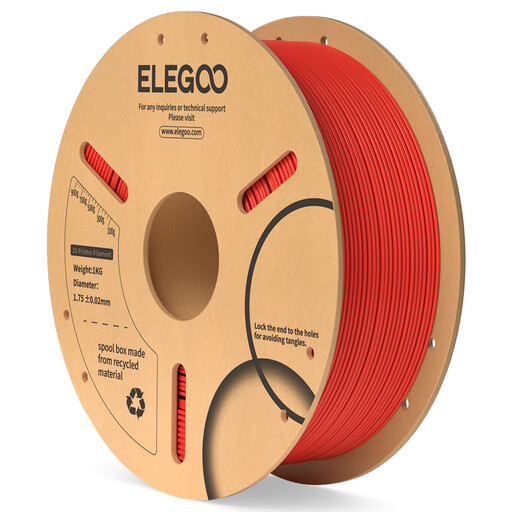
Why It Stands Out: This filament from Elegoo features exceptionally neat and tangle-free winding, ensured by mechanical winding and manual inspection. The eco-friendly cardboard spool is an added bonus.
Pros:
Who Is It For? For eco-conscious makers who value a hassle-free experience and neat winding to prevent print interruptions.
If red isn't quite the right shade for your project, or if you're looking for different material properties, you can find more options in our assortment.
Discover more filaments in the burgundy PLA filament category.
Standard PLA is optimised for print speeds of around 40–100 mm/s. High-Speed PLA contains additives that allow for faster melting and more rapid cooling. This enables it to be processed at speeds of up to 600 mm/s without issues like underextrusion or weak layer adhesion. For printers that support such speeds, High-Speed PLA is the better choice.
PLA is hygroscopic, meaning it absorbs moisture from the air. Damp filament leads to poor print quality (e.g., bubbling, stringing). Therefore, store your 1kg filament spool in a cool, dry place, preferably in a resealable bag or an airtight container along with a desiccant (silica gel).
Yes, PLA is considered the ideal PLA for beginners. It has a low printing temperature, typically doesn't require a heated print bed, and has a very low tendency to warp. Additionally, it is low-odour during printing and is more forgiving of minor errors in print settings than other materials like ABS or PETG.