
Lieferung heute & morgen

Qualitätsgarantie

Willkommens-Angebote freischalten: KOSTENLOSE Lieferung | Bis zu 80 % RABATT | Kostenlose 30-Tage-JoyPlus-Testphase
App herunterladen
A sudden loss of tire pressure can unexpectedly interrupt any journey. Whether you're on your way to work, out for a bike ride, or heading off on holiday, correct tire pressure is crucial for safety and efficiency. A cordless air compressor promises a quick, mobile solution. However, the market is flooded with devices whose real-world performance often fails to live up to their advertising claims.
As your Joybuy Product Recommendation Officer, I have analysed the most common issues that arise when choosing an electric air pump. This guide will show you how to avoid typical purchase mistakes and find a device that works reliably when you need it most.
Many buyers are drawn to high pressure ratings or a low price, only to discover after a short time that their device is unsuitable for practical use. Watch out for these three common pitfalls:
To avoid a bad purchase, you should focus on the technical specifications that are essential for reliable performance.
The choice of power source is fundamental. A cordless air pump offers maximum flexibility. You can use it anywhere—on a bike in the basement, a motorcycle in the garage, or for sports balls in the park. For this, look for a battery capacity of at least 4000 mAh to ensure you have enough reserve power to inflate car tires.
Conversely, a 12V compressor powered by the vehicle's cigarette lighter socket is the more dependable choice for roadside emergencies. You don't have to worry about a dead battery, but you are tethered to your vehicle. Some models offer a dual power supply, combining the best of both worlds.
The maximum pressure, often stated in Bar or PSI, indicates what the device is suitable for. While 2.2 to 2.5 Bar (32-36 PSI) is usually sufficient for car tires, racing bike tires can require up to 7 Bar (100 PSI) or more. However, a high maximum pressure is useless without an adequate airflow rate. A value of 20 L/min or more is a good indicator that the compressor can inflate a standard car tire in a few minutes, not half an hour.
Modern devices offer more than just air. These features make a real difference in practice:
Instead of making a one-size-fits-all recommendation, we have identified models tailored to specific user groups and their needs.
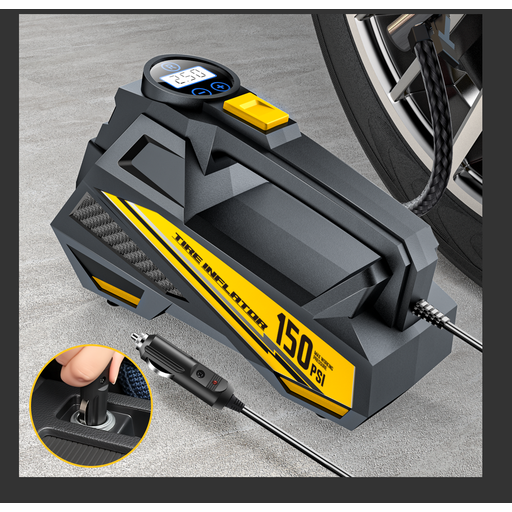
Why it's a good fit: Ideal for drivers who want a reliable emergency solution in their car without worrying about a battery's charge level. Powering it via the 12V socket guarantees it's ready to use at any time.
This model completely bypasses the insufficient battery pitfall by drawing power directly from the vehicle. The digital display with auto-shutoff also prevents inaccurate inflation.
Consistent power with no charging times. The long cable (3 metres) provides enough reach for all four tires, even on larger vehicles.
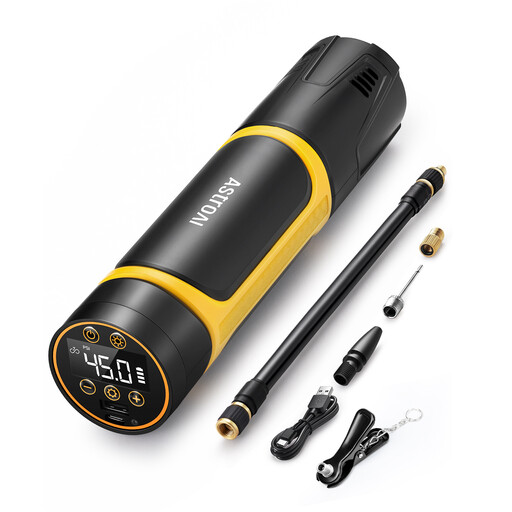
Why it's a good fit: Perfect for cyclists, motorcyclists, and car owners who want a single, cordless device for all their vehicles. Its compact design and included adapters make it a true all-rounder.
With 5 preset modes (Car, Motorcycle, Bicycle, Ball, Manual) and a precise auto-shutoff, it avoids the pitfall of an inaccurate gauge. The 4500 mAh battery capacity (3x1500mAh) is sufficient for most everyday tasks.
Excellent user-friendliness thanks to smart modes and the flexibility of a cordless electric bike pump that is also powerful enough for car tires.

Why it's a good fit: For users who need maximum power and independence. Ideal for camping trips where, in addition to tires, air mattresses need inflating, and the device can also serve as a power bank for a smartphone.
The weak battery pitfall is decisively avoided here with a 6000 mAh capacity and a dual power option (battery or 12V). You always have a power source available.
A large battery capacity that doubles as an emergency power bank, combined with the security of an additional 12V power option. Maximum flexibility and reliability in one device.
We have compiled a complete, up-to-date list of products that fully meet these strict selection criteria and UK safety regulations.
The runtime heavily depends on the battery capacity (mAh) and the job at hand. As a rule of thumb, a model with a capacity between 4000 and 6000 mAh can typically top up several car tires by 0.2-0.3 Bar (3-4 PSI) or fully inflate 4-6 bicycle tires. Fully inflating a flat car tire will often use a significant portion of the battery's charge.
Yes, the more powerful models can do this. However, it takes significantly longer than with a workshop pump and puts a heavy strain on the battery. A car tire inflator is primarily designed for pressure correction and emergencies. For inflating a completely flat tire, a model with a high airflow rate or a 12V compressor is the better choice to avoid overheating.
Most cars use Schrader valves. Bicycles often use Presta or Dunlop valves. Make sure the compressor comes with the right adapters for your needs. The models presented here are typically equipped with adapters for all common valve types.