
Lieferung heute & morgen

Qualitätsgarantie

Willkommens-Angebote freischalten: KOSTENLOSE Lieferung | Bis zu 80 % RABATT | Kostenlose 30-Tage-JoyPlus-Testphase
App herunterladen
A flat tire never comes at a good time. Whether you're on your way to work, on the motorway, or out for a bike ride, a sudden loss of pressure is more than just an annoyance. A cordless air compressor promises a quick and straightforward solution, without a trip to the garage or a search for the nearest petrol station. But the market is flooded with devices whose marketing promises often suggest more than the technology can deliver.
Many buyers invest in a portable compressor that fails at the critical moment. To help you avoid such a bad purchase, we'll show you the three most common pitfalls and what you need to look for when making your choice.
To separate the good from the bad, you should check three core technical parameters before buying. These will determine whether your cordless tire inflator becomes a reliable assistant or a source of frustration.
The battery's capacity, measured in milliampere-hours (mAh), is crucial for its mobile usability. A small 2000 mAh battery might be enough for an electric bike pump, but it will quickly reach its limits with a car tire.
The maximum pressure indicates the highest value to which a tire can be inflated. Most devices reach 10 Bar (approx. 150 PSI), which is sufficient for all common vehicle types. However, far more important for practical use is the air flow rate, measured in litres per minute (L/min).
Modern cordless compressors are often more than just a cordless air pump. Useful additional features and a well-thought-out design significantly increase their practical value.
Instead of presenting a confusing list, we have selected models that fit specific user profiles and avoid the pitfalls mentioned.
Why This Fits Their Persona: Ideal for users looking for a reliable, entry-level solution for occasional tire pressure checks and emergencies. The device combines the most important functions at a fair price without unnecessary bells and whistles.
The dual power supply bypasses the battery trap. If the 2000mAh battery is empty, the compressor can be operated directly from the vehicle via the 4-meter-long 12V cable, which also prevents overheating from continuous load on the battery.
Flexibility: Choice between cordless battery operation and wired 12V use. Ease of Use: 4 preset modes and an auto-shutoff function.

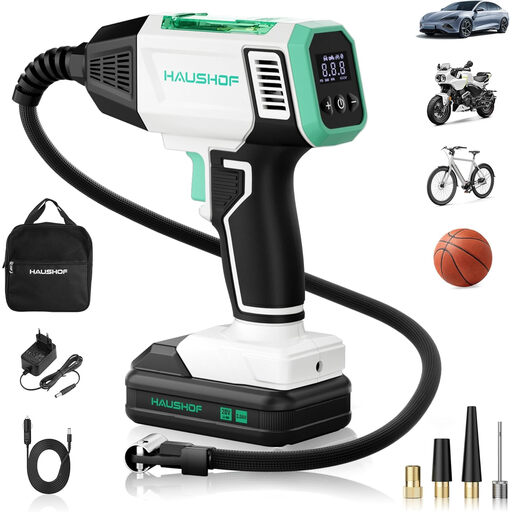
Why This Fits Their Persona: Designed for car and motorcycle drivers who value speed and endurance. Perfect for regular maintenance and quick jobs without needing to be near a power outlet.
With a 7500mAh battery and a high air flow rate of 35 L/min, this model avoids the pitfalls of weak performance and slow inflation. According to the manufacturer, it can increase a car tire's pressure by several PSI in about a minute.
High Performance: Large battery and fast inflation save time. Large LED Display: All values are easy to read, even in low-light conditions.
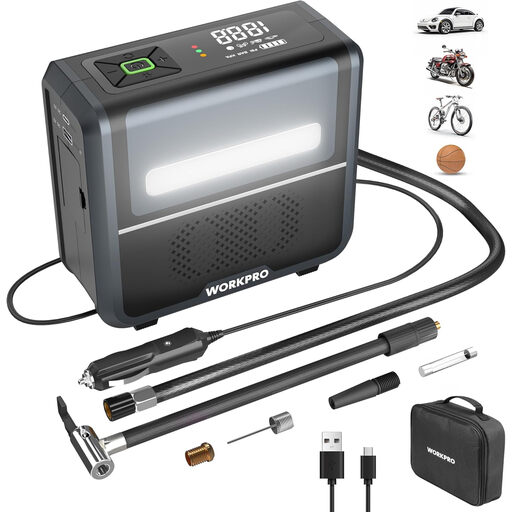
Why This Fits Their Persona: For campers, tech fans, and anyone who appreciates a multifunctional tool for on the go. This device is an air pump, power bank, and flashlight in one, impressing with its thoughtful details.
It addresses the inaccurate sensor trap with a smart three-colour display that visualises the pressure status (too low, correct, too high) at a glance. The dual power supply also ensures maximum operational reliability.
3-in-1 Functionality: Serves as a compressor, power bank, and LED light (incl. SOS mode). Smart Pressure Display: Colour codes for a quick reading of the pressure status.
We've compiled a complete, up-to-date list of products that fully meet these strict selection criteria and safety regulations.
The battery life depends heavily on the capacity (mAh) and the workload. A high-quality battery with 6000-7500 mAh can top up several car tires by a few PSI or inflate 1-2 completely flat bicycle tires. For models with smaller batteries (approx. 2000-4000 mAh), the performance is correspondingly lower. For emergency use on a car, a dual power supply with a 12V connection is recommended.
Yes, most powerful models (e.g., with an air flow rate of 30+ L/min and a large battery) can do this. However, it takes significantly longer than with a stationary air pump at a petrol station—expect it to take 5 to 10 minutes, depending on the tire size. It's important to give the device breaks in between to prevent overheating, especially if the model does not have active cooling.
The correct tire pressure for your vehicle is usually found on a sticker in the driver's side doorjamb, inside the fuel door, or in the vehicle's manual. Set your cordless air compressor to this exact value. The auto-shutoff function will ensure that the inflation process stops automatically. Always check the pressure on cold tires, as the pressure increases as they warm up during driving.