
Lieferung heute & morgen

Qualitätsgarantie

Willkommens-Angebote freischalten: KOSTENLOSE Lieferung | Bis zu 80 % RABATT | Kostenlose 30-Tage-JoyPlus-Testphase
App herunterladen
A cordless air compressor promises freedom and peace of mind: No more searching for the next gas station with a working air pressure gauge, no more laboriously pumping up bicycle tyres by hand. But the market is full of devices whose marketing promises often fall short in practice. Before you make a purchasing decision, it's crucial to know the common pitfalls that can lead to disappointment and unnecessary expenses.
As your Joybuy Product Recommendation Officer, I'll help you define objective criteria for your selection and distinguish marketing hype from genuine performance features.
Many devices look similar at first glance, but the differences are in the details. Pay special attention to these three points to avoid a bad purchase:
To find the right device for your needs, you should focus on three core technical specifications. These determine the real-world usability of a portable compressor.
The battery capacity, specified in milliampere-hours (mAh), is an important indicator of its endurance. For occasional top-ups of car tyres, a device should have at least 4000 mAh. If you regularly check multiple tyres (e.g., on a car and a bike) or want to inflate larger items like air mattresses, you should consider models with 6000 mAh or more.
Devices with a dual power supply offer a particularly flexible solution. These can be operated not only via the battery but also directly through the car's 12V compressor port (cigarette lighter socket). This ensures you are ready to go at any time, even with a dead battery.
The maximum pressure, often advertised as up to 150 PSI (approx. 10.3 bar), is more than sufficient for most applications. A standard car tyre only requires 2.2 to 2.8 bar. Far more crucial for speed is the airflow rate, measured in litres per minute (L/min). A higher value means the tyre will be filled faster. A good electric tyre inflator should offer an airflow rate of at least 20 L/min to inflate a car tyre in a reasonable amount of time and not just serve as an electric bike pump.
A modern mini compressor should have a pressure preset with an auto-shutoff function. You set the target pressure, and the device stops automatically once it's reached. This prevents over-inflation and ensures precise results.
Other useful features include:
Based on these objective criteria, we have identified a few models that represent a smart choice for specific user groups.

Why this model is a good fit: This device is a solid all-rounder for the glove compartment. It's compact, offers flexibility for cars, bikes, and balls with its 5 modes, and has sufficient power for regular pressure checks and emergencies.
The auto-shutoff function ensures precise pressure and avoids the risk of inaccurate measurements. The 4000 mAh battery offers a realistic capacity for several top-ups.
Five preset modes and a clear LCD display make operation simple and intuitive. The integrated LED light with an SOS function enhances safety at night.
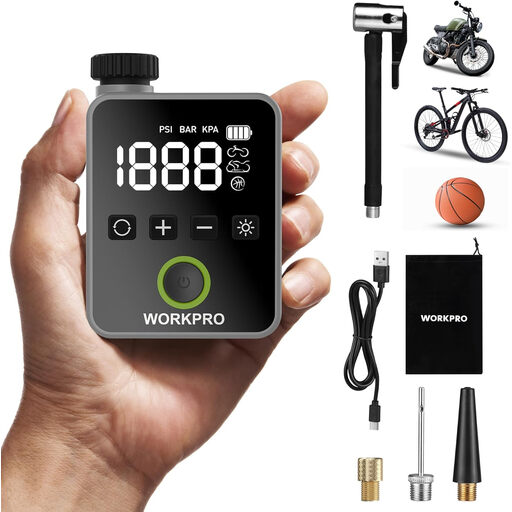
Why this model is a good fit: For cyclists, campers, and anyone who values minimal weight and pack size. At just 270 grams, it's lighter than many smartphones and fits into any jersey or trouser pocket.
The focus is clearly on portability, not on exaggerated performance claims for large tyres. The auto-stop function ensures precise pressure results for bikes or balls, even in this compact device.
Extreme compactness and low weight (270 g). The additional power bank function is a practical bonus on the go.

Why this model is a good fit: Ideal for users with multiple vehicles (car, motorcycle, bikes) or for use while camping. The combination of a large battery and a 12V connection offers maximum reliability and performance.
The dual-power system completely eliminates the worry of a dead battery. The high capacity of 6000 mAh is designed for more demanding tasks and is not just an empty marketing promise.
Maximum flexibility through battery and 12V operation. The large battery capacity allows for inflating multiple tyres or serves as a powerful power bank.
We have compiled a complete, up-to-date list of products that fully meet these strict selection criteria and German safety regulations.
That heavily depends on the model. Compact, less powerful devices are primarily designed for topping up air pressure and may overheat or run out of battery when faced with a completely flat tyre. More powerful models with a high airflow rate (L/min) or devices with a 12V connection are better suited for this task, but they will take longer than a workshop's compressed air system.
Accuracy can vary. Models with an auto-shutoff function are generally sufficiently accurate for home use. However, it's good practice to occasionally double-check the pressure with a separate, calibrated tyre pressure gauge to rule out any discrepancies.
To maximise the life of the lithium-ion battery, you should avoid storing it completely discharged for long periods. It is recommended to charge the battery every two to three months, even when not in use. Also, store the device in a cool, dry place and avoid extreme temperatures (e.g., in a car in direct sunlight in summer or in deep frost in winter).