
Lieferung heute & morgen

Qualitätsgarantie

Willkommens-Angebote freischalten: KOSTENLOSE Lieferung | Bis zu 80 % RABATT | Kostenlose 30-Tage-JoyPlus-Testphase
App herunterladen
A drop in tire pressure rarely announces itself. You usually notice it at the most inconvenient time: in the morning before an important meeting or on your way to a vacation. A modern cordless air compressor promises a quick and straightforward solution, entirely eliminating the need for a trip to the nearest gas station. However, the market is flooded with devices whose performance claims often don't hold up in practice.
As a Joybuy Product Recommendation Officer, I analyze product data and customer feedback daily. In doing so, I consistently see the same pitfalls that lead to frustration and unnecessary expenses. Before you make a decision, you should be aware of these common flaws.
To avoid these traps, you should focus on a few crucial technical specifications. These will determine if a device is truly suitable for your needs—whether for a car, motorcycle, or bicycle.
The maximum pressure, specified in Bar or PSI (1 Bar ≈ 14.5 PSI), indicates how much pressure a compressor can theoretically build. For standard car tires, values around 2.5 Bar are common, while racing bike tires can require over 7 Bar. However, a high maximum pressure alone is not a definitive indicator of performance.
The crucial factor for speed is the air flow rate, measured in Liters per Minute (L/min). It describes how much air volume the compressor can move per minute.
A good electric tire inflator offers a balanced combination of sufficient pressure and a solid air flow rate.
The freedom of a cordless air pump is directly dependent on its battery performance. The capacity is specified in milliampere-hours (mAh).
Some models also offer a 12V connection as a failsafe. This 12V mini compressor can be operated directly from the car's cigarette lighter socket when the battery is dead, thus combining flexibility with operational reliability.
Modern devices should have a clear digital display that shows the current and target pressure. An auto-shutoff feature is essential: you set the desired pressure, start the process, and the compressor stops automatically once the value is reached. This prevents over- or under-inflation and ensures safety.
Useful extra features that increase practical value include:
Based on objective product data, we have identified several models that are well-suited for different user groups.

Why This Fits Their Persona: Ideal for drivers looking for a reliable, straightforward solution for occasional tire pressure checks and emergencies. Its compact design allows for easy storage in the glove compartment or trunk.
The 2,500 mAh battery is designed for occasional top-ups and isn't marketed with unrealistic continuous performance claims. The digital modes and clear display prevent user error and inaccurate results.
Compact and lightweight: At 530g and with small dimensions, the device is highly portable. Includes Emergency Light: The integrated LED light with an SOS function provides added safety at night.
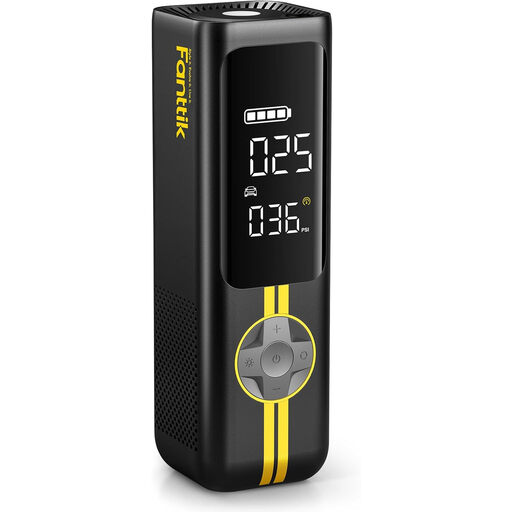
Why This Fits Their Persona: For users who value speed, high battery capacity, and multifunctionality. Perfect for long-distance commuters, outdoor enthusiasts, or owners of larger vehicles like SUVs.
This model avoids the trap of unrealistic performance claims with demonstrably fast inflation times (e.g., 56 seconds for 28-33 PSI on a mid-size car tire). The long battery life of up to 40 minutes is a clear, measurable feature.
High Inflation Speed: Saves significant time compared to standard models. Multifunctional: Serves as a compressor, a powerful power bank (USB-A and USB-C), and an LED flashlight.
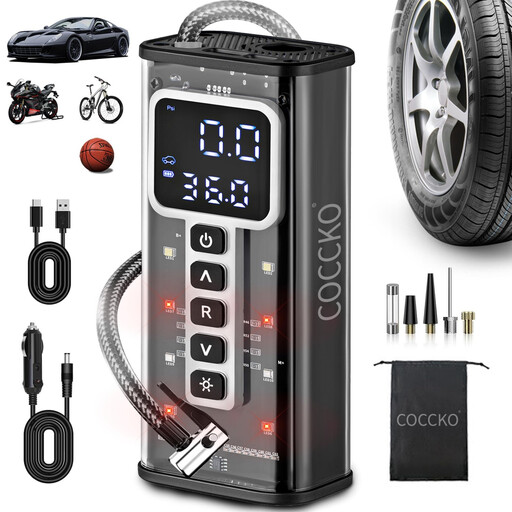
Why This Fits Their Persona: Designed for users who regularly check the tire pressure on multiple vehicles (car, motorcycle, bicycles) or need a device with maximum endurance for long trips.
With a 6,000 mAh battery, this model directly addresses the weak point of many competitors. The high air flow rate of 35 L/min ensures that performance doesn't drop off even with repeated use.
Large Battery Capacity: The 6,000 mAh battery provides enough energy for multiple inflation cycles without recharging. Efficient Cooling: The dual-sided vent design improves heat dissipation and increases the device's lifespan during intensive use.
We have compiled a complete, up-to-date list of products that fully meet these strict selection criteria and relevant safety standards.
Yes, most high-performance models can. However, it takes significantly longer than simply topping off the air. Look for the inflation time for an empty tire (e.g., 0 to 2.5 Bar) in the product details. Models with a high air flow rate (L/min) and a robust battery have a clear advantage here. For very large tires (e.g., on vans or RVs), many compact devices will reach their limits.
The accuracy varies depending on the quality of the sensor. High-quality models offer a precision of ±0.1 Bar (or ±1-2 PSI). This is perfectly sufficient for everyday use. Nevertheless, it's good practice to occasionally cross-check the pressure with a separate, calibrated tire pressure gauge to be certain. The auto-shutoff feature is only as precise as its built-in sensor.
To extend the life of the lithium-ion battery, you should follow a few basic rules. Store the compressor in a cool, dry place and avoid extreme temperatures (both summer heat in the car and winter frost). Recharge the battery after use and avoid deep discharging it. It is advisable to check the charge level every 2-3 months and, if necessary, top it up to about 50-80%, even if the device is not in use.