
Lieferung heute & morgen

Qualitätsgarantie

Willkommens-Angebote freischalten: KOSTENLOSE Lieferung | Bis zu 80 % RABATT | Kostenlose 30-Tage-JoyPlus-Testphase
App herunterladen
A flat tire on the way to work or a deflated soccer ball before the weekend game – situations where a cordless air compressor is a practical lifesaver. These handy devices promise a quick fix without needing a gas station or a power outlet. But the market is flooded with models whose advertising claims often suggest more than the technology can deliver.
As your Joybuy Product Recommendation Officer, I'll help you spot the typical pitfalls. Instead of falling for exaggerated marketing claims, you should focus on the features that truly matter. This way, you'll find a device that works reliably when you really need it.
Many buyers are disappointed after a short time because their device fails at the crucial moment. This is often due to three common problems that are rarely mentioned in the product description.
To avoid a bad purchase, focus on the technical specs that are relevant in practice. A good portable air compressor is more than the sum of its parts.
The maximum pressure indicates the pressure level the device can theoretically reach. For car tires, values around 2.5 Bar are common, so most devices are sufficiently powerful for this. Much more important is the air flow rate (L/min). It determines how quickly the air is pumped into the tire.
The battery capacity, specified in milliampere-hours (mAh), is the heart of any cordless tire inflator.
Modern devices often offer more than just inflation. Look for features that make use easier and safer:
Instead of a one-size-fits-all recommendation, we present devices tailored to specific use cases.
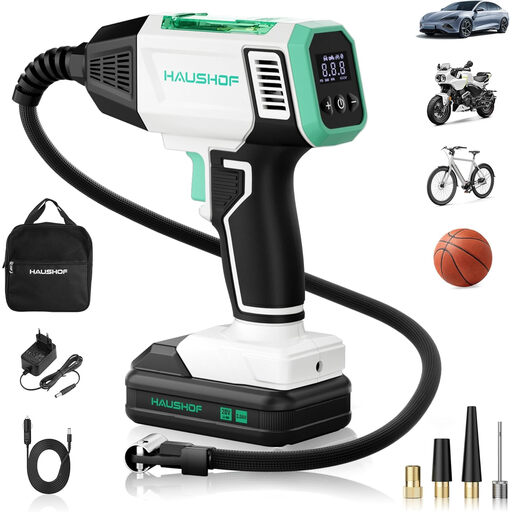
Why This Fits Their Persona: Ideal for drivers seeking a reliable, basic solution for emergencies and occasional pressure checks without a large budget.
Bypasses the weak battery trap with a dual power supply. If the 2000 mAh battery isn't enough, the device can be powered via the included 4-meter 12V cable.
Offers a solid 22 L/min air flow rate for this price point and features an automatic shut-off function as well as preset modes.

Why This Fits Their Persona: Perfect for commuters and families who need a powerful, multifunctional device for regular use on cars, bikes, and recreational items.
Counters the "high pressure" trap with a strong 35 L/min air flow rate. The large 7500 mAh battery also ensures long runtime without constant recharging.
Combines high performance with useful extras like a large LED display, a power bank function, and a bright light with an SOS mode.
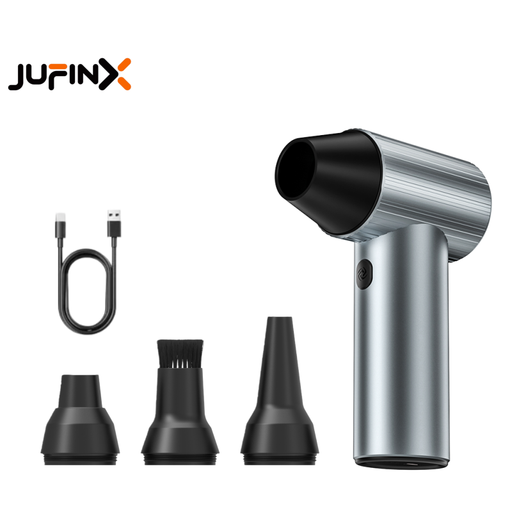
Why This Fits Their Persona: For tech enthusiasts and car detailers looking for a powerful tool to clean sensitive surfaces, air vents, and electronics.
This isn't a classic tire inflator, but a specialized electric air duster. It avoids the compromise of being a jack-of-all-trades and instead focuses on an extremely powerful airflow for cleaning purposes.
Using a turbo fan (up to 90,000 RPM), it generates a much stronger and more focused air stream than conventional compressors. Ideal for dust-free cleaning of PCs, keyboards, and vehicle interiors.
We have compiled a complete, up-to-date list of products that fully meet these strict selection criteria and safety standards.
1. How long does the battery of a portable air compressor last? The battery life depends heavily on the capacity (mAh) and the load. A model with 6000-7500 mAh can typically top up 4-5 car tires by a small amount or fully inflate several bicycle tires. However, inflating a completely flat car tire can consume most of the battery charge.
2. Can a cordless compressor inflate a completely flat car tire? Yes, most high-quality models can. However, it will take significantly longer and put a heavy strain on the battery. Pay special attention to a high air flow rate (L/min) and adequate device cooling. Models with an additional 12V cable are particularly suitable for this emergency.
3. What is the difference between a tire inflator and an electric air duster? A tire inflator (or compressor) is designed to build up high pressure in a closed volume (like a tire). It typically has a moderate air flow rate. An electric air duster is optimized for high airflow at low pressure. Its purpose is to blow dust and debris off surfaces, not to fill a volume.