
Lieferung heute & morgen

Qualitätsgarantie

Willkommens-Angebote freischalten: KOSTENLOSE Lieferung | Bis zu 80 % RABATT | Kostenlose 30-Tage-JoyPlus-Testphase
App herunterladen
A flat tire on your way to work or on vacation is more than just an annoyance. A cordless air compressor promises a quick, hassle-free solution right on the spot. But the market is flooded with devices whose performance claims are often more marketing than reality. Many users report dead batteries at the crucial moment, disappointingly slow inflation times, or overheating motors on budget models.
As your Joybuy Product Recommendation Officer, I'm here to help you navigate these common pitfalls. We'll focus on the key features that define a reliable portable air pump, so you can make an informed decision and avoid wasting money on a useless device.
Before we dive into the important technical specs, let's identify the marketing gimmicks that often lead to a bad purchase.
To separate the wheat from the chaff, you should focus on three objective core parameters. These determine whether an electric tire inflator is right for your needs.
The maximum pressure, often stated in PSI (Pounds per Square Inch) or Bar, defines the range of applications. Most devices reach up to 150 PSI (approx. 10.3 Bar), which is more than enough for cars, motorcycles, and even racing bikes.
However, far more important for speed is the Airflow Rate, measured in Liters per Minute (L/min). This value indicates how much air volume the compressor can move per minute. A higher value means significantly faster inflation. While 15-20 L/min is sufficient for an electric bike pump, a good cordless car tire pump should deliver at least 25-35 L/min to fill larger tires efficiently.
The choice of power source depends on your use case:
Some models offer a hybrid solution and can be powered by either the battery or the 12V system.
Modern devices offer features that make them much easier and safer to use:
We have selected a few models from our range that are suitable for different needs and avoid the pitfalls mentioned.

Why This Fits Their Persona: Ideal for drivers who want a reliable and simple solution for emergencies or occasional pressure checks. The device plugs directly into the 12V socket, ensuring it's always ready to use.
This model completely bypasses the "dead battery" trap. The direct 12V connection ensures a steady power supply as long as the vehicle is running. No waiting for it to charge in an emergency.
Plug-and-Play Design: Simply plug it in and go, with no complex settings. Compact and Lightweight: Easily stows away in the glove compartment or trunk.
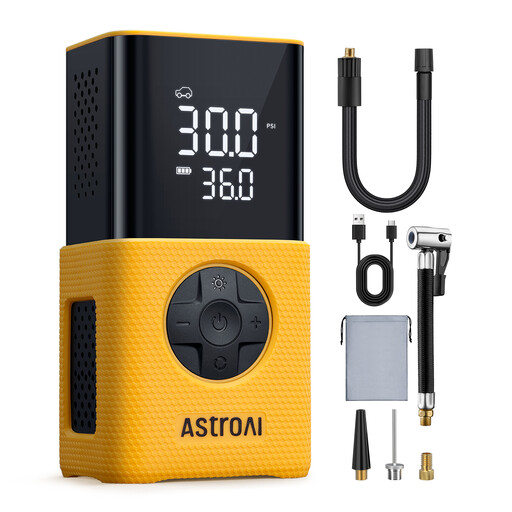
Why This Fits Their Persona: Perfect for commuters and tech enthusiasts who need a versatile, cordless device for their car, bike, and recreational gear. The power bank function is a handy bonus for on-the-go use.
This model counters the "unrealistic performance claims" trap. According to the manufacturer, it delivers an airflow of 17 L/min and can inflate a tire from 30 to 36 PSI in 1.5 minutes—a transparent and realistic claim.
Multifunctional: Serves as a compressor, LED flashlight (3 modes), and power bank. Smart Operation: 5 preset modes and a precise auto-shutoff function make it simple and safe to use.

Why This Fits Their Persona: Designed for users with high standards who are often on the road, own vehicles with larger tires (e.g., SUVs), or simply value speed and endurance.
With a 7500mAh battery and a high airflow rate of 35 L/min, this device directly addresses the problems of weak performance and short battery life. It's built for demanding tasks and is less prone to overheating.
High Performance: The powerful motor and high airflow rate ensure fast inflation, even for large tires. Long Battery Life: The large battery allows for inflating multiple tires on a single charge.
We've compiled a complete, up-to-date list of products that fully meet these strict selection criteria and safety standards.
Yes, most high-quality models can. However, it consumes a lot of energy and takes a correspondingly long time. Some manufacturers, like WORKPRO, provide specific time estimates for this (e.g., "inflates a 0-bar car tire in 9 minutes"). A completely flat tire will use up a large portion of the battery's capacity.
For everyday use and regular checks, the integrated digital manometers are generally accurate enough. Deviations are usually within a tolerable range. However, for precise calibration, such as before a long road trip, it is advisable to double-check the pressure with a separate, calibrated tire pressure gauge.
The runtime heavily depends on the battery capacity (mAh), motor efficiency, tire size, and target pressure. As a rule of thumb, a model with a 4000-5000 mAh battery can inflate about 2-4 average car tires (e.g., from 2.0 to 2.5 bar) before needing a recharge. Models with a larger battery (7500 mAh or more) can handle more accordingly.