
Lieferung heute & morgen

Qualitätsgarantie

Willkommens-Angebote freischalten: KOSTENLOSE Lieferung | Bis zu 80 % RABATT | Kostenlose 30-Tage-JoyPlus-Testphase
App herunterladen
A flat tire on the way to work or low tire pressure before a long road trip—these situations are more than just an annoyance. A cordless air compressor promises a quick and straightforward solution. However, the market is flooded with devices whose real-world performance often fails to live up to their advertising claims. As your Joybuy Product Recommendation Officer, I'm here to help you separate the wheat from the chaff and find a device that will reliably get the job done.
Many buyers are disappointed with their new device after only a short time. This is often due to exaggerated marketing claims that don't align with reality. Pay close attention to these three points to avoid a bad purchase:
To ensure your new portable compressor is a dependable tool, you should check three core technical features. These determine its practical usability far more than flashy advertising slogans.
Battery capacity, measured in milliampere-hours (mAh), is a key indicator of endurance. For occasionally inflating bicycle tires or balls, models around 2000 mAh are sufficient. However, if you're looking for a car tire inflator for emergencies or regular maintenance, you should consider devices with at least 4000 mAh. Some models also offer a dual power supply: they can be operated cordlessly via the battery or through the car's 12V compressor port (cigarette lighter). This provides maximum flexibility and peace of mind should the battery ever run out.
While almost every mini compressor can reach a high maximum pressure of 150 PSI (approx. 10.3 Bar), the airflow rate (L/min) is the crucial metric for speed. It indicates how much air the device can move per minute. A value below 20 L/min is often too slow for car tires. Look for models with at least 25 L/min to be able to inflate a standard car tire in a reasonable amount of time (e.g., from 2.0 to 2.5 Bar in just a few minutes).
A reliable cordless air pump should do more than just pump air. Look for the following features:
Based on these objective criteria, we have identified several models that offer a suitable solution for different user profiles.
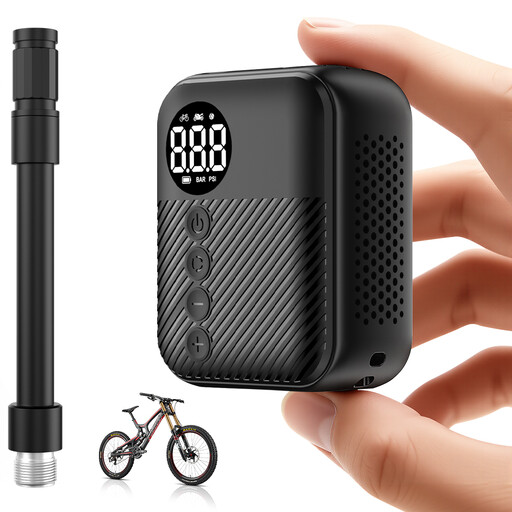
Why This Fits Their Persona: Ideal for cyclists or families looking for an extremely compact solution for bike tires, balls, or inflatable toys. Its pocket-friendly size makes it an easy companion for on-the-go use.
This device sidesteps the "low airflow rate" trap because it's designed for smaller volumes where speed is less critical than with a large car tire.
Extremely portable, pocket-sized design; rechargeable for mobile use; digital gauge for accurate pressure readings.
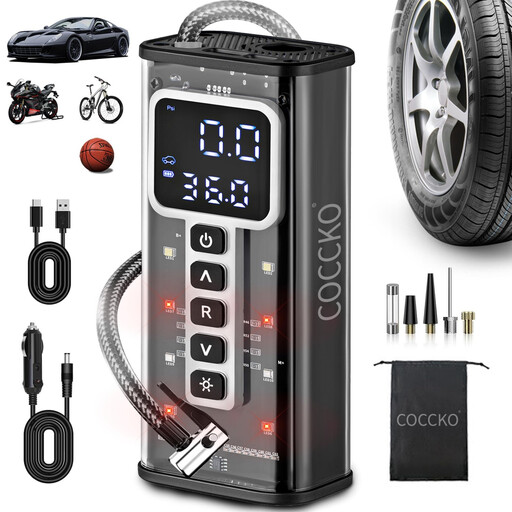
Why This Fits Their Persona: Perfect for drivers who need a reliable tool for regular tire pressure checks and emergencies. Thanks to its various modes and powerful battery, it's also suitable for motorcycles, bicycles, and balls.
This model tackles the "inaccurate gauge" pitfall with a smart display that shows the target pressure and automatically shuts off when it's reached, ensuring precise results.
Powerful 6000 mAh battery for long runtime; high airflow rate of 35 L/min for fast inflation; 5 smart modes and a power bank function.

Why This Fits Their Persona: For users who demand maximum performance and endurance. Ideal for owners of larger vehicles, frequent drivers, or anyone who uses one device for multiple vehicles and needs to rely on high capacity.
With a 7500 mAh battery, this model avoids the "unrealistic battery life" trap. According to the manufacturer, one charge is enough for up to 5 car tires, ensuring high reliability in an emergency.
Very large battery capacity (7500 mAh); high airflow rate of 35 L/min; large, easy-to-read LED display and robust construction.
We've compiled a complete, up-to-date list of products that fully meet these strict selection criteria and safety regulations.
Modern digital gauges in quality devices are generally quite accurate, with deviations often of only ±1-2 PSI. It's important to choose a model with an automatic shutoff function. This stops the process exactly at the preset value, compensating for minor display tolerances. For the most accurate measurement, tire pressure should always be checked when the tires are cold.
Yes, most portable compressors are designed to be stored in a car. However, you should avoid extreme temperatures. Do not leave the device on the dashboard in direct sunlight during the summer, and protect it from freezing temperatures in the winter, as this can affect the battery's lifespan. The trunk or glove compartment are generally suitable storage locations.
The time depends heavily on the compressor's airflow rate (L/min) and the tire size. A powerful model with about 35 L/min can increase the pressure of a common car tire (e.g., 215/55 R17) by 0.5 Bar (about 7.3 PSI) in approximately 1-2 minutes. Fully inflating a flat tire can take between 5 and 10 minutes, depending on the device.