
Lieferung heute & morgen

Qualitätsgarantie

Willkommens-Angebote freischalten: KOSTENLOSE Lieferung | Bis zu 80 % RABATT | Kostenlose 30-Tage-JoyPlus-Testphase
App herunterladen
A sudden loss of tyre pressure can bring any trip to an abrupt halt. A modern cordless air compressor promises a quick and straightforward solution, whether for your car, motorcycle, or bicycle. However, the market is flooded with devices whose advertised features often fail to deliver in practice. Before making a purchase, it's crucial to understand the common pitfalls to avoid a bad investment.
As your Joybuy Product Recommendation Officer, I'm here to help you separate the wheat from the chaff. This guide focuses on the critical technical specifications and shows you what to look for to find a reliable and durable device.
Many devices entice buyers with impressive numbers and long feature lists. In reality, however, three specific shortcomings often render a compressor useless after a short time or cause it to fail when you need it most.
To avoid these traps, you should base your selection on three objective criteria. These determine whether an electric tyre inflator will be a reliable assistant for everyday use and emergencies.
The required pressure depends on the vehicle. While an electric bike pump often needs higher pressures for narrow road bike tyres (up to 8 Bar), car tyres usually require 2.0 to 3.0 Bar. A good cordless air compressor should offer a maximum pressure of at least 7 Bar (approx. 100 PSI) to ensure it has sufficient reserves.
Even more important is the airflow rate, measured in litres per minute (L/min). This value indicates how quickly the tyre will inflate. Devices with an airflow rate below 15 L/min are often too slow for car tyres. Models with 20 L/min or more offer noticeably better performance. An auto-shutoff feature, which stops the inflation process once the preset pressure is reached, is now a standard feature for precise and safe operation.
The battery capacity, specified in milliampere-hours (mAh), determines the runtime. A battery with at least 4000 mAh is a good baseline for topping up several tyres or fully inflating a flat one.
Models with a dual power supply are particularly flexible. They can be operated cordlessly and, in an emergency, can also be powered directly via the car's 12-volt socket (cigarette lighter). Such a 12V mini compressor ensures you're not left stranded, even with a dead battery. Some devices also offer a useful power bank function to charge external devices like smartphones via a USB port.
A robust construction and a heat-resistant air hose are essential for longevity. Look for an easy-to-read digital display that shows both the current and target pressure. The package should include various valve adapters so the device can be used not only as a cordless car tyre pump but also for bicycles (Presta/Sclaverand valve), balls, or air mattresses. A compact design and an included carrying case make it easy to store in the glove compartment or a backpack.
Based on the criteria above, we have identified several models that represent a smart choice for specific user groups.
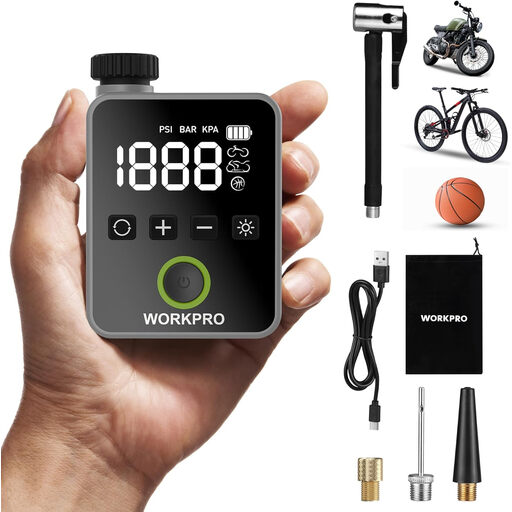
Why This Fits Their Persona: Ideal for users seeking an extremely compact solution for the glove compartment or backpack. Perfect for occasionally topping up car and bicycle tyres, as well as inflating balls.
The device avoids the "impractical extra features" pitfall by focusing on the essentials. The preset modes and auto-shutoff function ensure simple, error-free operation without exaggerated performance claims.
Extremely lightweight and compact: At just 270g and with minimal dimensions, it's lighter than most smartphones. Versatile Modes: Presets for bicycles, motorcycles, and balls, plus a customisable mode, simplify operation.
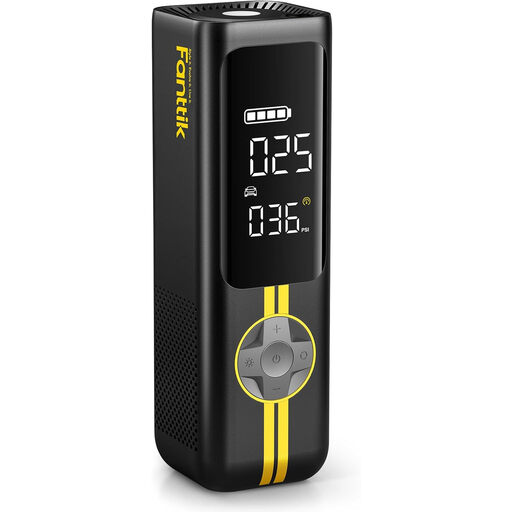
Why This Fits Their Persona: Designed for drivers of mid-size cars or SUVs who value speed and endurance. Ideal for regular tyre pressure checks and quick flat tyre fixes without long waits.
This model counters the "misleading performance specs" pitfall. It provides concrete inflation data (e.g., 28-33 PSI in 56 seconds for a mid-size tyre) and features a cooling system that allows for up to 40 minutes of continuous use, thus preventing overheating.
High Inflation Speed: Significantly faster inflation compared to standard models. Long Continuous Runtime: The integrated cooling system allows for inflating multiple tyres consecutively without forced breaks.
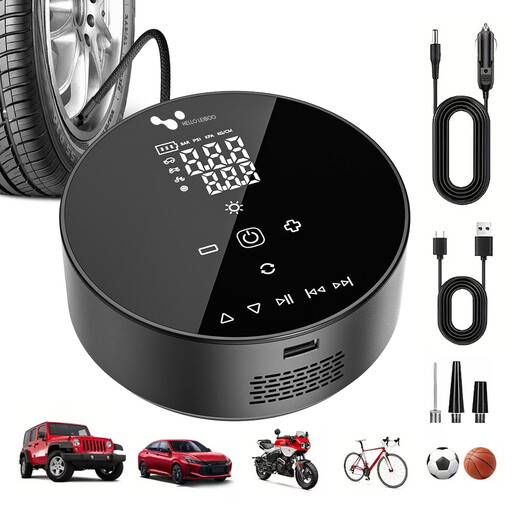
Why This Fits Their Persona: The perfect choice for outdoor enthusiasts and anyone looking for a multifunctional emergency gadget for their car, camping, and leisure activities. It combines several useful tools in one compact device.
This device bypasses the "poor battery performance" trap by offering a dual power supply (battery and 12V DC). This ensures functionality even when the battery is dead. The additional features (power bank, speaker) are well-supported by the 4500 mAh battery and are not mere gimmicks.
4-in-1 Functionality: Combines a compressor, power bank, LED light, and Bluetooth speaker. Dual Power Supply: Maximum operational reliability thanks to cordless battery operation and a 12V cable option for the car.
We have compiled a complete, up-to-date list of products that fully meet these strict selection criteria and all relevant safety standards.
1. How long does the battery of a cordless compressor last? The runtime heavily depends on the battery capacity (mAh) and the power being drawn. A high-quality model with 4000-6000 mAh should be able to top up all four tyres of a car by a few PSI or fully inflate several bicycle tyres. Completely inflating a flat car tyre can consume a significant portion of the battery charge, depending on the tyre size.
2. Can I use a mini compressor to inflate truck or RV tyres? No, most portable cordless compressors are designed exclusively for cars, motorcycles, bicycles, and smaller inflatable items. Tyres on trucks, RVs, or trailers require significantly higher pressure and a much larger volume of air. Using an unsuitable device can lead to overheating and permanent damage to the compressor. Always check the manufacturer's specifications for suitability.
3. What is the difference between the pressure units PSI, Bar, and kPa? These are different units for measuring pressure. PSI (Pound-force per square inch) is common in the US and UK. Bar is the most common unit for tyre pressure in Europe (1 Bar ≈ 14.5 PSI). kPa (Kilopascal) is the official SI unit (100 kPa = 1 Bar). Almost all digital cordless compressors allow you to easily switch between these units, so you can directly set the value recommended by your vehicle's manufacturer.