
Lieferung heute & morgen

Qualitätsgarantie

Willkommens-Angebote freischalten: KOSTENLOSE Lieferung | Bis zu 80 % RABATT | Kostenlose 30-Tage-JoyPlus-Testphase
App herunterladen
A sudden loss of tyre pressure is more than just an annoyance—it can bring a trip to an unexpected halt and turn the search for the next working air station at a petrol station into a test of patience. Owning a cordless air compressor promises independence and peace of mind. However, the market is flooded with devices whose advertising claims often suggest more than their technology can deliver. Before you make a purchase, it's crucial to understand the common pitfalls that can lead to buyer's remorse.
Many buyers are drawn to high PSI ratings or large battery figures, only to find that the device is impractically slow for a car tyre or that the battery is dead just when they need it most. Two of the most common problems are:
To find a reliable portable compressor that serves its purpose, you should focus on objective technical parameters rather than marketing buzzwords.
The maximum pressure, often stated in PSI (Pound per Square Inch) or Bar, is important, but it's not the sole indicator of performance. For car tyres, values around 2.5 Bar (approx. 36 PSI) are common, while racing bike tyres require significantly more (up to 8 Bar / 120 PSI). A compressor should be able to reach this target pressure effortlessly.
At least as important is the airflow rate, measured in litres per minute (L/min). This value determines how quickly a tyre is filled. A good electric tyre inflator for cars should have an airflow rate of at least 15-20 L/min to be able to inflate a standard tyre (e.g., 195/65 R15) by 0.5 Bar in just a few minutes. For bicycle tyres or balls, this value is less critical.
A cordless tyre inflator is only as good as its battery. Pay attention to the following features:
The practicality of a mini compressor heavily depends on its handling and features.
Based on these objective criteria, we have compiled a selection of models for different user profiles.
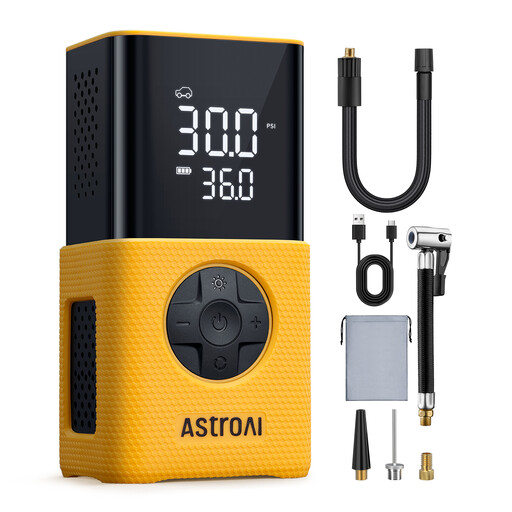
Why This Fits Their Persona: Ideal for drivers who want a fast and straightforward solution for regular tyre pressure checks and emergencies. The device is designed for efficiency and ease of use.
With a stated airflow rate of 17 L/min, it avoids the slow inflation trap. According to the manufacturer, it can top up a tyre (195/65R15) from 30 to 36 PSI in 1.5 minutes, which is highly practical for everyday use.
The 4000 mAh battery offers high capacity for multiple uses. The preset modes and automatic shut-off make it safe and easy to operate, even for non-technical users.
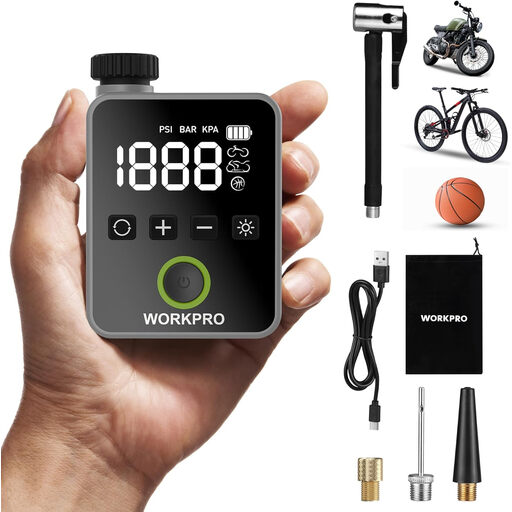
Why This Fits Their Persona: Perfect for cyclists, campers, and anyone who needs an extremely lightweight and multifunctional tool. Its low weight and compact size make it the ideal companion for on-the-go adventures.
This model clearly focuses on portability (only 270g) and versatility, rather than promising unrealistic performance for heavy vehicles. It is honestly targeted at its core applications (bicycles, balls, motorcycles).
The combination of an air pump, power bank, and emergency flashlight in a tiny package is its key advantage. The modern USB-C charging port ensures up-to-date convenience.

Why This Fits Their Persona: For users who demand maximum reliability and don't want to worry about a battery's charge level. Ideal for being permanently stored in the car for emergencies.
This model completely bypasses the battery trap by running directly from the vehicle's 12V socket. It's always ready as long as the car provides power and doesn't suffer from self-discharge or aging battery cells.
Its plug-and-play functionality offers the highest operational reliability. Despite being corded, the device is very compact and still provides modern conveniences like preset modes and an LED light.
We've compiled a complete, up-to-date list of products that fully meet these strict selection criteria and UK safety regulations.
The battery life depends heavily on the capacity (mAh) and usage. A good model with 4000-5000 mAh should be able to top up four car tyres by a few tenths of a bar or inflate a single car tyre from 0 to approx. 2.5 Bar. Most compact cordless devices are not designed for multiple full inflations or for use with very large tyres (e.g., from motorhomes).
Yes, this is possible with most high-quality models, but it requires patience. Inflating a completely flat tyre can take between 8 and 15 minutes, depending on the tyre size and the compressor's performance. It is important to observe the manufacturer's specifications for the maximum continuous running time (often 10-15 minutes) to avoid overheating the device.
The main difference is the power source. A cordless compressor offers maximum flexibility and can be used anywhere, but it must be charged. A 12V compressor is powered via the car's cigarette lighter socket. It is not cordless but is always ready for use as long as the car battery is working. 12V models are often a very reliable choice for purely emergency use in the car.