
Lieferung heute & morgen

Qualitätsgarantie

Willkommens-Angebote freischalten: KOSTENLOSE Lieferung | Bis zu 80 % RABATT | Kostenlose 30-Tage-JoyPlus-Testphase
App herunterladen
A sudden loss of tyre pressure on your way to work or a flat bicycle tyre before a weekend ride—these situations are more than just an inconvenience. A cordless air compressor promises a quick and straightforward solution. However, the market is flooded with devices whose performance claims often don't hold up in practice. As a Joybuy Product Recommendation Officer, I'm here to help you identify the common pitfalls and make an informed decision.
Many buyers rely on marketing claims that later prove to be misleading. Pay close attention to these three points to avoid a bad purchase:
To find the right cordless air compressor for your needs, you should focus on objective technical specifications.
The required pressure depends on the type of vehicle. While a car tyre typically needs 2.2 to 2.8 Bar (approx. 32-40 PSI), racing bike tyres often require up to 8 Bar (approx. 115 PSI). Most devices offer a maximum pressure of up to 10.3 Bar (150 PSI), which is sufficient for almost all common applications. More important than the maximum pressure is often the airflow rate (litres per minute), which determines how quickly an electric tyre pump can inflate a tyre.
The battery capacity, measured in milliampere-hours (mAh), gives an indication of how many tyres you can inflate on a single charge. For example, a model with 2500 mAh may be sufficient to top up the pressure in four car tyres. For completely inflating multiple tyres, capacities of 5000 mAh or more are recommended. Look for modern charging ports like USB-C, which allow for flexible charging in your car or at home.
A good cordless air pump should make operation as simple as possible.
Instead of making a one-size-fits-all recommendation, we have identified products tailored to specific user profiles.

Why it's a good fit: Ideal for drivers looking for a reliable and straightforward solution for the glove compartment. It focuses on the core functions for routine tyre pressure checks and emergencies, without unnecessary extras.
The clear digital display and auto-stop function counteract the pitfall of inaccurate pressure readings. Its compact build avoids the problem of a cumbersome design.
Simple operation and a robust housing designed for its core function: reliable inflation. The integrated emergency LED is a practical safety feature.
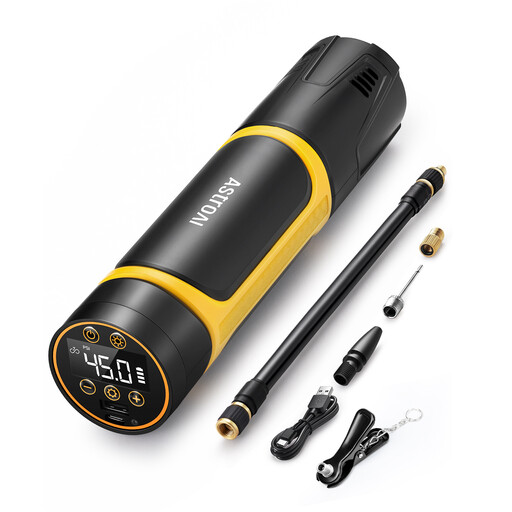
Why it's a good fit: Perfect for users with various vehicles (car, motorcycle, e-bike) and active families. The preset modes and included adapters cover every need, from car tyres to footballs.
The 5 smart modes with preset pressure values prevent user error. The integrated accessory compartment ensures that the necessary adapters are never lost.
High versatility thanks to 5 inflation modes and a USB output that turns the device into a power bank for your smartphone in an emergency. Includes adapters for Presta and Schrader valves.
We have compiled a complete, real-time list of products that fully meet these strict selection criteria and local safety regulations.
The runtime depends heavily on the battery capacity (mAh) and the application. A typical 2500–5000 mAh battery can top up the pressure in four to eight car tyres by a few PSI or fully inflate two to three bicycle tyres. Completely inflating a flat car tyre will consume a significant amount of the battery's charge.
Yes, most quality models are capable of this. However, the process takes significantly longer than at a petrol station (often 8–10 minutes per tyre) and puts a heavy strain on the battery. They are ideal for emergencies and top-ups but are not a replacement for a workshop's compressed air system.
Most cars use a Schrader valve. Many racing bikes and modern mountain bikes are equipped with a narrower Presta valve. For balls, air mattresses, and other inflatables, a ball needle or a plastic adapter is required. A good portable compressor should include the most common adapters.