
Lieferung heute & morgen

Qualitätsgarantie

Willkommens-Angebote freischalten: KOSTENLOSE Lieferung | Bis zu 80 % RABATT | Kostenlose 30-Tage-JoyPlus-Testphase
App herunterladen
A sudden loss of tire pressure is more than just an annoyance—it's a safety hazard and an interruption to your day. Many drivers know the frustration of driving to the nearest gas station only to find the air pump is broken or in use. A cordless air compressor offers an independent and fast solution, right in your own vehicle.
However, the market is flooded with devices whose performance claims often don't match reality. Before you make a purchase, it's crucial to understand the common pitfalls that lead to a useless gadget in your glove compartment. This guide will show you what to look for to make an informed choice.
Many devices advertise impressive numbers but fail in practice. Pay attention to these three critical points to avoid a bad purchase:
To avoid these traps, you should base your selection on objective technical data. The following three parameters are crucial for the performance and reliability of a cordless tire inflator.
The maximum pressure, given in Bar or PSI, defines the device's upper limit. For a compressor for car tires, values up to 8 Bar (approx. 116 PSI) are generally sufficient, as passenger car tires rarely require more than 3.5 Bar. More important, however, is the airflow rate, measured in liters per minute (L/min). A higher value means a faster inflation time. A rate of 20 L/min or more is recommended for car tires to avoid excessively long waits.
The battery's capacity, specified in milliampere-hours (mAh), determines how many tires you can inflate on a single charge. For automotive use, a device should have a capacity of at least 5000 mAh. Models with 7500 mAh or more offer a comfortable reserve and can often service multiple vehicles or double as a power bank for your smartphone. Also, look for a modern charging port like USB-C for easy compatibility with your existing chargers.
A reliable electric air pump for your car must have precise pressure measurement with an auto-stop function. You set the desired target pressure, and the compressor automatically shuts off once it's reached. This prevents tire damage and makes operation simple and safe. Useful extra features like an integrated LED light for nighttime emergencies or various adapters for bicycles, balls, and other inflatables increase the device's versatility.
Based on these objective criteria, we have identified a few models that represent a smart choice for specific user groups.

Why This Fits Their Persona: Ideal for drivers and families looking for a powerful and versatile device. It's suitable for car tires, motorcycles, bicycles, and balls, and its power bank function offers real added value on the go.
With a battery capacity of 7500 mAh, it bypasses the trap of insufficient battery life. The preset modes and auto-stop function address the problem of inaccurate handling.
High airflow rate (35 L/Min according to the manufacturer) for fast inflation; large battery capacity with an additional power bank function.
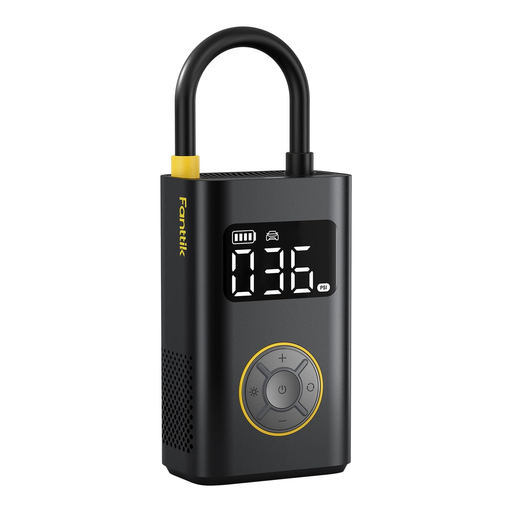
Why This Fits Their Persona: Perfect for users who value design, efficiency, and smart features. The thoughtful, integrated design makes it especially easy to store and use, ideal for quick deployment with your car.
The performance specs are specific (e.g., 1 minute for 30 to 35 PSI), which sidesteps the trap of vague promises. The automatic shut-off when inserting the hose prevents accidental activation and preserves the battery.
Smart design with an integrated hose that acts as an on/off switch; 4+N smart modes for easy operation.

Why This Fits Their Persona: Specifically designed for cyclists (road, MTB, e-bike). The extremely compact and lightweight design makes it the ideal companion on tours, without compromising on performance for high tire pressures.
This device avoids the trap of unrealistic performance by being clearly declared as "For Bicycles Only". It doesn't promise performance for car tires and instead delivers specialized, high performance for its intended purpose.
Extremely compact palm-sized form factor; all-in-one hose with integrated support for Presta and Schrader valves.
We have compiled a complete, up-to-date list of products that fully meet these strict selection criteria and EU safety regulations.
The battery life depends heavily on the capacity (mAh) and usage. A high-quality model with a capacity between 5,000 and 7,500 mAh can typically top off several car tires (e.g., from 2.2 to 2.5 Bar) or fully inflate multiple bicycle tires. Manufacturers often specify how many tires can be filled on a full charge. For maximum lifespan and readiness, the device should be recharged after use and stored at moderate temperatures.
Yes, powerful models are capable of this. However, it requires significantly more time and consumes a large portion of the battery capacity. These devices are primarily designed as an electric tire pump for correcting air pressure and for emergencies involving a slow leak. For a completely flat tire, they provide a functional emergency solution, but pay attention to the manufacturer's specified maximum continuous runtime to avoid overheating the device.
For branded products, the accuracy of the digital tire pressure gauge is typically within ±0.1 Bar (or ±1-2 PSI). This level of precision is perfectly adequate for everyday use and ensuring driving safety. The auto-stop function is directly dependent on the accuracy of this sensor, which is why the quality of this component is a key feature.