
Lieferung heute & morgen

Qualitätsgarantie

Willkommens-Angebote freischalten: KOSTENLOSE Lieferung | Bis zu 80 % RABATT | Kostenlose 30-Tage-JoyPlus-Testphase
App herunterladen
A sudden loss of tire pressure can unexpectedly interrupt any journey. Whether you're on your way to work, on a family holiday, or out on a bike tour, a reliable solution is crucial in these moments. A cordless air compressor promises independence from the nearest gas station and provides quick assistance. However, the market is flooded with devices whose advertised features often fail to deliver in practice.
As your Joybuy Product Recommendation Officer, I'm here to help you separate the wheat from the chaff. Instead of falling for marketing promises, we'll focus on the facts. In this guide, I'll show you the most common pitfalls to avoid when buying and which technical features truly matter, so you can make an informed decision.
Many buyers are disappointed with their device after a short time. This is often due to exaggerated advertising claims that can be traced back to three core problems:
To avoid a bad purchase, you should focus on verifiable technical data. A good portable compressor is characterised by a balanced ratio of these three core parameters.
The maximum pressure indicates how much pressure the device can theoretically build. For car tires, values around 2.5 Bar (approx. 36 PSI) are common, while racing bikes can require up to 8 Bar (approx. 115 PSI). A device with a maximum pressure of 150 PSI (approx. 10.3 Bar) therefore offers plenty of reserve capacity.
However, the airflow rate, measured in litres per minute (L/min), is much more important. It determines how quickly the tire is inflated. A cordless tire inflator for car tires should have an airflow rate of at least 20 L/min. If the value is significantly lower, inflating an empty tire will take an extremely long time and place excessive strain on the battery.
The battery capacity, specified in milliampere-hours (mAh), is the direct indicator of endurance. To be prepared for an emergency, the capacity should be sufficient to fully inflate at least one, or preferably two, empty car tires.
Also, look for a modern USB-C port. It allows for flexible charging in the car, via a power bank, or from a laptop and has become the standard.
Modern devices offer more than just inflation. Useful additional features significantly increase their practical value:
A robust mini compressor with a high-quality, flexible air hose and solid valve adapters is a sign of durability.
Instead of making a one-size-fits-all recommendation, we have selected models tailored to specific use cases.
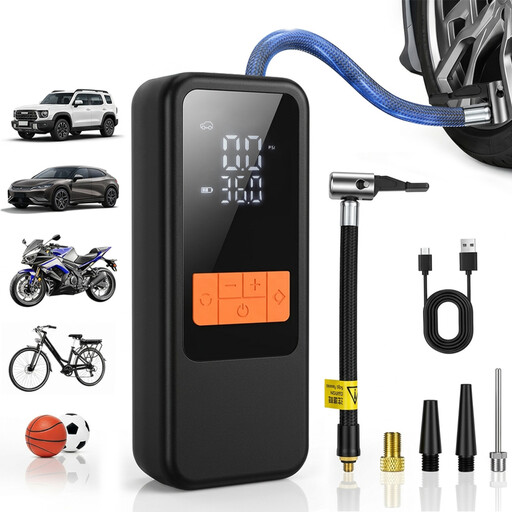
Why This Fits Their Persona: Ideal for drivers looking for a reliable and versatile device for the glove compartment. It combines performance for car tires with useful everyday features like a power bank and LED light.
With a 4000 mAh battery capacity and an airflow rate of 26 L/min, this device offers real-world performance instead of just high PSI numbers. According to the manufacturer, one charge is enough for two empty 195-size car tires.
Five preset modes and the auto-shutoff feature make operation simple and precise. The integrated power bank function (5V/2A) is a real added value in an emergency.
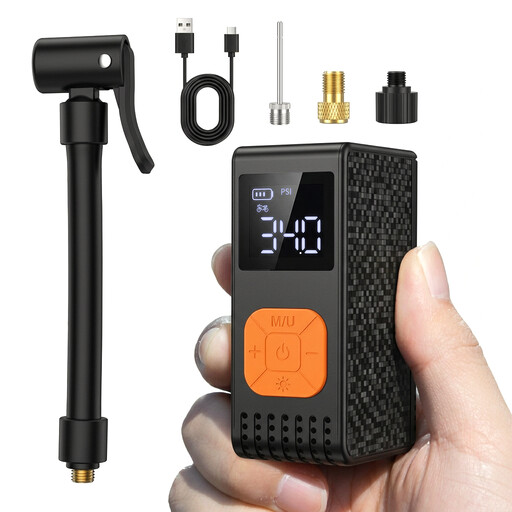
Why This Fits Their Persona: Perfect for cyclists and hikers where every gram counts. This extremely compact electric bike pump fits into any jersey pocket or backpack.
Instead of trying to do everything, this model focuses on the essentials: quickly inflating bike tires. The battery performance is optimised for this purpose and not designed for large car tires.
Extremely compact (85 mm height) and lightweight. The charging time of just 1.5 hours via USB-C is ideal for on-the-go use. Modes for motorcycles, bikes, and balls cover typical applications.

Why This Fits Their Persona: For users who need a powerful device for a wide range of tasks—from car and motorcycle tires to balls and pool toys. The focus here is on speed.
This model avoids the slow-inflation trap with a powerful motor. According to the manufacturer, it inflates a car tire from 0 to 2.0 Bar in 9 minutes, which is solid performance for a cordless device.
The 21,000 RPM motor ensures a high inflation speed. The three pressure units (PSI, BAR, KPA) and the clear digital display offer flexibility and control for various applications.
We've compiled a complete, up-to-date list of products that fully meet these strict selection criteria and safety regulations.
Yes, powerful models with a high airflow rate (e.g., over 25 L/min) and sufficient battery capacity (e.g., 4000 mAh) are capable of this. The process can take between 7 and 10 minutes per tire, depending on the tire size and device, and will consume most or all of the battery charge. However, for an emergency, this is an absolutely viable solution.
The accuracy varies depending on the quality of the device. Models from established manufacturers typically have a deviation of only ±0.1 Bar (approx. ±1.5 PSI). For regular pressure checks and emergencies, this level of precision is perfectly adequate. The automatic shut-off function is directly dependent on the accuracy of this sensor.
The lifespan is primarily determined by the battery and the motor. Most lithium-ion batteries in these devices are rated for 300 to 500 full charge cycles. With occasional use for tire pressure checks or emergencies, a high-quality device can easily remain functional for several years. Proper storage (cool and dry, not deeply discharged) will further extend the battery's lifespan.