
Lieferung heute & morgen

Qualitätsgarantie

Willkommens-Angebote freischalten: KOSTENLOSE Lieferung | Bis zu 80 % RABATT | Kostenlose 30-Tage-JoyPlus-Testphase
App herunterladen
A sudden loss of tyre pressure is more than just an annoyance—it's a safety hazard that often leads to unplanned stops at crowded petrol stations. A personal cordless air compressor offers a solution: fast, location-independent corrections to your tyre pressure for your car, motorcycle, or bicycle. However, the market is flooded with devices whose advertised features often fail to deliver in practice. Before you make a purchase, it's crucial to understand the most common pitfalls.
Some models entice with impressively high pressure ratings but take an eternity to inflate a single car tyre. Others disappoint with a weak battery that fails after only a short period of use. Another critical point is the accuracy of the pressure gauge. An unreliable sensor can lead to incorrect tyre pressure, which increases tyre wear and compromises driving safety.
To avoid a bad purchase, you should carefully examine three core technical specifications. These determine whether a device is a genuine help in everyday life or just a source of frustration.
The maximum pressure rating, often 150 PSI, is a common marketing figure. Far more crucial for practical use, however, is the air flow rate—that is, how quickly the compressor pumps air. A powerful device should be able to top up a standard car tyre (e.g., from 2.0 to 2.5 bar) in just a few minutes. For road bike tyres, which require high pressure, a high maximum pressure is relevant, but for most users—from car drivers to those using an electric bike pump—the inflation speed in the 2 to 4 bar range is the deciding factor. A digital tyre inflator with a precise display is essential here.
A cordless car tyre pump offers maximum flexibility. The battery's capacity, measured in milliampere-hours (mAh), determines how many tyres you can inflate on a single charge.
Also, look for modern charging ports like USB-C. This allows you to charge the device with the same cable you use for your smartphone or laptop, making you independent of proprietary power adapters. Models that can be powered via the car's 12V socket are an alternative, but they limit portability.
The reliability of a mini compressor depends heavily on its electronics. Two functions are particularly important here:
An easy-to-read display, ideally with a backlight, and an integrated LED light for use in the dark are other features that significantly enhance the practical utility of a portable air pump for cars.
Based on these objective criteria, we have compiled a selection of devices suitable for different user profiles and applications.
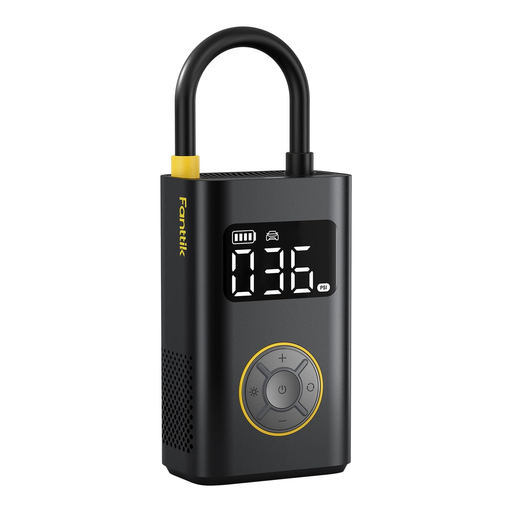
Why This Fits Their Persona: Ideal for users who want a single, cordless device for their car, e-bike, motorcycle, and sports balls. The combination of a powerful battery and pre-set modes makes operation fast and straightforward.
Addresses the problems of weak batteries and inaccurate readings with an integrated 7.4V (2.5Ah) battery and an auto shut-off function that precisely maintains the pre-set pressure.
Features 4+N smart modes for various applications and an easy-to-read display. The integrated hose and accessory compartment keep everything tidy.
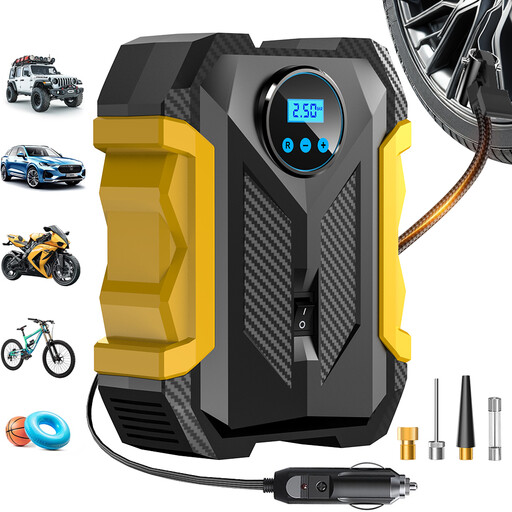
Why This Fits Their Persona: Perfect for value-conscious drivers who want a dependable pump in the boot for emergencies and don't require a cordless function. Powering it via the 12V socket ensures the device is always ready to go when the car is running.
Completely bypasses the issue of a dead battery by drawing power directly from the vehicle. The digital pressure detection ensures precise results without any guesswork.
The 3-metre long cable provides enough reach for all four tyres, even on larger vehicles. The integrated LED light is extremely useful for roadside emergencies in the dark.
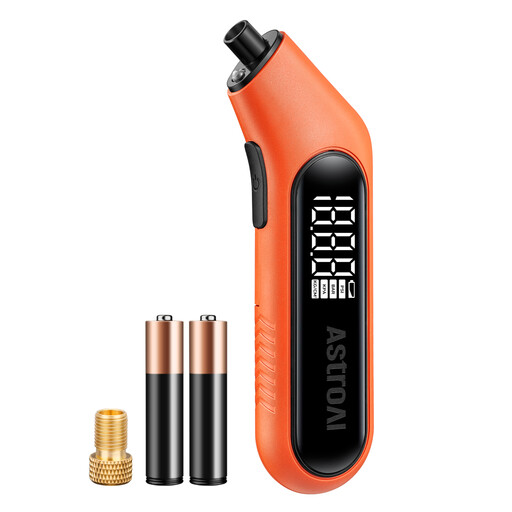
Why This Fits Their Persona: For users who already own a compressor (e.g., at a petrol station or an older model) but distrust its accuracy. This separate gauge is for quick and precise verification of tyre pressure.
Solves the problem of inaccurate built-in manometers. It provides a high-precision measurement certified to ANSI B40.7 Grade 2A standard, ensuring tyre pressure matches manufacturer specifications exactly.
Large, backlit display for excellent readability. The nozzle is designed for a leak-proof connection. Battery-powered and therefore ready to use anytime, anywhere.
We have compiled a complete, up-to-date list of products that fully meet these strict selection criteria and safety standards.
The runtime heavily depends on the battery capacity (in mAh) and the work being done. A model with a capacity between 5000 and 7500 mAh can typically raise the pressure of four to eight car tyres by a few tenths of a bar. However, fully inflating a flat car tyre can consume most of a single charge. With proper care, especially avoiding deep discharges, the battery can last for several years.
Yes, most high-quality models are capable of this. However, you will need to be patient. The process can take 8 to 15 minutes or longer, depending on the tyre size and compressor power, and it will heavily tax the battery. These devices are primarily designed for regular tyre pressure adjustments, not for repeatedly inflating empty tyres from scratch.
For devices from established manufacturers, the accuracy typically falls within a tolerance range of ±1 to 2 PSI (approx. ±0.07 to ±0.14 bar). This is perfectly sufficient for everyday use. For applications requiring extremely high precision, such as in motorsport or professional cycling, it is advisable to verify the pressure with a separate, calibrated digital manometer.