
Lieferung heute & morgen

Qualitätsgarantie

Willkommens-Angebote freischalten: KOSTENLOSE Lieferung | Bis zu 80 % RABATT | Kostenlose 30-Tage-JoyPlus-Testphase
App herunterladen
A sudden loss of tyre pressure can unexpectedly interrupt any journey. A reliable cordless air compressor in your boot provides security and independence from the nearest petrol station. However, the market is flooded with devices making lofty promises. To make an informed decision, it's crucial to know the common pitfalls and which technical features truly matter.
As your Joybuy Product Recommendation Officer, I'll help you navigate through the marketing noise. We will highlight the most common flaws that can lead to a bad purchase and show you what to look for when making your selection.
Many buyers are swayed by advertising claims that don't hold up in practice. Pay close attention to these three points to avoid disappointment:
To find the right device for your needs, you should focus on objective, technical parameters. These three criteria are decisive for performance and reliability.
The choice of power source depends on your use case.
These two values must always be considered together.
Modern compressors are often multi-functional tools.
Based on the criteria above, we have selected a few products for different user profiles.

Why It's a Match: This wired model is ideal for drivers who want a completely reliable solution for emergencies. It plugs directly into the 12V socket, making it always ready for use without worrying about a battery's charge level. Its compact size makes it easy to store in the glove compartment.
Completely bypasses the "insufficient battery" pitfall by drawing power directly from the vehicle. The performance is consistent and not dependent on an ageing battery.
Plug-and-play functionality for instant readiness. Five preset modes and an integrated LED light make operation simple and safe, even at night.
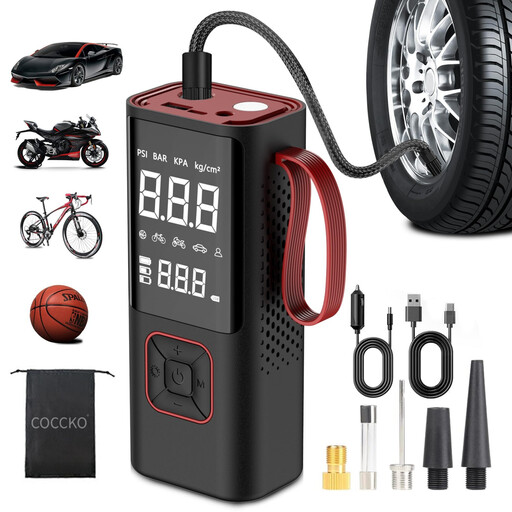
Why It's a Match: For commuters who value convenience and safety. This cordless model with a 6,000 mAh battery provides enough power for multiple tyre pressure adjustments. It's compact, quick to deploy, and the auto-shutoff feature ensures precise pressure without constant monitoring.
Addresses the weak battery pitfall with a high capacity of 6,000 mAh. The combination of a 35 L/min airflow rate and an efficient motor also prevents overheating during normal use.
High performance (the manufacturer claims it fills a 215/55 R17 tyre from 28 to 33 PSI in about 1 minute) and a smart LCD display with 5 modes for easy operation. Also functions as a power bank.

Why It's a Match: Perfect for users who need maximum flexibility. Whether for a car, motorcycle, bicycle, or football, this hybrid model works both cordlessly with its powerful 6,000 mAh battery and wired via the 12V socket. This makes it ready for any situation.
The dual-power function eliminates any range or battery anxiety. If the battery is dead, operation can simply continue via the 12V cable. This combines the best of both worlds.
Maximum versatility thanks to dual power supply. The digital display with auto-stop function and the included adapters make it an all-in-one device for the home, garage, and on the go.
We have compiled a complete, up-to-date list of products that fully meet these strict selection criteria and German safety regulations.
The runtime heavily depends on the battery capacity (mAh) and the work being done. A good model with 4,000–6,000 mAh can typically top up several car tyres by a few PSI or fully inflate 1-2 empty bicycle tyres. However, completely filling a flat car tyre can consume a large portion of the battery charge.
Yes, most modern cordless compressors with sufficient power (e.g., 30+ L/min) are capable of inflating a flat car tyre to the recommended pressure. Depending on the tyre size and device performance, this can take between 5 and 10 minutes and will heavily drain the battery. For such cases, a hybrid model or a dedicated 12V compressor is a particularly safe choice.
The main difference is the power source. A cordless air compressor offers portability and can be used anywhere, but its runtime is limited by the battery. A 12V compressor connects to the car's cigarette lighter socket and runs as long as the car provides power, making it very reliable for longer tasks or emergencies, but it restricts its use to the immediate vicinity of the vehicle.