
Lieferung heute & morgen

Qualitätsgarantie

Willkommens-Angebote freischalten: KOSTENLOSE Lieferung | Bis zu 80 % RABATT | Kostenlose 30-Tage-JoyPlus-Testphase
App herunterladen
A flat tire on the way to work or low tire pressure before a long road trip—situations every driver knows. A cordless air compressor promises a quick and easy solution, without a trip to the nearest gas station. But the market is flooded with devices making lofty claims. Before you make a purchase, it's crucial to understand the common pitfalls that often lead to disappointment and a useless device.
As your Joybuy Product Recommendation Officer, I'll help you separate marketing hype from genuine performance features. We'll shed light on the critical points that define a reliable portable compressor.
Many devices look promising at first glance but prove to be unreliable in practice. Pay special attention to these three weaknesses:
To avoid a bad purchase, you should focus on the following objectively measurable criteria. These determine whether a cordless car air pump is genuinely helpful in everyday life.
Battery capacity, specified in milliampere-hours (mAh), is a key indicator of endurance. A value below 4000 mAh is often insufficient for car tires. Look for models with at least 5000 mAh or more if you plan to fill multiple tires or larger volumes (e.g., on an SUV). Modern devices should also feature a USB-C port, enabling fast and convenient charging, even via a power bank in your car.
The crucial metric for speed is the airflow rate, specified in litres per minute (L/min). A high maximum pressure is only useful if the flow rate is also adequate. A good value for quickly inflating car tires is 20 L/min or more. Devices rated at 35 L/min can often top up a standard car tire (e.g., from 2.0 to 2.5 Bar) in under two minutes. A 12V mini compressor with a cord can be an alternative, but it is less flexible.
A reliable automatic shut-off is not a luxury but an essential safety feature. You set the desired target pressure, and the compressor stops exactly when that value is reached. This prevents over- or under-inflation. Useful additional features that enhance practical value include:
Based on these objective criteria, we have identified several models that represent a smart choice for different user profiles.
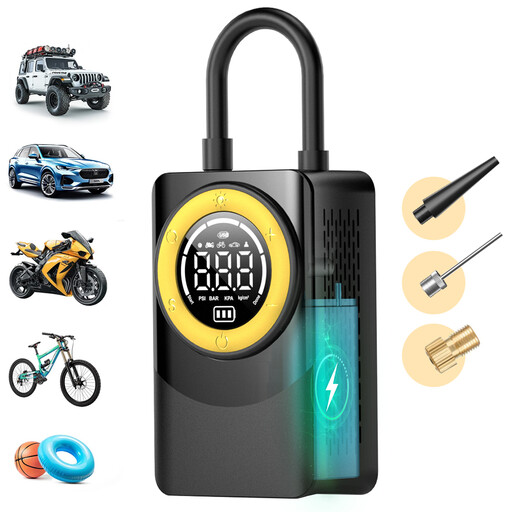
Why It's a Good Fit: Ideal for users seeking a straightforward and affordable solution for occasional tire pressure checks or emergencies. The device focuses on core functions without expensive extras.
Features a digital display and an automatic shut-off function, minimizing the risk of inaccurate inflation—a common problem with budget models.
The cordless design and compact size make it easy to store in the glove compartment or trunk. The fast-charging feature ensures it's ready for use quickly.
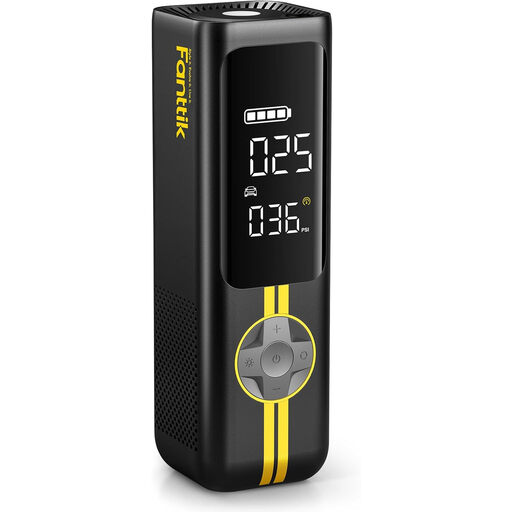
Why It's a Good Fit: For commuters and tech enthusiasts who value speed, endurance, and extra features. Ideal for regular maintenance of car, motorcycle, and bicycle tires.
Directly addresses the weaknesses of battery life and speed. According to the manufacturer, a single charge allows for up to 40 minutes of continuous runtime and fast inflation, making it a reliable tool.
The combination of high filling performance, long battery life, and additional features like an LED light and power bank function makes it a multifunctional all-in-one device.

Why It's a Good Fit: Designed for demanding tasks. With its large battery and high airflow rate, it's suitable for owners of SUVs, RVs, or for users who regularly maintain multiple vehicles.
The 7500mAh battery offers one of the highest capacities in its class, directly addressing the problem of insufficient runtime. According to the manufacturer, it can fill up to 5 car tires on a single charge.
The combination of a powerful battery, a high airflow rate of 35L/Min, and a maximum pressure of 160 PSI ensures high performance even with large tire volumes.
We have compiled a complete, up-to-date list of products that fully meet these strict selection criteria and safety regulations.
The runtime heavily depends on the battery capacity (mAh) and the power being drawn. A high-quality model with 6000-7500 mAh can often inflate several car tires (e.g., 4-5 tires from 2.0 to 2.5 Bar) or run continuously for up to 30-40 minutes. Cheaper models with smaller batteries often only manage one car tire or a few bicycle tires.
Yes, powerful models can do this. The key factors are a high airflow rate (e.g., over 25 L/min) and a long-lasting battery. The process can take between 5 and 10 minutes, depending on the tire size and compressor performance. It's important to give the device breaks to cool down as recommended in the user manual.
Accuracy is crucial for safety. Look for models where the pressure measurement has a low deviation (e.g., ±0.1 Bar or ±1 PSI). A reliable automatic shut-off function that precisely stops the inflation process when the preset pressure is reached is the most important feature to ensure accurate filling.