
Lieferung heute & morgen

Qualitätsgarantie

Willkommens-Angebote freischalten: KOSTENLOSE Lieferung | Bis zu 80 % RABATT | Kostenlose 30-Tage-JoyPlus-Testphase
App herunterladen
A flat tire never happens at a convenient time. Whether you're on your way to work, heading out on a family vacation, or on a bike tour, a sudden loss of pressure is more than just an annoyance. A modern cordless air compressor promises a quick and straightforward solution. However, the market is flooded with devices whose marketing promises often fall short in practice. As your Joybuy Product Recommendation Officer, I'll help you separate the wheat from the chaff and navigate the common pitfalls of buying one.
Many buyers invest in a device that fails when they need it most. This is often due to three common problems that are overlooked during the selection process:
To avoid a bad purchase, you should focus on objective, technical features rather than marketing slogans. The following three parameters are crucial for the functionality and reliability of your device.
The flexibility of a compressor is largely determined by its power source.
A compressor's performance is defined by two key metrics:
A precise cordless air pump with a pressure gauge and an automatic shutoff function is essential. You set the target pressure, and the device stops on its own once it's reached. This prevents damage to the tire and ensures safety.
A good portable compressor is more than just a pump. Useful extra features significantly increase its practical value:
Instead of making a one-size-fits-all recommendation, we have identified products tailored to specific use cases.
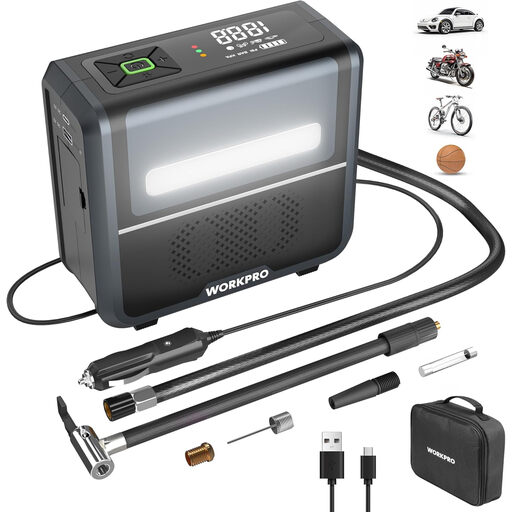
Why This Fits Their Persona: Ideal for users who want a single device for cars, motorcycles, bikes, and recreational items. The combination of a powerful battery and a 12V option offers maximum flexibility for use at home and on the go.
The dual-power feature (battery and 12V cable) eliminates the risk of being stranded with a dead battery. Additionally, its smart modes with preset pressure values prevent inaccurate inflation.
3-in-1 Functionality: Compressor, power bank, and LED flashlight. Dual power supply for guaranteed readiness.

Why This Fits Their Persona: Perfect for road, mountain, and e-bike riders who need an extremely compact, lightweight, and powerful device for high tire pressures that fits in any jersey pocket.
This device avoids the 'jack-of-all-trades' trap where a tool fails at specialized tasks. It's optimized as an electric bike pump, quickly delivering the high pressure that bike tires need without overheating.
Specialized Design: Integrated hose with Presta and Schrader valve support. Compactness: Its palm-sized build fits easily into a backpack or jersey pocket.
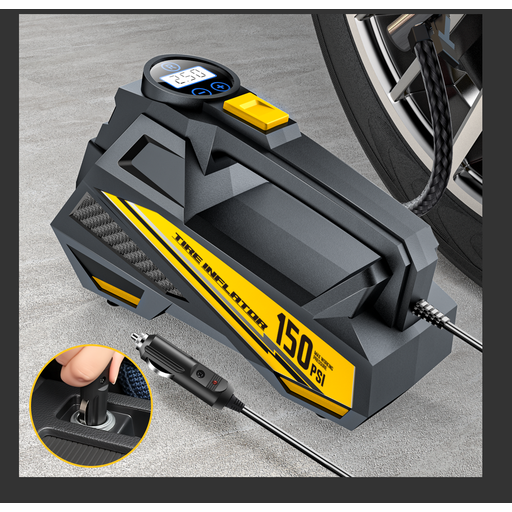
Why This Fits Their Persona: For drivers seeking an absolutely reliable, maintenance-free solution for the glove compartment. The focus isn't on cordless flexibility, but on guaranteed functionality in an emergency.
This corded model bypasses the most common point of failure: the battery. There are no charge levels to monitor or dead batteries in an emergency. Just plug it into the 12V socket and go.
Maximum Reliability: Works every time, as long as the car battery has power. Simple Operation: No complex modes, just the core function of inflation.
We've compiled a complete, up-to-date list of products that fully meet these strict selection criteria and safety standards.
Yes, most modern cordless compressors are designed for this purpose. However, it's crucial that the model is explicitly rated for car tires and has a sufficient airflow rate (e.g., over 20 L/min). Very small models intended only for bicycles might struggle with a completely flat car tire or take a very long time. Always check the manufacturer's specifications.
The battery life depends heavily on the battery capacity (in mAh or Wh), the tire type, and the target pressure. A good mid-range model can typically inflate 2-4 car tires completely or fill 8-10 bicycle tires. Models with very large batteries can do more. For occasional use and emergencies, the performance of most current devices is sufficient.
Both are units for measuring pressure. In Europe, Bar is the more common unit, while PSI (Pounds per Square Inch) is prevalent in the US and UK. Most digital pressure gauges allow you to switch between units. As a rule of thumb: 1 Bar ≈ 14.5 PSI. A typical car tire pressure of 2.5 Bar is therefore equivalent to about 36 PSI.