
Lieferung heute & morgen

Qualitätsgarantie

Willkommens-Angebote freischalten: KOSTENLOSE Lieferung | Bis zu 80 % RABATT | Kostenlose 30-Tage-JoyPlus-Testphase
App herunterladen
A cordless air compressor promises independence: no more waiting at the gas station, no more fumbling with cumbersome cables. But the market is flooded with devices whose marketing claims often don't hold up in practice. As a Joybuy Product Recommendation Officer, I see daily which pitfalls lead to disappointment and unnecessary expenses. This guide shows you what really matters and how to sidestep the typical marketing traps.
Many buyers focus on superficial features and overlook critical technical flaws. Pay close attention to these three points to avoid a bad purchase:
To avoid these traps, you should check three core parameters before buying. These determine whether a portable air compressor is a genuine help or just another unused gadget in your trunk.
The maximum pressure indicates the pressure a compressor can theoretically build. However, far more important for practical use is the airflow rate, measured in liters per minute (L/min). It determines how quickly air actually gets into the tire.
The battery's capacity, specified in milliampere-hours (mAh), determines your mobility.
Modern devices offer a digital display and an automatic shutoff function once the target pressure is reached. Look for manufacturer specifications on measurement accuracy (e.g., ±0.1 Bar or ±1 PSI). A reliable auto-shutoff not only prevents dangerous over- or under-inflation but also makes operation significantly more convenient.
Based on these objective criteria, we have identified a few models that represent a smart choice for specific user groups.
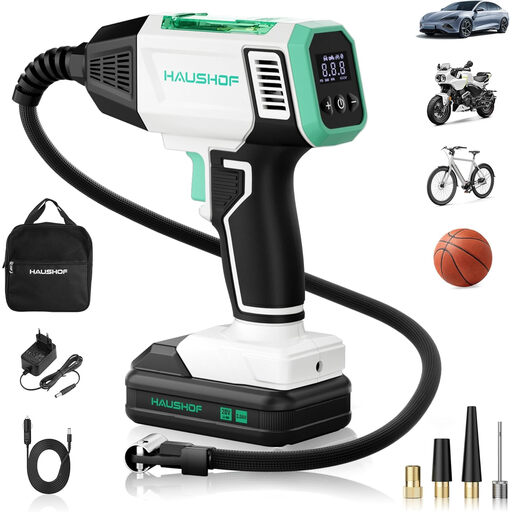
Why This Fits Their Persona: A solid choice for occasional use and as an emergency kit in the car. The device offers the most important functions without a high initial cost and is easy to operate.
Bypasses the "dead battery" trap with the included 4-meter 12V cable. The specified airflow rate of 22 L/min is a transparent performance metric that is sufficient for standard passenger car tires.
Dual power supply (battery and 12V cable) for maximum operational reliability. Four preset modes for easy handling.
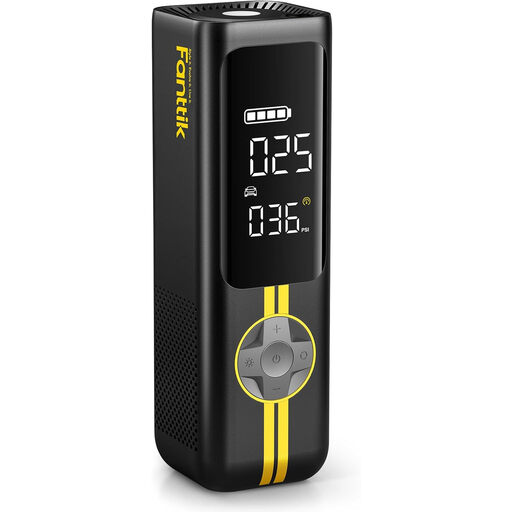
Why This Fits Their Persona: Ideal for those who regularly check tire pressure on multiple vehicles (car, motorcycle, bike) and value speed and precision.
Directly addresses the slow performance trap with a high inflation speed. According to the manufacturer, it achieves a high accuracy of ±1 PSI, which counteracts the trap of imprecise sensors.
Very fast inflation times and a long battery life of up to 40 minutes in continuous operation. The dual LED display provides a clear overview.
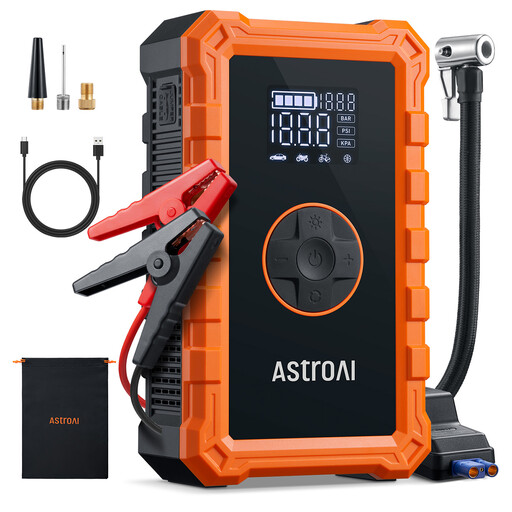
Why This Fits Their Persona: Perfect for anyone looking to consolidate their emergency gear. This device combines a jump starter for the car battery with a powerful compressor, a power bank, and an LED light.
As a multifunctional device from an established brand, it is designed for reliability in emergencies. The large 2.4-inch display provides clear and easy-to-read pressure values, minimizing the risk of inaccurate readings.
Combines a jump starter (up to 6.0L gas/3.0L diesel) and a compressor with a 25 L/min airflow rate. Saves space and is highly versatile.
We have compiled a complete, up-to-date list of products that fully meet these strict selection criteria and safety regulations.
The battery life depends heavily on the capacity (mAh) and usage. A model with 4000–6000 mAh can typically top up several car tires by a few PSI or fully inflate 1-2 flat tires. For bicycle tires, the capacity is often sufficient for numerous refills. Check the manufacturer's specifications, which often state how many tires can be inflated on a full charge.
Most portable mini compressors are designed for cars, motorcycles, and bicycles. These devices are generally not suitable for truck or RV tires, which require a very high volume and pressure. Always check the product description for suitability and the maximum supported pressure.
Accuracy varies by model and manufacturer. Quality models typically have a small deviation of ±0.1 to ±0.2 Bar (approx. 1-2 PSI). It is good practice to initially compare the displayed pressure with a separate, calibrated tire pressure gauge to get a feel for the device's accuracy.