
Lieferung heute & morgen

Qualitätsgarantie

Willkommens-Angebote freischalten: KOSTENLOSE Lieferung | Bis zu 80 % RABATT | Kostenlose 30-Tage-JoyPlus-Testphase
App herunterladen
A sudden loss of tyre pressure is more than just an annoyance—it can bring a trip to an abrupt halt and lead to unsafe situations on the roadside. A cordless air compressor promises a quick and independent solution. However, the market is flooded with devices making bold promises. Many drivers invest in a model that fails in an emergency or quickly becomes useless due to hidden defects. As your Joybuy Product Recommendation Officer, I'll help you recognise the typical marketing traps and make an informed decision.
Before you decide on a model, you should be aware of the most common issues that lead to a bad purchase. Many devices look good on paper but disappoint in practice.
To make a good choice, focus on the technical specifications that make a difference in everyday use.
Instead of just looking at the maximum pressure, look for the airflow rate, often specified in litres per minute (L/min). For a portable compressor, a value over 20 L/min is a good benchmark to inflate a standard car tyre from 2.0 to 2.5 Bar in just a few minutes. For battery performance, the capacity in Watt-hours (Wh) is a more reliable indicator than Milliam-pere-hours (mAh) alone. Look for practical manufacturer claims, such as "inflates up to 4 car tyres on a single charge." A modern USB-C port for recharging the device itself is also a clear convenience feature.
If you are considering a multi-function device, check the performance of each individual component:
Here are some recommendations tailored to the different needs of drivers in the UK and Europe.
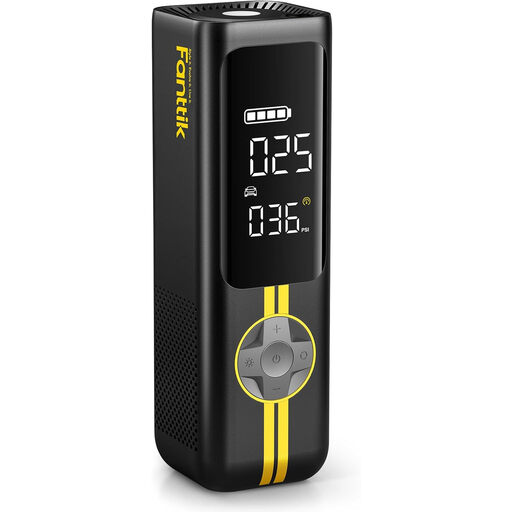
Why it's a good fit: Ideal for regular tyre pressure checks and quick top-ups. Its compact design fits easily into the glove compartment, ensuring it's always within reach without taking up boot space. Perfect for commuters and city drivers.
This device avoids the "high pressure" trap by focusing on inflation speed. According to the manufacturer, inflating a mid-size car tyre from 28 to 33 PSI takes only 56 seconds, highlighting the importance of airflow rate.
Its simple operation with preset modes and an auto-shutoff feature makes it incredibly user-friendly. The long battery life of up to 40 minutes of continuous operation is another major plus.
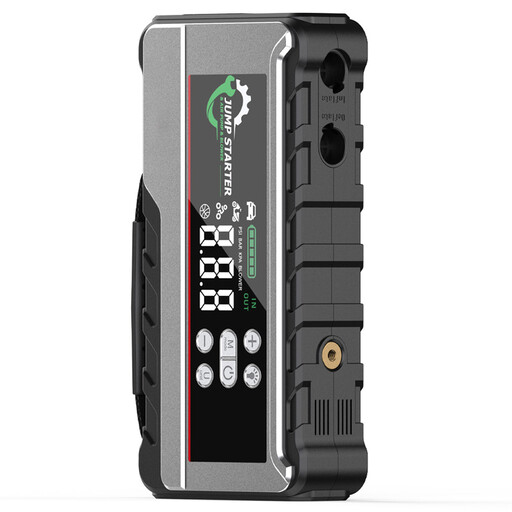
Why it's a good fit: For those who want to be prepared for anything. This device combines a powerful jump starter with a full-featured compressor and a power bank that can even charge laptops. Ideal for long-distance drivers, owners of vehicles with large engines, and campers.
It avoids the "all-in-one" compromise by delivering high performance across the board: 3000A peak current for jump-starting, 150 PSI for the compressor, and PD65W fast charging for the power bank. The specifications are clear and designed for demanding tasks.
Its incredible versatility. It's not just an air pump for car tyres, but also an inflator for air mattresses and a jump starter for a wide range of vehicles, including vans and boats.
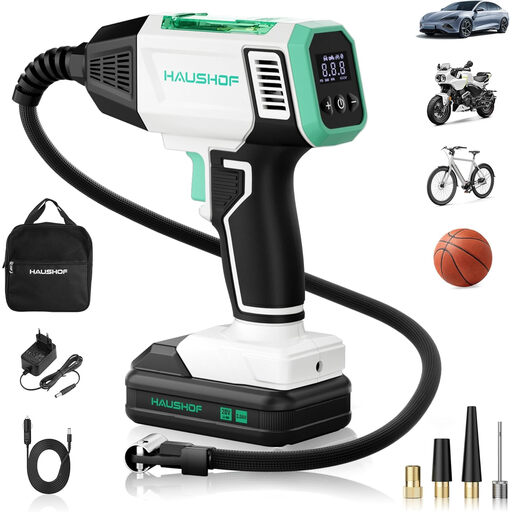
Why it's a good fit: For users looking for a simple and cost-effective solution for basic tyre maintenance. This **mini compressor** offers the core functions without expensive extras and is very easy to handle thanks to its light weight and compact size.
It avoids the "vague battery spec" trap through transparency. The 2000 mAh battery capacity is reasonable for the price, and the additional option to power the device via a 4-metre 12V cable provides an honest and practical solution in case the battery runs out.
The dual power supply (battery and cable) offers high operational reliability at an attractive price. The preset modes and auto-shutoff are also included, even at this price point.
We've compiled a full, up-to-date list of products that fully meet these strict selection criteria and European safety regulations.
The runtime heavily depends on the battery capacity (in Wh), the tyre type, and the target pressure. A good cordless tyre inflator can typically top up 4 to 8 car tyres by a few PSI on a single charge. Fully inflating a flat tyre consumes significantly more energy. Look for manufacturer claims that refer to specific use cases.
Yes, most modern cordless compressors can, but it takes longer and puts a heavy strain on the battery. The crucial metric here is again the airflow rate (L/min). Models with a higher rate (e.g., over 30 L/min) are better suited for this task. For a completely flat tyre, it may be wise to use a model that can also be powered by the car's 12V socket to conserve the battery.
Both are units for measuring pressure. In the UK and Europe, Bar is the common unit for tyre pressure, though PSI is also widely understood. PSI (Pounds per Square Inch) is prevalent in North America. The conversion is simple: 1 Bar is approximately 14.5 PSI. Most digital compressors allow you to switch between units, so you can directly set the recommended value for your vehicle (usually found in Bar on a sticker inside the fuel filler flap or on the driver's side B-pillar).