
Lieferung heute & morgen

Qualitätsgarantie

Willkommens-Angebote freischalten: KOSTENLOSE Lieferung | Bis zu 80 % RABATT | Kostenlose 30-Tage-JoyPlus-Testphase
App herunterladen
A flat tire on your way to work or low pressure before a long road trip—these situations aren't just annoying; they can compromise your safety. A cordless air compressor promises a quick and straightforward solution, right on the spot and without a detour to the nearest gas station.
But the market for these handy helpers is large and overwhelming. Many devices entice customers with impressive performance specs, only to prove unreliable in practice. As your Joybuy Product Recommendation Officer, I'm here to help you separate the wheat from the chaff. In this guide, I'll show you which critical features to look for and how to avoid the most common pitfalls when buying.
Before you decide on a model, you should be aware of the typical flaws that often only become apparent after the purchase. An informed decision will save you from disappointment and unnecessary expenses.
To find a reliable and durable cordless compressor, you should focus on the following practical features.
The battery capacity, specified in milliampere-hours (mAh), is the heart of any cordless compressor. It determines how long the device can operate without an external power source.
These two values determine the device's efficiency.
Modern devices offer convenience features that significantly simplify their use.
We have selected a few models from our range that are suitable for different user groups and avoid the pitfalls mentioned.
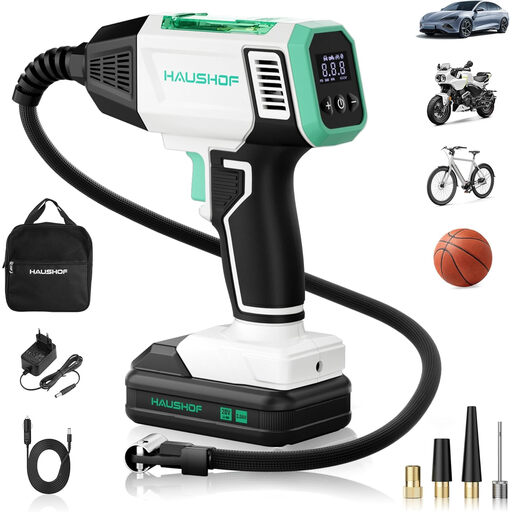
Why This Fits Their Persona: Ideal for users seeking a reliable, basic solution for occasional tire pressure corrections on cars, bikes, or sports balls without a large budget. The dual power supply (battery and 12V cable) offers extra peace of mind.
Despite the 2000 mAh battery, the included 4-meter 12V cable provides a reliable power source if the battery runs out, bypassing the risk of short battery life. The auto-shutoff feature ensures precise pressure.
Dual Power Supply: Flexible use via battery or 12V connection. Compact and Lightweight: At only 0.8 kg, it's easy to transport and store.

Why This Fits Their Persona: Perfect for drivers who regularly check the pressure on multiple vehicles (e.g., family fleet, RV) and need a fast, powerful device. The high battery capacity also makes it attractive for campers and outdoor activities.
With a 7500 mAh battery capacity and an airflow rate of 35 L/min, this model directly addresses the problems of short runtime and slow inflation. According to the manufacturer, it can run continuously for up to 45 minutes.
High Performance: Fast inflation thanks to 35 L/min. Large Battery & Power Bank Function: 7500 mAh for long runtime and for charging external devices.

Why This Fits Their Persona: For drivers who want not just a compressor, but a comprehensive safety tool for the glove box. This multifunctional device combines a reliable air pump with life-saving tools for emergencies.
This device doesn't just focus on inflation. It offers solid performance specs with 4000 mAh and 35 L/min, avoiding the trap of pure marketing gimmicks by integrating genuinely useful safety features.
Integrated Safety Tools: Includes a window hammer and a seatbelt cutter. Good Performance: Fast inflation and a solid battery capacity for everyday use.
We have compiled a complete, up-to-date list of products that fully meet these strict selection criteria and safety standards.
1. How long does the battery of a portable air compressor last on a full charge? The runtime heavily depends on the battery capacity (mAh) and the power being drawn. A model with 6000-7500 mAh can typically inflate four to five car tires from 0 to the target pressure or correct the pressure by a few PSI more than a dozen times. Smaller batteries (2000-4000 mAh) are often sufficient for a complete pressure correction on all four tires or fully inflating 1-2 tires.
2. Can I use a cordless compressor to inflate tires on vans or RVs? Most compact cordless compressors are designed for passenger car, motorcycle, and bicycle tires. They are generally not suitable for the tires of large vans, trucks, or heavy RVs, which require very high pressure and a large volume of air. For these applications, check the manufacturer's specifications for maximum pressure and recommended vehicle size.
3. How accurate is the digital pressure gauge on these devices? Modern digital gauges in quality devices offer high accuracy, often with a deviation of only ±0.1 Bar (or ±1-2 PSI). This is sufficiently precise for personal use. However, it is good practice to occasionally compare the pressure with a separate, calibrated tire pressure gauge to verify your device's accuracy.