
Lieferung heute & morgen

Qualitätsgarantie

Willkommens-Angebote freischalten: KOSTENLOSE Lieferung | Bis zu 80 % RABATT | Kostenlose 30-Tage-JoyPlus-Testphase
App herunterladen
A flat tyre on the way to work or low tyre pressure before a long holiday drive – situations every driver knows and wants to avoid. A cordless air compressor promises a quick and straightforward solution, without the detour to the nearest petrol station. But the market is flooded with devices whose marketing promises often suggest more than the technology can deliver.
As a Joybuy Product Recommendation Officer, I see daily which pitfalls lead to disappointment. Before you make a decision, you should know the three most common marketing traps that often lead to a bad purchase.
To avoid falling into these traps, you should focus on the objectively measurable core features. These three parameters determine the practical usability and reliability of your device.
Nearly every cordless air compressor advertises a high maximum pressure of 150 PSI (approx. 10.3 bar). For a standard car tyre, which typically requires between 2.2 and 2.8 bar, this value is more than sufficient. However, far more crucial for speed is the air flow rate, specified in litres per minute (L/min). A higher value means the tyre fills up faster. A device with 20 L/min is noticeably faster than one with 10 L/min, especially when a tyre has lost a lot of air.
The battery capacity, measured in milliampere-hours (mAh), gives an indication of how many tyres you can inflate on a single charge. Models with 4000 mAh to 7500 mAh generally offer a good balance of weight and performance. Look for modern charging ports like USB-C for fast and convenient charging. A particularly flexible solution is a 12V mini compressor that can be powered by the car's cigarette lighter socket in addition to its battery. This ensures unlimited runtime in an emergency.
A reliable electric tyre pump should always have a digital display and an auto-stop function. You set the target pressure, and the compressor automatically shuts off once it's reached. This prevents dangerous over-inflation and ensures precise results. Other useful extras include:
Based on these objective criteria, we have identified several models that are particularly well-suited for different user profiles.

Why This Fits Their Persona: Ideal for drivers looking for a simple, reliable device for occasional tyre pressure checks and for inflating bicycle tyres or balls. Its compact design allows for easy storage in the glove compartment or a backpack.
This model focuses on core functions: a clear digital display, preset modes, and an auto-stop function. It avoids exaggerated performance claims and delivers a solid basic feature set.
Very compact design and low weight (530 g). Includes an LED emergency light with an SOS function.
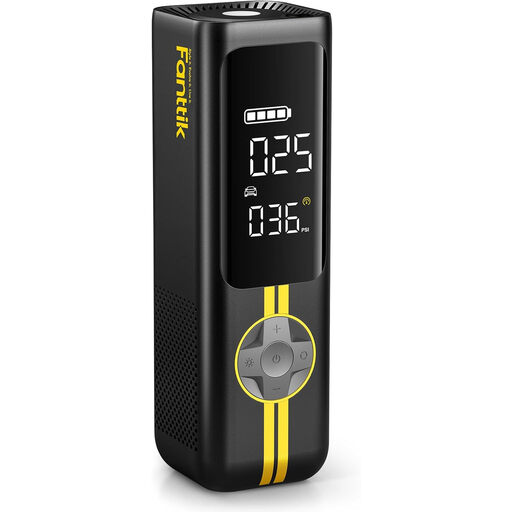
Why This Fits Their Persona: For drivers of larger vehicles (MPVs, SUVs) or tech enthusiasts who value speed, precision, and long runtime. The large display and high performance make regular tyre pressure checks fast and efficient.
Fanttik backs up its speed claim with a concrete example (56 seconds for a mid-size car tyre from 28 to 33 PSI). The specified continuous runtime of up to 40 minutes directly addresses the weakness of many competing models that overheat quickly.
High inflation speed and long battery life. According to the manufacturer, the device can also serve as an emergency air source for pneumatic nailers (for nails ≤ 3 cm).
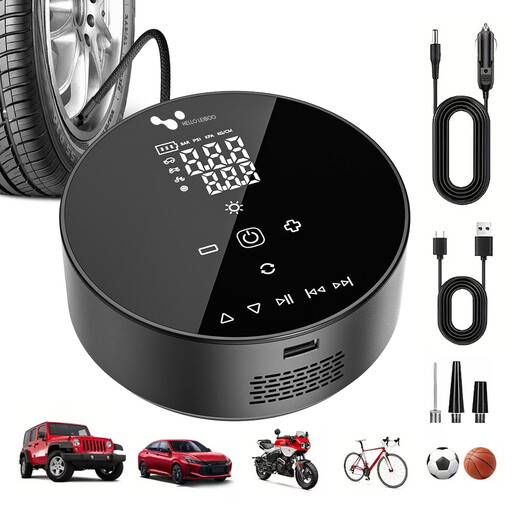
Why This Fits Their Persona: This 4-in-1 device is the perfect companion for road trips and camping. It combines a tyre inflator with a Bluetooth speaker, a power bank, and an LED work light. The dual power supply (battery or 12V DC) offers maximum flexibility far from civilisation.
Instead of just advertising a weak LED as an "extra feature," this model integrates several functions relevant to outdoor activities. The added value is clearly defined and goes beyond simply inflating tyres.
Multifunctionality (compressor, power bank, speaker, light) and dual power modes (battery and 12V socket).
We have compiled a complete, up-to-date list of products that fully meet these strict selection criteria and UK safety regulations.
The number heavily depends on the battery size (mAh), tyre size, and the pressure difference. As a rule of thumb, a solid quality model with a capacity between 4000 and 6000 mAh should be able to correct the pressure on four to five car tyres by a few PSI or completely fill a single, empty bicycle tyre. Fully inflating a flat car tyre will often use up a large portion of the battery charge.
Yes, most models that can reach a maximum pressure of over 100 PSI are capable of this. However, the process can take between 5 and 15 minutes, depending on the tyre size and the device's air flow rate, and will heavily drain the battery. For such emergencies, a model with an additional 12V connection for the cigarette lighter socket is a more reliable choice.
A good car tyre inflator comes with several adapters to be versatile.