
Lieferung heute & morgen

Qualitätsgarantie

Willkommens-Angebote freischalten: KOSTENLOSE Lieferung | Bis zu 80 % RABATT | Kostenlose 30-Tage-JoyPlus-Testphase
App herunterladen
A flat tire is never convenient. Whether on your way to work, on a holiday trip, or during a weekend bike tour, a sudden loss of pressure is more than just an annoyance. A modern cordless air compressor promises a quick and straightforward solution. However, the market is flooded with devices whose promotional promises often don't hold up in practice. Many users invest in a device that fails when they need it most.
As your Joybuy Product Recommendation Officer, I'll help you recognize the common pitfalls and make an informed decision. We'll focus on the facts that truly matter and leave the marketing hype aside.
Before you decide on a model, you should be aware of the three most common problems that lead to a bad purchase.
To avoid these traps, you should check three core technical specifications. These determine whether a portable tire inflator is suitable for your needs.
Maximum pressure is important, especially for road bike tires that require high pressure. However, for a typical car tire (approx. 2.5 Bar / 36 PSI), the air flow rate is more critical. It determines how quickly the tire is inflated.
A cordless air pump offers maximum flexibility. However, the battery capacity should match the intended use.
Modern devices offer more than just air. Look for features that make use easier and safer.
Based on these objective criteria, we have identified some models that are particularly suitable for different user profiles.
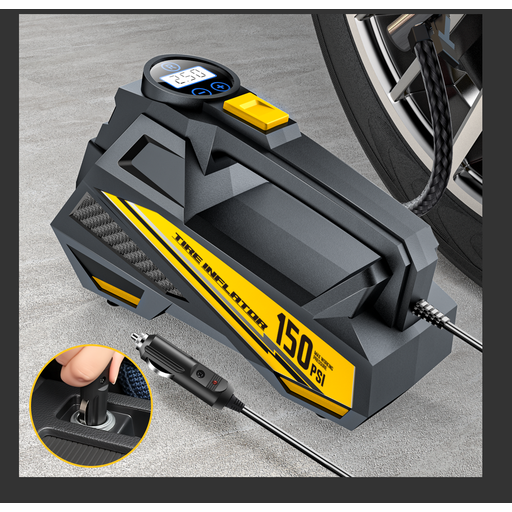
Why This Fits Their Persona: This model is designed for users seeking a completely reliable solution for the glove box. It forgoes a battery, relying instead on the vehicle's proven 12V port. Ideal for emergencies and regular pressure checks without worrying about a dead battery.
It completely bypasses the pitfall of insufficient battery life by drawing power directly from the vehicle. Its function is clearly defined and reliable.
Continuous power from the 12V port; digital display with auto-shutoff for precise inflation.
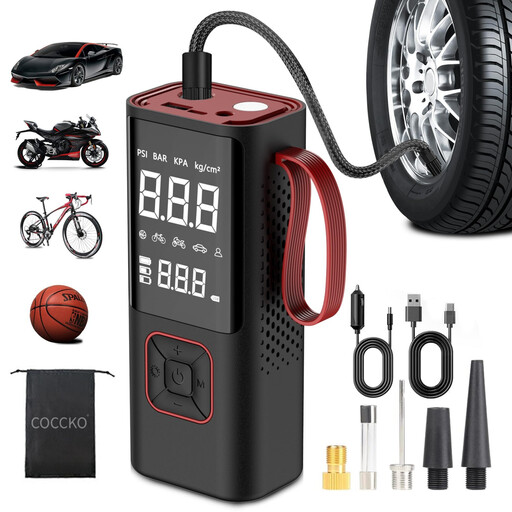
Why This Fits Their Persona: This model offers the freedom of a cordless design combined with a powerful battery and useful extra features. It's ideal for anyone who regularly checks tire pressure on various vehicles (car, bicycle, e-bike) and values a versatile tool for leisure and emergencies.
With a 6000 mAh battery, it directly addresses the problem of weak batteries. The high air flow rate (35 L/min according to the manufacturer) and the smart auto-shutoff feature counteract the pitfalls of low performance and inaccuracy.
Large battery capacity for multiple uses; power bank function and 3-mode LED light for added versatility.
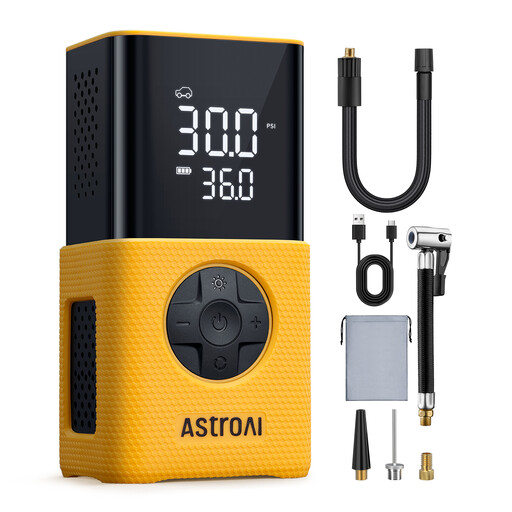
Why This Fits Their Persona: For cyclists and motorcyclists, every gram and inch counts. At just 460g, this model is extremely lightweight and compact. It fits easily into a backpack or saddlebag while still offering enough power and the right modes for two-wheelers.
It avoids the trap of being too bulky. While many compressors are designed for cars and are therefore too cumbersome, this device is engineered for maximum portability without compromising on core features like pressure and accuracy.
Very compact and lightweight (460 g); specific modes for bicycles and motorcycles; power bank function as a handy extra for on the go.
We have compiled a complete, up-to-date list of products that fully meet these strict selection criteria and UK safety regulations.
Yes, most powerful models (with approx. 4000-6000 mAh battery and over 20 L/min air flow) can inflate a standard car tire from 0 Bar to the target pressure. Depending on the tire size and device, this can take between 8 and 15 minutes and will use up a large portion of the battery charge. For such cases, a model with a 12V connection is a safe bet.
The runtime heavily depends on the battery capacity and the application. A good cordless compressor with 5000-6000 mAh can typically top up 2-4 car tires (e.g., from 2.2 to 2.5 Bar) or inflate about 8-10 bicycle tires. However, completely inflating a flat car tire can consume the entire capacity of a battery.
Accuracy varies by manufacturer and quality. Models from established brands generally offer high precision with deviations of less than 0.1 Bar (approx. 1.5 PSI). It is advisable to occasionally check the pressure displayed by the compressor with a calibrated, separate pressure gauge to ensure accuracy. The auto-shutoff feature is an important function that relies on a precise measurement.