
Lieferung heute & morgen

Qualitätsgarantie

Willkommens-Angebote freischalten: KOSTENLOSE Lieferung | Bis zu 80 % RABATT | Kostenlose 30-Tage-JoyPlus-Testphase
App herunterladen
A sudden loss of tyre pressure can disrupt your plans and create an unsafe situation on the road. A modern cordless compressor promises a quick fix and freedom from the nearest petrol station. However, the market is flooded with devices whose marketing claims often suggest more than the technology can deliver. Many buyers invest in a device that fails at the crucial moment. Before you make a decision, it's essential to know the most common pitfalls to avoid a bad investment.
As your Joybuy Product Recommendation Officer, I'm here to help you separate the wheat from the chaff. We'll focus on the critical features that define a reliable portable compressor and ignore exaggerated marketing hype.
The selection can be overwhelming. Many devices look similar, but the differences in performance and durability are significant. Pay close attention to these three points, where manufacturer specifications are often misleading:
To make the right choice, focus on verifiable technical data instead of marketing slogans. These three factors determine the real-world usability of your future roadside assistant.
The maximum pressure, specified in Bar or PSI (Pounds per Square Inch), defines the upper limit to which the device can inflate. For standard car tyres, pressures around 2.5 bar (approx. 36 PSI) are common. Most cordless compressors, offering up to 10.3 bar (150 PSI), provide more than enough headroom.
However, far more important for practical use is the airflow rate, measured in litres per minute (L/min). This value determines how quickly the tyre is inflated. A good tyre inflator for your car should have an airflow rate of at least 20 L/min to bring a standard car tyre from, for example, 2.0 to 2.5 bar in a reasonable amount of time. A device with a high airflow rate significantly shortens your waiting time on the roadside.
The battery capacity, given in milliampere-hours (mAh), is a direct indicator of the device's endurance. A higher capacity means you can inflate more tyres or fill a tyre from a lower starting pressure before the compressor needs to be recharged.
Also, look for modern charging ports like USB-C. Many devices also function as a compressor with a power bank and can charge your smartphone in an emergency via a USB-A output.
A reliable mini compressor should do more than just pump air. The following features enhance safety and convenience:
Instead of making a one-size-fits-all recommendation, we have identified models that meet specific needs and avoid the pitfalls mentioned earlier.
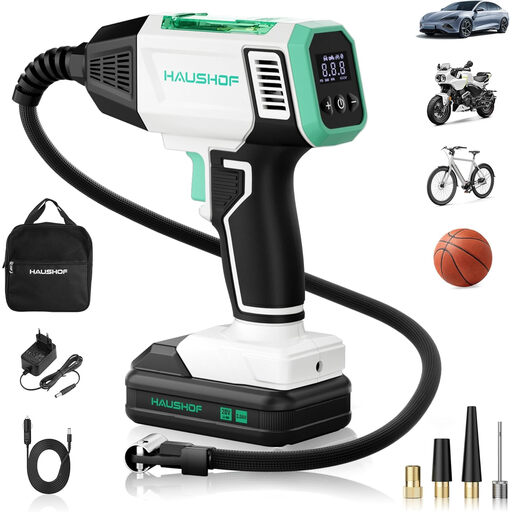
Why it's a good fit: Ideal for drivers looking for a reliable emergency solution without a large investment. The dual power supply option offers maximum flexibility for occasional pressure checks or breakdowns.
It bypasses the dead battery trap with the included 4-metre 12V cable. If the 2000 mAh battery isn't enough, operation can continue directly from the car's 12V socket.
Dual power supply (battery and 12V cable), 4 preset modes, and a digital display with auto-shutoff.
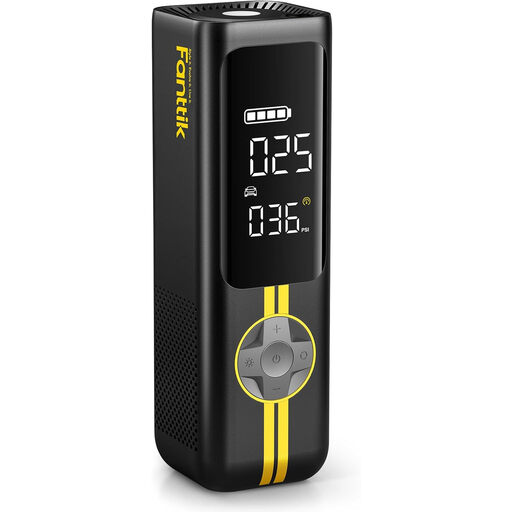
Why it's a good fit: For commuters and drivers who value speed and reliability. Perfect for regular pressure checks on multiple vehicles or for quick top-ups on the go.
Directly addresses the pitfalls of slow inflation and overheating. According to the manufacturer, it inflates a mid-size car tyre in about 56 seconds (28-33 PSI) and can run continuously for up to 40 minutes thanks to its cooling system.
High inflation speed, long continuous runtime, and precise pressure setting with auto-shutoff.

Why it's a good fit: The Swiss Army knife of air compressors. Perfect for campers, cyclists, and anyone who needs a versatile device for tyres, balls, and charging mobile devices.
It eliminates the worry of a weak battery with its large 7500 mAh capacity. The high airflow rate of 35 L/min also ensures swift inflation and prevents long waits.
Very large battery capacity, functions as a power bank, high airflow volume, and a large, easy-to-read LED display.
We have compiled a complete, up-to-date list of products that fully meet these strict selection criteria and safety standards.
1. Can a cordless compressor inflate a completely flat car tyre? Yes, most high-performance models can. However, it's important to know that this consumes a significant amount of energy and may use up most or all of the battery charge on an average device. The process also takes considerably longer than simply topping up a few PSI. For such cases, a model with a large battery or a 12V connection option is recommended.
2. How long does a compressor's battery last with normal use? The battery life heavily depends on the capacity (mAh), tyre size, and target pressure. A compressor with a capacity of around 4000-6000 mAh can typically correct the pressure on all four tyres of a car multiple times (e.g., from 2.2 to 2.5 bar). Many manufacturers specify how many tyres can be inflated on a single charge, which provides a good benchmark.
3. Are the digital gauges on portable compressors accurate? For everyday use and topping up tyre pressure, the accuracy of most digital gauges is sufficient. Deviations are typically within ±0.1 bar (approx. ±1.5 PSI). However, for precise calibration, such as for use on a racetrack, checking the pressure with a separate, calibrated tyre pressure gauge is still advisable.