
Lieferung heute & morgen

Qualitätsgarantie

Willkommens-Angebote freischalten: KOSTENLOSE Lieferung | Bis zu 80 % RABATT | Kostenlose 30-Tage-JoyPlus-Testphase
App herunterladen
A flat tire never comes at a good time. Whether on your way to work, on a road trip, or during a bike tour, a reliable cordless air compressor can turn an unexpected breakdown into a minor inconvenience. However, the market is flooded with devices whose marketing promises often suggest more than the technology can deliver. Many buyers invest in a device that fails at the critical moment.
As your Joybuy Product Recommendation Officer, I'm here to help you separate the wheat from the chaff. Instead of falling for exaggerated marketing hype, we'll focus on the facts. This guide will show you the three most common pitfalls when buying a cordless air compressor and what technical aspects you really need to look for to make an informed decision.
Many devices look identical at first glance, but the differences are in the details. These three weaknesses most often lead to disappointment:
To avoid the pitfalls mentioned above, you should check three core parameters before buying. These determine whether an electric air pump for your car is truly useful in everyday life.
A car tire rarely needs more than 3.5 Bar (about 50 PSI). Therefore, the crucial factor is not the maximum pressure, but the airflow rate. This value indicates how many liters of air are pumped into the tire per minute.
The battery capacity, specified in milliampere-hours (mAh), is an important indicator. However, always consider it in relation to the device's performance.
A good cordless tire inflator should make the job easier, not harder.
Based on the objective criteria mentioned above, we have identified a few models that represent a smart choice for specific user groups.

Why it's a good fit: Ideal for drivers looking for a compact and straightforward emergency solution for the glove box. It covers the basic functions for occasional tire pressure corrections on cars and bikes without breaking the bank.
The device features a clear digital display with an auto-shutoff function, thus avoiding the pitfall of inaccurate gauges and the risk of over-inflation.
Very compact design (530 g) and an integrated LED light for use in the dark. The 2500 mAh battery is sufficient for occasional top-offs.

Why it's a good fit: Designed for users who value speed and endurance. Ideal for commuters or families with multiple vehicles who regularly check and quickly correct tire pressure.
This model combines a high max pressure (160 PSI) with a strong airflow rate of 35 L/min. It avoids the "pressure rating only" pitfall and actually delivers fast results. The large 7500 mAh battery avoids the pitfall of weak runtime.
High inflation speed (e.g., a car tire from 30 to 36 PSI in approx. 63 seconds, according to the manufacturer) and long battery life for multiple uses. Also serves as a power bank.
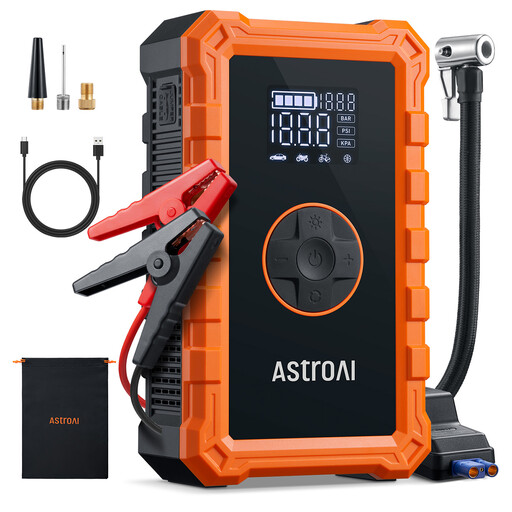
Why it's a good fit: The all-in-one solution for those who want to be prepared for any eventuality. It combines a powerful compressor with a full-fledged jump starter for gasoline and diesel engines.
This device isn't just a compressor but a multifunctional emergency tool. It avoids the pitfall of a 'single-purpose device' with a weak battery by providing a robust battery base for multiple demanding tasks (jump-starting, inflating, charging).
Combines a 1500A jump starter for engines up to 6.0L Gas/3.0L Diesel with a 150 PSI compressor (25 L/min). The large 2.4-inch display ensures clear readability of all functions.
We have compiled a complete, up-to-date list of products that fully meet these strict selection criteria and safety regulations.
1. How long does the battery of a cordless air compressor last? The runtime heavily depends on the battery capacity (mAh) and the motor's efficiency. A good device with 4000-6000 mAh can typically inflate 2-4 car tires completely or correct the pressure on over 8 tires. Models with smaller batteries are more suited for occasional top-offs or bicycle tires.
2. Can a small cordless compressor inflate a completely flat car tire? Yes, most high-quality models can. However, it's a matter of time and battery capacity. A powerful portable air compressor with a high airflow rate (e.g., 35 L/min) and a large battery (over 6000 mAh) can do this reliably. With cheaper devices, the battery might run out before reaching the target pressure, or the unit may need to pause to prevent overheating.
3. What should I look for in terms of pressure gauge accuracy? Look for a digital display with an accuracy of +/- 1 PSI (approx. 0.07 Bar). A crucial feature is the auto-shutoff function, which stops the inflation process once the preset pressure is reached. This ensures high accuracy and safety, as it eliminates the need for manual checking with a separate gauge.