
Lieferung heute & morgen

Qualitätsgarantie

Willkommens-Angebote freischalten: KOSTENLOSE Lieferung | Bis zu 80 % RABATT | Kostenlose 30-Tage-JoyPlus-Testphase
App herunterladen
Low tyre pressure can compromise driving safety and increase fuel consumption. You often only notice it just before setting off or in an inconvenient location. Driving to the nearest petrol station becomes unavoidable, but the air pressure gauges there are often broken, inaccurate, or require payment. A modern cordless air compressor offers an independent and reliable solution.
As your Joybuy Product Recommendation Officer, I've taken a close look at the market for portable air pumps. This article explains what you should look for when making your choice and presents a selection of devices that stand out for their functionality and ease of use. The goal is to provide you with a solid basis for making an informed decision.
The range of available devices is vast. To find the right cordless compressor for your needs, three criteria are particularly important.
The most important feature of a compressor is its performance. This is specified in bar or PSI (pounds per square inch).
Since this is a wireless device, the battery is its heart.
A good mini compressor should not only be powerful but also user-friendly.
Based on the criteria mentioned, we have compiled a selection of models suitable for various applications.

What Makes This Model Stand Out This compressor is designed for efficiency and mobility. With a power of up to 10.3 bar and an airflow rate of 35 L/min, it can increase the pressure of a standard car tyre (215/55 R17) from 28 to 33 PSI in about one minute, according to the manufacturer. Its low weight of under 500 grams makes it an unobtrusive companion in the glove compartment or backpack.
Benefits at a Glance
Who Is This Device For? Ideal for car and bike owners looking for a fast, compact, and straightforward solution for regular maintenance and emergencies.

What Makes This Model Stand Out The strength of this model lies in its endurance and flexibility. The 6000 mAh battery provides high capacity for multiple uses on a single charge. A special feature is the dual-power mode: the device can be operated wirelessly or, if the battery is empty, connected directly to the vehicle's 12V socket. Additionally, the compressor functions as a power bank for charging smartphones.
Benefits at a Glance
Who Is This Device For? Perfect for users who want maximum operational reliability and don't want to be without a dependable air source, even on longer trips or while camping. The power bank function is a practical bonus.
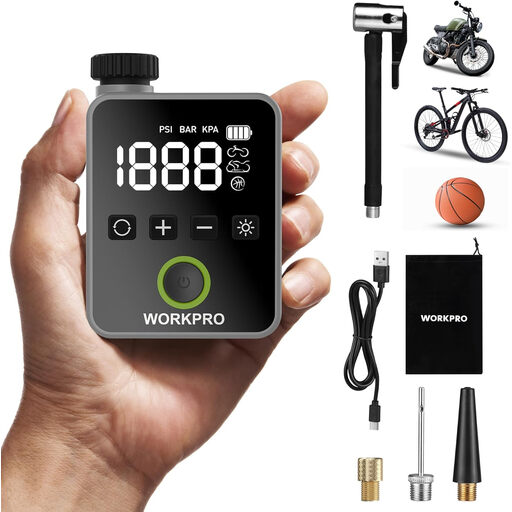
What Makes This Model Stand Out Weighing only 270 grams, this compressor sets a new standard for portability. It's so compact that it fits easily in a jacket pocket or a small bike bag. Despite its small size, it offers a pressure of up to 140 PSI (approx. 9.7 bar) and four different modes, including three presets and a manual mode.
Benefits at a Glance
Who Is This Device For? The top choice for cyclists, motorcyclists, and campers where every gram counts. Its multifunctionality makes it a useful tool for on the go. Note: Not suitable for truck tyres.
A cordless air compressor is a versatile tool. However, if you're looking for an even more compact solution specifically for sports and leisure items, a specialised pump might be the right choice.
Discover our selection of pumps for Mini Ball here.
The time depends on the compressor's performance (litres per minute), the tyre size, and the pressure difference to be covered. To increase the pressure of a standard car tyre by 0.2 to 0.3 bar, most models only take a few minutes. Fully inflating a flat tyre will take correspondingly longer.
This depends on the battery capacity (mAh) and the condition of the tyres. With a high-capacity device (e.g., 6000 mAh), it's often possible to correct the pressure in all four tyres. However, if the tyres need to be inflated significantly, an intermediate charge or connection to an external power source (if supported) may be necessary.
Bar and PSI (Pounds per Square Inch) are both units for measuring pressure. In Europe, bar is the more common unit, while PSI is primarily used in Anglo-American regions. Most digital compressors allow you to switch between the units. As a rule of thumb: 1 bar is approximately equal to 14.5 PSI.