
Lieferung heute & morgen

Qualitätsgarantie

Willkommens-Angebote freischalten: KOSTENLOSE Lieferung | Bis zu 80 % RABATT | Kostenlose 30-Tage-JoyPlus-Testphase
App herunterladen
A sudden loss of tyre pressure is more than just an annoyance—it can compromise driving safety and disrupt your travel plans. A cordless air compressor promises a quick and straightforward solution, whether you're on the roadside or in your own garage. However, the market is flooded with devices whose advertising claims often promise more than their technology can deliver. As your Joybuy Product Recommendation Officer, I'm here to help you separate the wheat from the chaff and make an informed decision.
Many buyers invest in a portable air compressor only to find it fails at the critical moment. To help you avoid such a bad buy, we'll highlight the three most common pitfalls you should be aware of.
To avoid falling into these traps, you should check three core technical specifications before buying. These will determine if an electric tyre inflator is suitable for your intended use case.
These two values are often confused, but they are crucial for different tasks.
The mobility of a cordless compressor lives and dies by its power source.
Modern devices are often more than just an electric air pump for your car.
Based on the criteria above, we have identified a few models that represent a considered choice for specific user groups.

Why this model is a good fit: Ideal for drivers who want to keep a reliable emergency solution in their car without worrying about a battery's charge level. The device is powered directly from the vehicle's 12V socket and is easy to store thanks to its compact design.
The direct 12V connection completely eliminates the problem of battery runtime and self-discharge. The device is always ready for use as long as the car battery is working.
Focuses on the core function of inflation without complex electronics. The mechanical design is engineered for durability and simple operation.
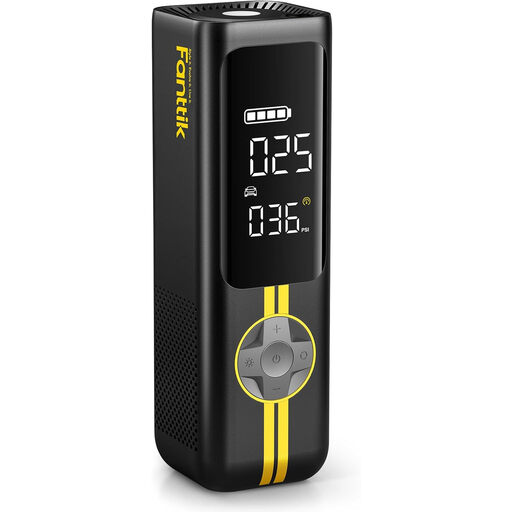
Why this model is a good fit: For users who regularly check the pressure on multiple vehicles (car, motorcycle, bicycle) and value speed, precision, and multi-functionality. The combination of a powerful battery and high airflow rate makes it a high-performance all-rounder.
Addresses the issues of overheating and performance. According to the manufacturer, a cooling system allows for a continuous runtime of up to 40 minutes, enabling the inflation of multiple tyres without a forced cooldown.
Offers preset modes for various applications and an automatic shut-off. The additional power bank function and LED light increase its practical utility in daily use and emergency situations.
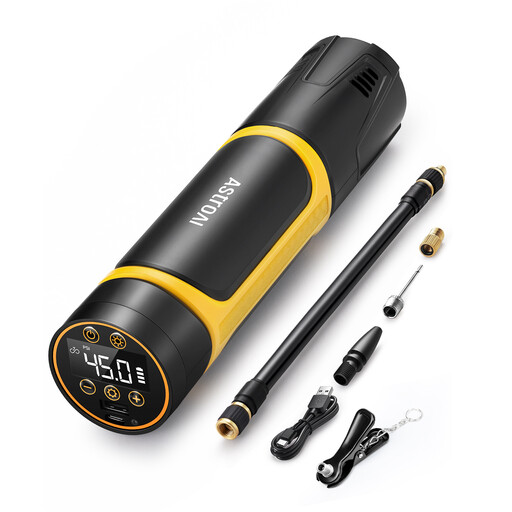
Why this model is a good fit: This electric bike pump is tailored to the needs of two-wheeler riders. It's compact enough for a backpack or pannier and comes with adapters for Presta and Schrader valves, making it universally compatible with almost all types of bicycles and motorcycles.
Special modes for bicycles and motorcycles ensure that the preset pressure values and performance are optimised for these applications. This avoids the problem of a device designed for car tyres working imprecisely on bike tyres.
The cordless design and compact dimensions offer maximum portability on the go. An integrated storage compartment for accessories ensures that important adapters don't get lost.
We have compiled a complete, up-to-date list of products that fully meet these strict selection criteria and relevant safety standards.
Most modern cordless compressors offer sufficient accuracy for general use, often with a deviation of ±0.1 bar (approx. ±1.5 PSI). The automatic shut-off function relies on this sensor. For a precise measurement, however, it is still advisable to occasionally check the pressure with a separate, calibrated gauge.
Battery life depends heavily on the model, battery capacity (specified in mAh), and usage. A device with a capacity between 6000 and 7500 mAh can typically inflate several car tyres (e.g., from 2.0 to 2.5 bar) on a single charge. Pay attention to the manufacturer's specifications for continuous runtime, as this is a good indicator of performance.
Generally, no. Portable cordless compressors are designed for use with cars, motorcycles, bicycles, and smaller inflatables. Their maximum pressure and airflow rate are insufficient for the large, heavy-duty tyres of trucks or RVs. These vehicles require specialised, more powerful compressors.