
Lieferung heute & morgen

Qualitätsgarantie

Willkommens-Angebote freischalten: KOSTENLOSE Lieferung | Bis zu 80 % RABATT | Kostenlose 30-Tage-JoyPlus-Testphase
App herunterladen
A flat tire on your way to work or a deflated air mattress while camping—these situations are more than just annoying. A cordless air compressor promises a quick and easy fix, no matter where the nearest gas station is. But the market is flooded with devices making bold promises. Many buyers soon discover that their new helper fails them in the crucial moment.
As your Joybuy Product Recommendation Officer, I'm here to help you separate the wheat from the chaff. Instead of falling for marketing hype, we'll focus on the facts. In this guide, I'll show you the three most common pitfalls when buying a cordless compressor and what you need to look for to make an informed decision.
Before you invest in a new mini compressor, you should know the typical weaknesses that often only become apparent after the purchase.
To avoid a bad purchase, you should focus on the technical specs that make a difference in everyday use.
The battery capacity, measured in milliampere-hours (mAh), determines how long you can use the device without recharging. For occasionally inflating bicycle tires or balls, a smaller battery may suffice. However, if you're looking for a reliable car tire inflator for emergencies, you should consider models with 4000 mAh or more.
A dual power supply is a crucial advantage. Devices that can be operated both cordlessly and via a 12-volt cable in the car offer maximum flexibility and security. This way, you're always ready to go, even with a dead battery.
As mentioned earlier, the air delivery rate (L/min) is more important than the maximum pressure alone.
Modern cordless compressors offer more than just hot air. Look for the following features that significantly simplify their use:
Based on the criteria above, we have identified a few models that represent a smart choice for specific user groups.
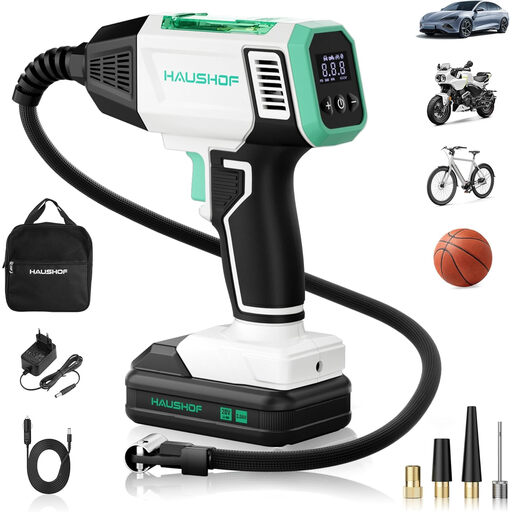
Why This Fits Their Persona: Ideal for drivers who need a reliable device for regular tire pressure checks and emergencies. The combination of battery and corded operation offers maximum security.
Avoids the "dead battery" trap with its additional 4-meter 12V power cable. This ensures functionality is always guaranteed, even when the battery is drained.
22 L/min air delivery rate for quickly inflating car tires. Four preset modes plus a manual mode for easy operation.
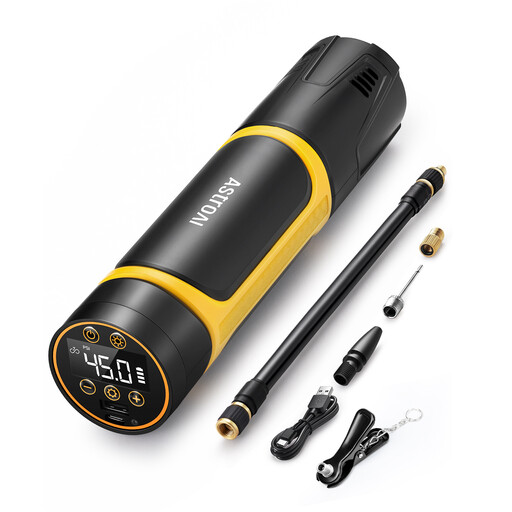
Why This Fits Their Persona: Perfect for cyclists and campers who need a lightweight and compact portable air pump. The design and included adapters are tailored for mobile use.
Addresses the issue of incompatible connections with included Presta and Schrader adapters. The precise pressure setting is ideal for sensitive, high-pressure bicycle tires.
Compact design with integrated accessory storage. The 3x1500mAh battery provides solid runtime for on-the-go use and can be charged via USB-C.
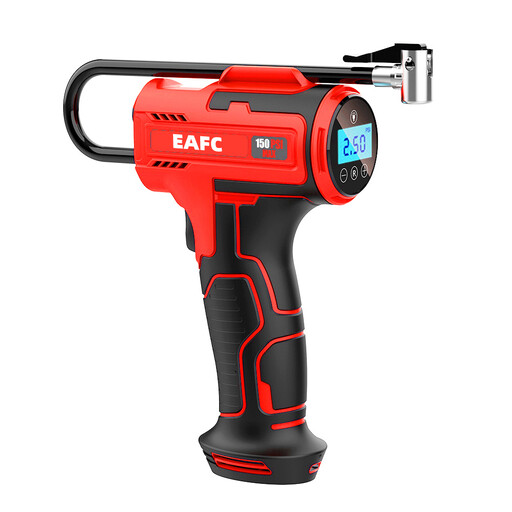
Why This Fits Their Persona: A solid choice for users looking for a versatile device for cars, bikes, and balls without breaking the bank. It offers all the essential functions in one package.
Offers a good battery capacity for this price range with 4000mAh (2x2000mAh), thus avoiding the problem of a quickly depleted device. The digital display with auto-stop prevents inaccurate inflation.
Universally applicable for cars, motorcycles, bicycles, and balls. The integrated LED light and digital display are practical features not always standard in this category.
We have compiled a complete, up-to-date list of products that fully meet these strict selection criteria and safety standards.
The runtime heavily depends on the battery capacity (mAh) and usage. A model with 4000 to 6000 mAh can typically top off several car tires or inflate one tire from flat. The actual performance is also affected by the ambient temperature and the required pressure. For maximum reliability, a device that can also be powered via a 12V connection in the car is recommended.
Yes, most modern cordless compressors with an air delivery rate of over 20 L/min are capable of this. However, note that this process can take several minutes depending on the tire size and may consume a large portion of the battery capacity. For such scenarios, a model with a 12V cable option is the safer choice as it ensures a constant power supply.
Accuracy can vary depending on the quality of the device. Models from established brands typically have a deviation of only 0.1-0.2 Bar (approx. 1-2 PSI). The auto-stop function relies on the accuracy of this sensor. It is good practice to check the pressure with a separate, calibrated tire pressure gauge after the first use to verify your device's accuracy.