
Lieferung heute & morgen

Qualitätsgarantie

Willkommens-Angebote freischalten: KOSTENLOSE Lieferung | Bis zu 80 % RABATT | Kostenlose 30-Tage-JoyPlus-Testphase
App herunterladen
Correct tire pressure is crucial for driving safety, fuel efficiency, and the lifespan of your tires. A modern cordless air compressor offers the freedom to check and adjust pressure anytime, anywhere—without being dependent on the next petrol station. But the market is flooded with devices making grandiose promises. As your Joybuy Product Recommendation Officer, I'll help you separate the wheat from the chaff and navigate the typical pitfalls of purchasing one.
Many buyers are disappointed after a short time because their new device fails when they need it most. This is often due to exaggerated marketing claims that don't match reality. Pay special attention to these three points:
To avoid a bad purchase, you should focus on objective, technical parameters. These three factors determine the real-world performance of any cordless air compressor.
The battery capacity, specified in milliampere-hours (mAh), is the foundation. For regular checks and top-ups of car tires, a device should have at least 4000 mAh. Models with 6000 mAh or more offer reserves to fill a nearly flat tire or inflate several bicycles. Also, look for a modern USB-C port. It allows for faster charging, and you can use the same cable as your smartphone. Some devices even double as a power bank—a useful extra for on the go.
The maximum pressure, often stated as 150 PSI (approx. 10.3 Bar), is more than sufficient for most applications (car, motorcycle, bicycle). Far more important is the air flow rate, measured in litres per minute (L/min). It indicates how quickly the compressor pumps air.
A good cordless tire inflator should do more than just pump. An automatic shut-off function is essential: you set the target pressure, and the pump stops precisely when this value is reached. Preset modes for cars, motorcycles, bicycles, and balls further simplify operation. An easy-to-read digital display that shows the current and target pressure simultaneously, as well as an integrated LED light for breakdowns at night, complete a solid overall package.
Based on the criteria mentioned, we have identified a few models that represent a smart choice for different user groups.
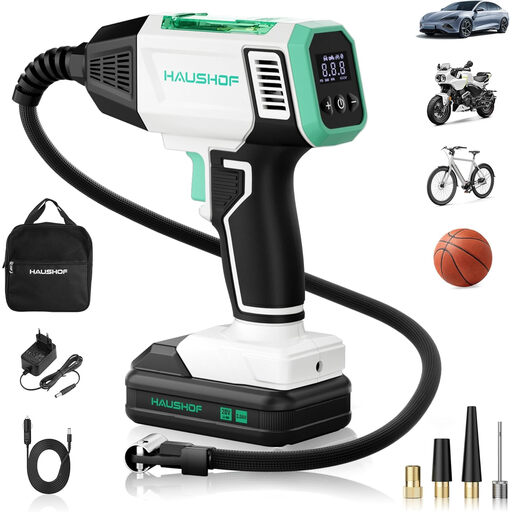
Why This Fits Their Persona: Ideal for users seeking a reliable, basic solution for occasional pressure checks and emergencies without a large budget. The dual power supply offers maximum flexibility.
Bypasses the weak battery trap by offering an additional option to run on the car's 12V electrical system. This ensures it's ready for use even with a dead battery.
Hybrid Power: Use as a cordless device or wired via the 4m long 12V plug. Compact and Lightweight: Easy to store at just 0.8 kg.
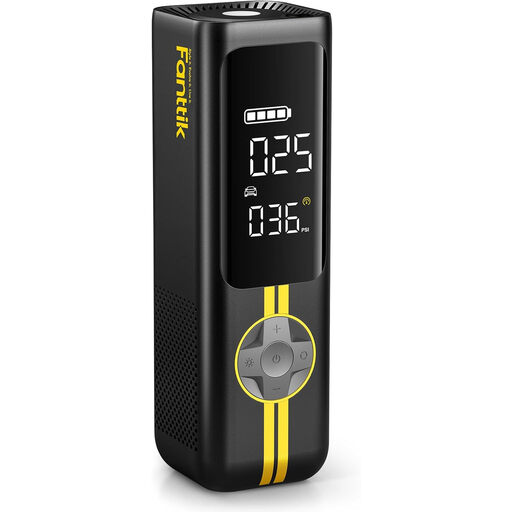
Why This Fits Their Persona: For drivers who value speed, performance, and premium build quality. Perfect for regular maintenance of cars, motorcycles, and bicycles without long waits.
Directly addresses the slow inflation trap. According to the manufacturer, it inflates a medium-sized car tire very quickly and has a cooling system for continuous operation.
High Inflation Speed: Saves valuable time when adjusting tire pressure. Long Battery Life: Up to 40 minutes of continuous operation according to the manufacturer, sufficient for multiple tires.

Why This Fits Their Persona: For anyone who wants a multifunctional safety tool in their car. This device is not just an **electric car air pump**, but also a potential lifesaver in an emergency.
This device goes beyond basic functionality and offers real added value that transcends mere convenience. It's a well-designed combination tool, not just a gadget.
Integrated Emergency Tools: Includes a window breaker and a seatbelt cutter for worst-case scenarios. Multifunctional: Serves as a compressor, LED flashlight (with SOS mode), and power bank.
We have compiled a complete, up-to-date list of products that fully meet these strict selection criteria and UK/EU safety regulations.
The battery life heavily depends on the capacity (mAh), the motor's efficiency, and the application. A good device with 4000-6000 mAh can increase the pressure of four car tires by 0.2-0.3 Bar several times. However, fully inflating a flat tire consumes significantly more energy and can completely drain the battery.
Yes, more powerful models with a high air flow rate (over 25 L/min) and a durable battery can do this. However, it will take several minutes per tire (often 8-10 minutes) and will heavily tax the battery. For such cases, a model with an optional 12V cable connection is a safe bet.
Accuracy on brand-name products has improved significantly in recent years. Many manufacturers specify a precision of ±1 PSI (approx. ±0.07 Bar), which is sufficient for personal use. Nevertheless, it's good practice to compare the pressure with a separate, calibrated tire pressure gauge after the first use to verify your device's accuracy.