
Lieferung heute & morgen

Qualitätsgarantie

Willkommens-Angebote freischalten: KOSTENLOSE Lieferung | Bis zu 80 % RABATT | Kostenlose 30-Tage-JoyPlus-Testphase
App herunterladen
A sudden loss of tire pressure never comes at a good time. Whether you're on your way to work, out for a bike ride, or about to start a long road trip, the correct tire pressure is crucial for both safety and efficiency. A cordless air pump promises a quick and hassle-free solution, right on the spot and without a detour to the nearest gas station.
However, the market is flooded with devices whose performance claims often suggest more than the technology can deliver. Before you make a purchase, it's essential to understand the common pitfalls that often only become apparent after you've bought the product.
This guide will help you navigate these issues and find a device that works reliably when you need it.
To avoid falling for empty marketing promises, you should focus on three verifiable technical specifications. These determine whether an electric air pump for your car or bicycle is a worthwhile investment.
The maximum pressure, often listed in Bar or PSI, is only half the story. It indicates the theoretical pressure the device can reach. For a standard car tire (approx. 2.5 Bar / 36 PSI) or a bicycle tire (up to 7 Bar / 100 PSI), most devices are sufficient on paper.
Far more important is the airflow rate, measured in liters per minute (L/min). This value describes how quickly the device pumps air into the tire. A mini compressor with a high airflow rate (e.g., over 25 L/min) will inflate a tire significantly faster, conserving the battery and protecting the device's motor. A device with a low airflow rate will take considerably longer for the same task and is prone to overheating.
The battery capacity, specified in milliampere-hours (mAh), determines the device's endurance. A model with low capacity (e.g., under 4000 mAh) might only manage to top off one or two car tires before needing a recharge. For larger vehicles or inflating multiple flat tires, capacities of 6000 mAh or more provide a more solid foundation.
Look for these features:
A reliable electric tire inflator should be precise and easy to use. A crucial feature here is the auto-shutoff function: you set the target pressure, and the pump automatically turns off once it's reached. This prevents dangerous over- or under-inflation and makes operation incredibly convenient.
Other useful features include:
Based on these objective criteria, we have identified several models that offer a suitable solution for different user profiles.
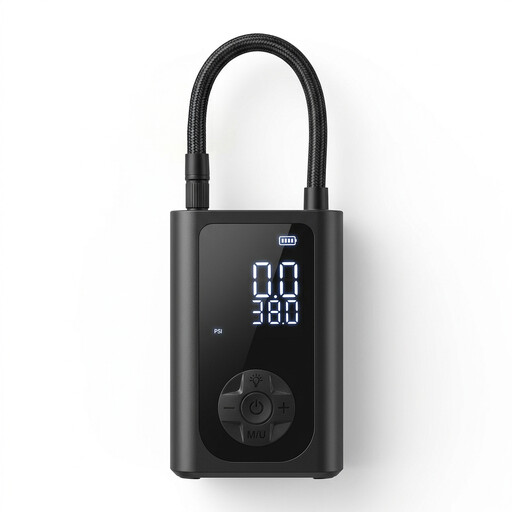
Why This Fits Their Persona: Ideal for drivers looking for a compact and reliable emergency solution to keep in the glove box. The device is designed for occasional tire pressure top-offs or inflating bike tires and balls, without being overloaded with unnecessary features.
With a clearly specified battery capacity of 4000 mAh and an airflow rate of 26 L/min, it provides concrete, verifiable performance data instead of vague promises. The stated precision of ±0.01 Kg/cm? addresses the concern of inaccurate measurements.
Combines solid baseline performance with useful extras like a power bank and an LED light with an SOS mode. Five preset modes simplify operation.
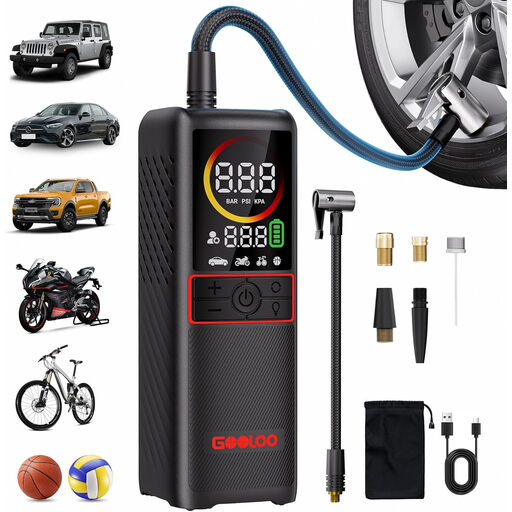
Why This Fits Their Persona: Suitable for individuals who regularly check tire pressure on multiple vehicles (car, motorcycle, e-bike) and appreciate a powerful, multifunctional device. Its high battery capacity also makes it a great companion for camping trips or as a mobile charging station.
The high battery capacity of 7500 mAh and an airflow rate of 35 L/min directly counter the most common weaknesses (weak battery, slow inflation). The auto-shutoff function and large LED display address the problem of inaccurate measurements.
Offers excellent endurance with up to 45 minutes of continuous operation, according to the manufacturer. The combination of high performance and a large battery makes it a versatile tool that also serves as a power bank.
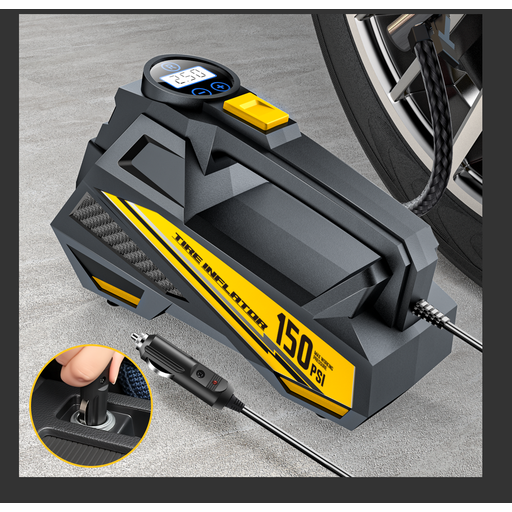
Why This Fits Their Persona: Perfect for safety-conscious drivers who want an absolutely dependable solution for a roadside emergency. Since the device is powered directly by the car battery, it's always ready for action—regardless of an internal battery's charge level.
This model completely bypasses the most common point of failure—the battery. As a corded portable 12V compressor, the worry of a dead battery in an emergency is irrelevant. Power is guaranteed as long as the vehicle is operational.
Maximum operational reliability thanks to the direct connection to the 12V power outlet. The digital display with an auto-shutoff function ensures precise and simple handling.
We've compiled a complete, up-to-date list of products that fully meet these strict selection criteria and safety standards.
1. How accurate are the digital pressure gauges on cordless air pumps? Accuracy can vary by model. Devices with an auto-shutoff function generally offer high reliability, as the sensor is directly linked to the control electronics. However, it's good practice to occasionally double-check the pressure with a separate, calibrated gauge to be certain.
2. Can a cordless compressor inflate a completely flat car tire? Yes, powerful models can. The key factors are a high airflow rate (L/min) and sufficient battery capacity. Fully inflating a flat tire takes longer and consumes a significant portion of the battery's charge. Some manufacturers, like Porbi, explicitly state how many empty tires can be inflated on a full charge.
3. What is the difference between a cordless air pump and a 12V compressor? The main difference is the power source. A cordless air pump offers maximum portability and can be used anywhere, but it is limited by its battery life. A 12V compressor is powered by the car's cigarette lighter socket, offering unlimited runtime (with the engine running), but its use is tied to the vehicle.