
Lieferung heute & morgen

Qualitätsgarantie

Willkommens-Angebote freischalten: KOSTENLOSE Lieferung | Bis zu 80 % RABATT | Kostenlose 30-Tage-JoyPlus-Testphase
App herunterladen
A sudden loss of tyre pressure on your way to work or a flat bicycle tyre before a planned tour—these situations are more than just an inconvenience. A reliable cordless air pump offers independence from the nearest petrol station and provides a quick solution. However, the market is flooded with devices whose performance claims often don't hold up in practice.
As your Joybuy Product Recommendation Officer, I'm here to help you sort the good from the bad. In this guide, I'll highlight the most common pitfalls and explain the technical features that truly matter, enabling you to make a well-informed decision.
Many devices advertise impressive numbers, but the devil is in the details. Pay attention to these three points to avoid disappointment:
To make the right choice, you should focus on objective performance data. The following three criteria are crucial for the functionality and longevity of a cordless air pump.
Battery capacity, measured in milliampere-hours (mAh), indicates how much energy can be stored. For occasionally topping up bicycle or motorcycle tyres, models with around 2000 mAh are sufficient. For car drivers who want to be prepared for a completely flat tyre, capacities of 4000 mAh or more are recommended.
A key advantage is found in models with a dual power supply. These can be operated not only cordlessly but also via the 12-volt socket (cigarette lighter) in your car when needed. This ensures unlimited runtime in emergency situations, even if the battery is dead.
The maximum pressure is often specified in PSI (Pounds per Square Inch) or bar. A value of 150 PSI (approx. 10.3 bar) is a common industry standard and more than sufficient for all typical applications, from car and road bike tyres to sports balls.
However, more important for practical use is the airflow rate, measured in litres per minute (L/min). It determines how quickly a tyre is inflated. A good cordless compressor should have an airflow rate of at least 20 L/min to increase the pressure in an average car tyre by a few tenths of a bar in just a few minutes.
Modern devices offer useful features that enhance comfort and safety. An auto-stop function is particularly valuable here: you set the target pressure, and the pump automatically switches off once it's reached. This reliably prevents over-inflation.
Preset modes for cars, motorcycles, bicycles, and balls further simplify operation. Also, look for a package that includes various valve adapters (e.g., for Presta valves on road bikes or needle valves for balls) to ensure the cordless air pump can be used versatilely. An integrated LED light is a handy extra for use in the dark.
Based on the criteria mentioned, we have curated a selection of models for typical use cases.
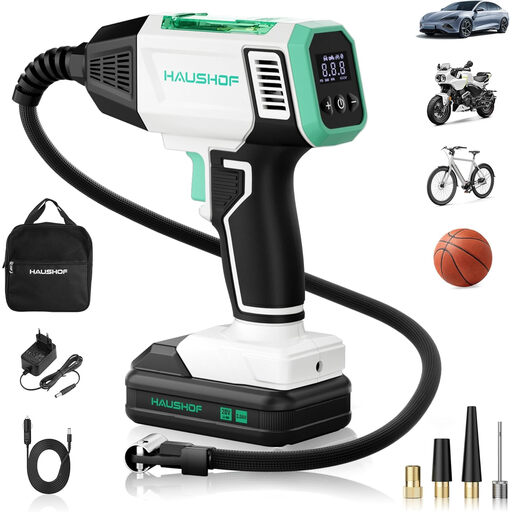
Why This Fits Their Persona: Ideal for drivers looking for a reliable device to keep in the glove compartment. It's perfect for regular pressure checks and provides peace of mind in emergencies, without needing to be plugged in.
The dual power supply (2000 mAh battery and a 4-metre 12V cable) bypasses the problem of a dead battery at a critical moment. You're not solely reliant on the battery charge.
Four preset modes plus a manual mode offer flexibility. The 22 L/min airflow rate ensures swift inflation.
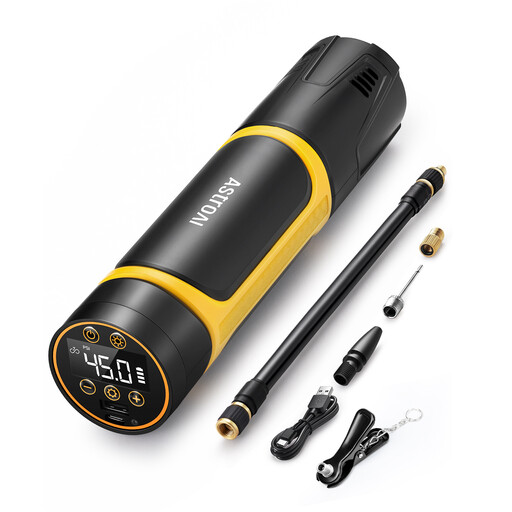
Why This Fits Their Persona: Perfect for cyclists and campers who need a compact yet powerful solution for on-the-go use. It fits easily into a backpack or pannier.
This model is specifically designed for different valve types (Presta and Schrader) and features dedicated modes, ensuring precise, material-safe inflation and making inaccurate universal adapters redundant.
The 4500 mAh battery (3x1500mAh) offers solid capacity for multiple uses. The USB-C charging port and USB-A output (power bank function) add to its versatility.
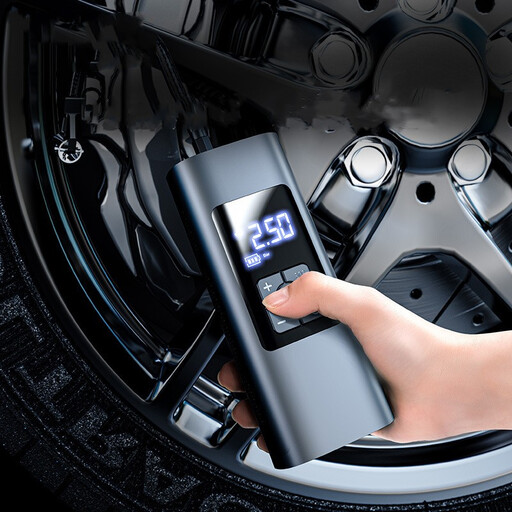
Why This Fits Their Persona: For users who inflate tyres more frequently (e.g., families with multiple bikes and cars) or need to service larger tyres (SUV, campervan) and require maximum battery performance.
With a 6000 mAh capacity, this model directly addresses the weak point of many competitors: poor endurance. It offers enough reserve power to top up multiple tyres or even fully inflate a flat one from scratch.
The combination of a large battery, dual power supply, and power bank function makes it an extremely versatile and fail-safe tool for demanding tasks.
We have compiled a complete, real-time list of products that fully satisfy these strict selection criteria and UK safety regulations.
Battery life depends heavily on the capacity (mAh), the object being inflated, and the target pressure. A pump with 4000-6000 mAh can typically top up 4-8 car tyres by 0.5 bar. However, inflating a completely flat tyre can consume most or all of the battery charge of a smaller model.
Yes, powerful models with a high airflow rate and sufficient battery capacity (over 4000 mAh recommended) are capable of this. However, it will take some time and put a significant strain on the battery. Models with an additional 12-volt connection have a clear advantage here, as they ensure an uninterrupted power supply.
Modern digital displays are generally accurate enough for everyday use, with typical deviations of +/- 0.1 bar. For safety-critical applications like vehicle tyres, it is still good practice to occasionally double-check the pressure with a separate, calibrated tyre pressure gauge. The auto-stop function operates based on the internal sensor and is a reliable aid.