
Lieferung heute & morgen

Qualitätsgarantie

Willkommens-Angebote freischalten: KOSTENLOSE Lieferung | Bis zu 80 % RABATT | Kostenlose 30-Tage-JoyPlus-Testphase
App herunterladen
A cordless car polisher makes it easier to care for your vehicle without an extension lead. It can help you apply wax, restore shine and carry out minor paint corrections. However, cordless polishers vary considerably in their drive type, backing plate, speed range and accessories.
If you focus solely on a high rotation speed or a large battery capacity, you could end up with a tool that isn’t right for the job. The points below will help you make sense of marketing claims and choose a suitable car care polisher.
A higher speed won’t automatically make polishing quicker. When waxing and polishing a car, low to medium speeds are usually easier to control. Too much pressure or heat, or an unsuitable polishing pad, can put unnecessary strain on the paintwork.
A sensible, adjustable speed range matters more than the maximum speed. Useful features include several speed settings, a soft start and a display showing the speed or battery level.
12 V and 20 V aren’t directly comparable as quality levels. Amp-hours, motor efficiency, load and whether you can swap the battery all affect actual runtime. For longer jobs, a second battery may be more useful than a higher maximum voltage.
Also check whether the charger and battery are included, and whether replacement batteries are available.
A 125-mm backing plate is handy for larger painted surfaces. For door handles, headlights, wheel rims or tight bodywork gaps, however, a mini polisher with a 25, 50 or 75 mm backing plate is a better choice.
Accessories are often overvalued too: a large number of sponges and cloths won’t be much use if there’s no clear guidance on which to use for polish, wax, finishing or sanding.
A random orbital polisher moves the backing plate in an orbit as well as rotating it. This prevents pressure from being concentrated on the same spot continuously. This type of drive is often easy to handle for beginners, light paint care and applying wax evenly.
A rotary polisher spins the backing plate around a fixed axis. It’s suitable for targeted work, but requires controlled handling and an appropriate speed. Some mini polishers let you switch between rotary and random orbital modes. This gives you more options, but also makes choosing and learning to use the tool more involved.
Don’t compare only the maximum speed. Also consider:
Specifications don’t replace the manufacturer’s instructions. Before restoring the paintwork, test the polish on an inconspicuous area first. Not every cordless polisher can remove visible scratches; deeper damage may reach the primer.
A cordless polisher with a replaceable battery is more practical if you’re working on several vehicles or larger surfaces. For short detailing jobs, a lightweight tool with a smaller battery may be enough.
Before you buy, check:
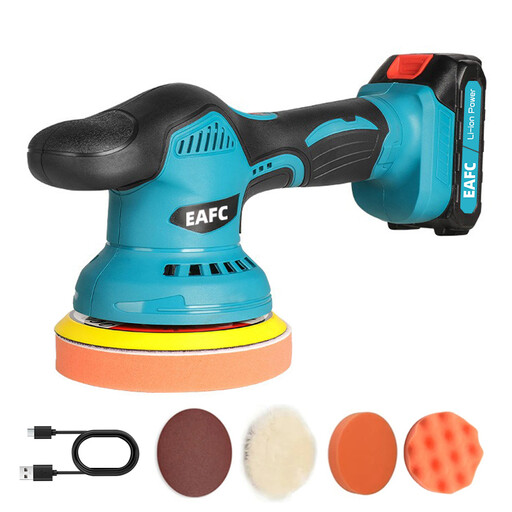
Why this product suits this profile: It has a 125-mm backing plate, eight speed settings and a stated range of 2.800 to 5.500 U/min, making it suitable for traditional polishing jobs on larger painted surfaces.
The eight settings help you avoid focusing solely on maximum speed. The included accessories make it easier to get started, but you should still test the pad on the vehicle first.
125-mm backing plate, eight speed settings and a stated weight of 1,13 kg.
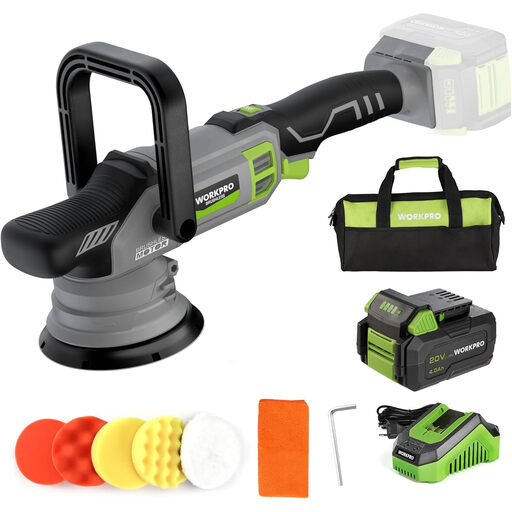
Why this product suits this profile: For users looking to work on larger areas, this tool combines a 20-V, 4,0-Ah battery with seven settings and a stated speed range of 2.000 to 5.000 U/min.
The dual-action movement and seven adjustable settings offer more choice than a tool with just one fixed speed. Actual runtime depends on the load, pressure and size of the painted area.
Brushless motor, according to the product details, 4,0-Ah battery, seven speed settings and a storage bag.
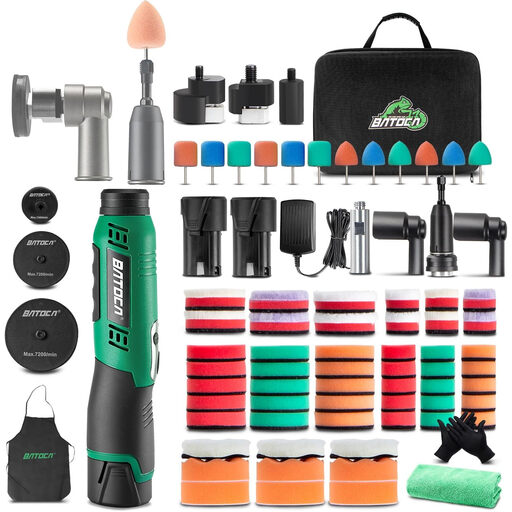
Why this product suits this profile: This kit is designed for detailing headlights, wheels, badges, mirrors and tight areas of bodywork. It offers rotary mode and two random orbital options.
The interchangeable 25, 50 and 75-mm backing plates mean you don’t have to use a large plate for every job. According to the product details, two 12-V batteries allow you to swap between them as you work.
RO and DA system, 3- and 12-mm orbital throws, plus six settings across the stated speed ranges.
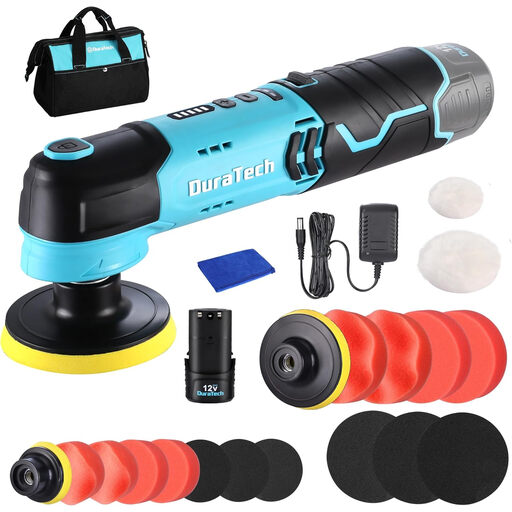
Why this product suits this profile: With 50- and 80-mm backing plates and a stated weight of 810 g, this mini polisher is well suited to smaller surfaces and tight spots.
The different plate sizes mean you’re less likely to have to tackle detailed areas with an oversized pad. According to the product details, the five settings range from 600 to 3.000 U/min.
50- and 80-mm pads, five speed settings, 2,0-Ah battery and accessories with a storage bag.
We’ve put together a complete, regularly updated list of products that meet these strict selection criteria and fully comply with the safety regulations in force in the EU.
Before polishing, wash the vehicle thoroughly and dry it completely. Remove sand and loose particles, as these can leave extra marks beneath the pad. Divide the surface into small sections and start on the lowest suitable setting.
Other important points:
Runtime depends on battery capacity, speed, pressure, pad and surface. Manufacturer figures are sometimes based on no-load conditions, so they don’t directly reflect how long you can polish for in practice. For longer jobs, two interchangeable batteries or a compatible replacement battery system can be useful.
A random orbital or dual-action machine with several speed settings is usually easier to control than a rotary polisher. 125-mm backing plates are common for larger surfaces. If you mainly want to work on headlights, wheels or badges, choose a mini polisher with smaller pads.
Polishing won’t remove every scratch. Depending on its depth and the condition of the paintwork, it may reduce superficial marks in the clear coat. If the damage reaches deeper layers of paint, don’t try to compensate by polishing harder. Always test a small area and follow the manufacturer’s instructions before making any corrections.