
Lieferung heute & morgen

Qualitätsgarantie

Willkommens-Angebote freischalten: KOSTENLOSE Lieferung | Bis zu 80 % RABATT | Kostenlose 30-Tage-JoyPlus-Testphase
App herunterladen
A cordless car polisher lets you work without an extension lead and, depending on its design, can be used for paint correction, wheels, headlights or hard-to-reach areas of the bodywork. However, a high speed, a wide range of accessories or a large battery capacity alone won’t guarantee that a car polisher is right for you.
Before you buy, there are three common pitfalls for car owners and DIY users to avoid:
A rotary polisher spins the plate around a fixed axis. This transfers power directly and is suitable for targeted work, but requires controlled handling. A dual-action polisher also moves the plate along an offset orbit, spreading the movement over a larger area.
For beginners, a dual-action system can be easier to control when caring for paintwork. If you want to work on specific small areas, a machine with switchable rotary and dual-action modes may be more useful. According to its product description, models such as the BATOCA S5 combine a rotary drive with 3-mm and 12-mm orbital throws.
Important: no polisher will automatically remove every scratch. Deep damage, paint defects through the full paint layer or rust should be assessed by a professional first. Whenever you’re working on paintwork, test on an inconspicuous area, use light pressure and keep the machine moving.
When waxing and polishing your car, variable speed is more important than the highest possible top speed. Lower settings are typically best for applying wax or sealant. Medium settings can be used for general polishing. Only use higher settings with a suitable pad and polish, and if you have enough experience.
Look for:
The speed ranges listed in product specifications aren’t directly comparable, as plate size, orbital throw, motor characteristics and load also play a part.
With a cordless car polisher, voltage isn’t the only thing that matters. Battery capacity in Ah, the number of batteries supplied, charging time and the availability of replacement batteries are all important. Two batteries can be more practical for longer jobs, as you can charge one while using the other.
Use these guidelines when choosing a plate size:
Also check whether the machine uses hook-and-loop or self-adhesive pads, and whether replacement sponges, microfibre discs, wool pads and suitable polishing accessory sets are available. Don’t use accessories intended for sanding, metal or wood on car paintwork without first checking they’re suitable for the material.
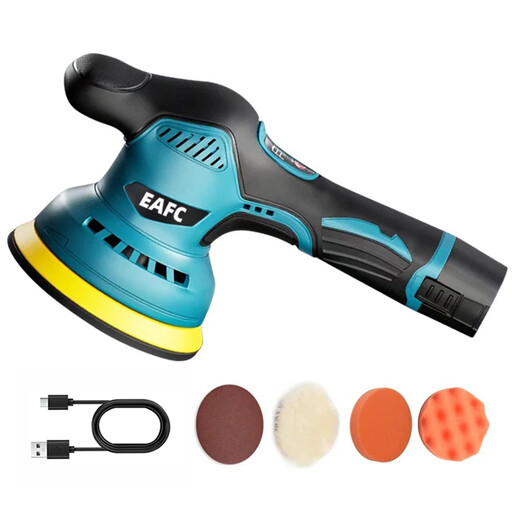
Why this product suits this user profile: This model has a 125-mm plate and eight adjustable settings between 2800 and 5500 U/min. It’s designed for larger painted surfaces and regular care.
The eight settings mean you aren’t limited to a single speed. The product specifications list a 0.9 cm orbital throw; even so, it’s best to start on a low setting.
125-mm backing plate, eight settings and replaceable 12-V lithium battery, according to the product description.
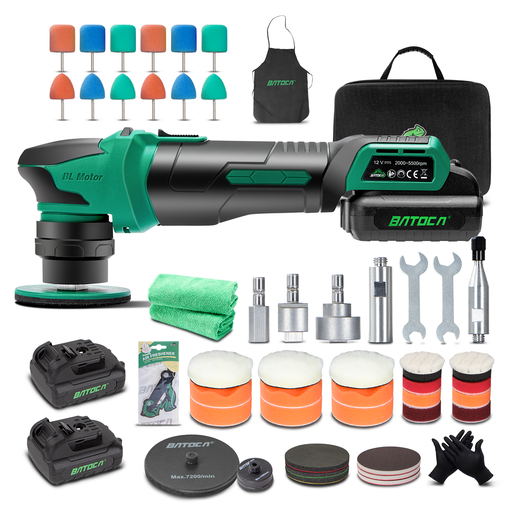
Why this product suits this user profile: The set combines rotary and dual-action functions, two 12-V batteries, each with a capacity of 2,5 Ah, and 25- and 75-mm backing plates. It’s a good choice if you want to work on different detailing areas.
The different drive modes and plate sizes mean you’re less reliant on a single working mode or an oversized pad.
Brushless motor according to the product specifications, two batteries and four speed settings from 2000 to 5500 U/min.
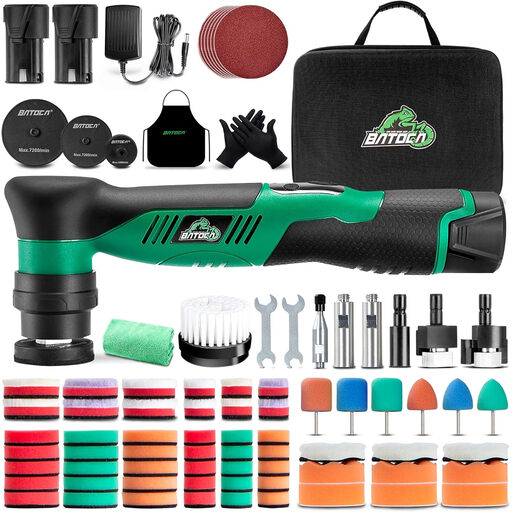
Why this product suits this user profile: This machine is designed for detailing headlights, wheels, badges and bodywork edges. It offers three working modes and 25-, 50- and 75-mm polishing plates.
Its compact design and interchangeable shafts are made for tight spaces. Two 12-V batteries reduce the risk of an unexpected interruption while you work.
Rotary mode plus 3- and 12-mm orbital throws; six settings from 2000 to 5500 U/min according to the product specifications.
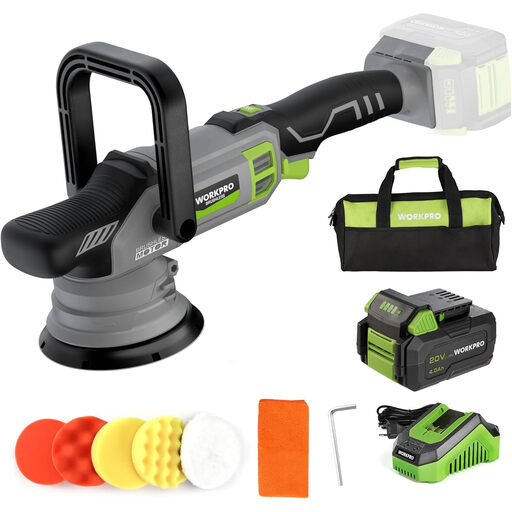
Why this product suits this user profile: This model is for users who want to work on floors, tiles or other larger surfaces as well as vehicles. Its 4,0-Ah battery is designed for longer periods of use.
Dual-action movement and seven settings between 2000 and 5000 U/min give you more flexibility than a machine without speed control.
Brushless motor according to the product description, 20-V system, 4,0-Ah battery and accessories including several sponges and a wool pad.
We’ve put together a complete, regularly updated list of products that meet these strict selection criteria and the safety regulations in force in the EU.
Before you start, make sure the vehicle and pad are clean and free from sand and coarse dirt. Use separate pads for different polishes and wash microfibre cloths regularly. It’s also helpful to:
A car detailing polisher is no substitute for a good understanding of paintwork. It’s best to take extra care with thin, weathered or previously repaired paint.
Run time depends on battery capacity, speed, pad, pressure and the material you’re working on. Manufacturers’ figures are sometimes measured with no load. For larger vehicles, two batteries or a replacement battery you can buy separately are more practical than a single low-capacity battery.
A dual-action polisher with several low speed settings and a soft start is often easier to control. For small areas, you’ll also need a suitably sized plate. Always start on an inconspicuous area and use light pressure.
In addition to the purchase price, you’ll need to budget for electricity, replacement batteries and polishing pads. The charger’s electricity consumption is usually only part of the running costs. What matters is whether batteries and accessories will remain available in the long term, and whether the plate size is compatible with the pads you use.