
Lieferung heute & morgen

Qualitätsgarantie

Willkommens-Angebote freischalten: KOSTENLOSE Lieferung | Bis zu 80 % RABATT | Kostenlose 30-Tage-JoyPlus-Testphase
App herunterladen
A cordless car polisher makes paintwork preparation easier without an awkward cable getting in the way. Depending on its design, it can be used on larger surfaces, headlights, alloy wheels, plastic parts and hard-to-reach areas. However, mini cordless polishers vary considerably in terms of drive system, speed, battery capacity and accessories.
If you focus solely on a high speed or a long list of accessories, you may end up buying a machine that does not suit your vehicle-care routine. The following criteria will help you assess technical specifications and avoid common buying mistakes.
Specifications such as 7,000 or 21,000 revolutions per minute may sound impressive. However, speed alone says little about the actual result. The drive system, backing plate, throw, power control and polishing pad used are also important.
A rotary polisher turns the backing plate directly around one axis. It is suitable for precise work but requires controlled handling. A dual-action polisher also moves the backing plate in an offset circular path. This distributes the movement differently across the paintwork. For beginners, this design can be easier to control when working evenly. However, it cannot replace the right polish or thorough preparation.
A 5 Ah battery has a higher nominal capacity than a 2 Ah battery. However, actual runtime also depends on speed, pressure, motor, temperature and breaks during use. Two batteries included in the box may be more practical than a single higher-capacity battery, as you can change batteries while preparing the vehicle.
You should therefore check:
Many sets include several sponges, wool pads, cloths and abrasives. What matters is whether the backing plate size is suitable for the intended application. A 125 mm backing plate covers larger areas, but is less manageable around door handles, wheel spokes or tight bumper corners. Sizes between 25 mm and 75 mm are often more practical for detail work.
The attachment system also matters: hook-and-loop and adhesive systems allow pads to be changed quickly, while specialised mounts or extensions can limit compatibility. Before buying, compare the included backing plates, shaft sizes and pads with the car-care accessories you plan to use.
For paintwork care across the entire vehicle, a dual-action movement is often designed to provide an even working pattern. A rotary drive can be used precisely for small repairs or spot areas, but requires particular care with pressure, speed and dwell time.
A dual system combines both types of movement. According to the product specifications, the BATOCA S4 features a rotary system as well as a 3 mm and 12 mm dual-action throw. Its speed can be adjusted across four settings between 2,000 and 5,500 rpm. This makes it possible to adapt the machine to different pads and stages of work, but it is no substitute for using the right polishing technique.
Step-based speed control makes it easier to work on sensitive surfaces. Lower speeds can be used, for example, to spread wax or sealant, while higher settings are intended for certain polishing tasks. The recommendations provided by the polish manufacturer and the vehicle-paint manufacturer must be taken into account.
A soft-start function reduces the risk of polish being flung across the surface when the machine is switched on. A memory function can be useful if you frequently switch between work areas. However, it should not be confused with automatic adjustment to the paintwork.
For vehicle preparation, the weight, grip position and vibration behaviour should suit the intended working time. Small machines are practical for hard-to-reach areas, while larger backing plates can cover surfaces more quickly. A backing plate that is too small for a large bonnet increases working time; one that is too large for a mirror housing makes control more difficult.
You should also look for:
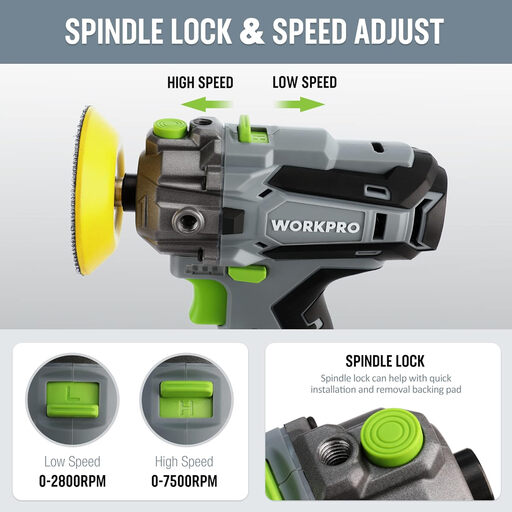
Why this product suits this profile: According to the product specifications, the compact 12 V machine weighs 0.88 kg including the battery and is designed for smaller surfaces and detail work. Two 2.0 Ah batteries and a stated charging time of one hour make planning easier.
The two speed ranges from 2,600 to 7,000 rpm make the speed easier to assess than a maximum figure alone. The package contents also specify particular pads and abrasives.
Compact design, two batteries, charging indicator and accessories for cars, furniture and metal.
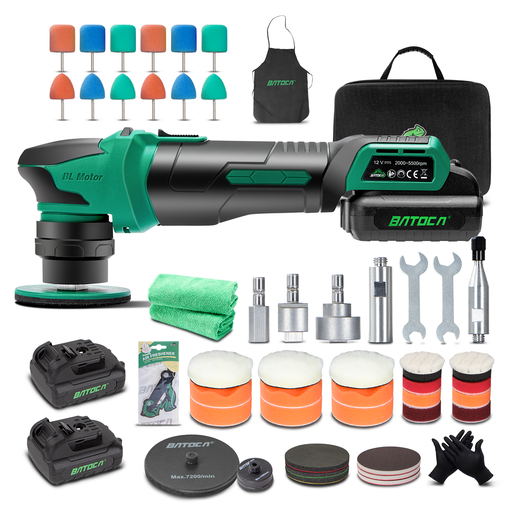
Why this product suits this profile: This cordless car polisher combines rotary and dual-action movement. Two 12 V, 2.5 Ah batteries, four speed settings and backing plate sizes of 25 mm and 75 mm cover a range of detail areas.
The product specifications state specific movement types, throws and speeds rather than providing only a general performance description. An extension shaft helps with work in tight spaces.
Brushless motor according to the product description, dual system, two batteries and several attachments for paintwork, plastic and glass.

Why this product suits this profile: A 125 mm backing plate can be useful for larger vehicles or recurring jobs. This model is supplied with two 5 Ah batteries, six speed settings and an LCD display showing speed and battery level.
The battery capacity is clearly specified. The display also makes it easier to monitor the machine while working, rather than estimating the remaining charge.
125 mm polishing plate, two 5 Ah batteries, LCD display and soft start according to the product specifications.
Before polishing your car, wash the vehicle thoroughly and dry it completely. Otherwise, sand, dust and metal particles may be moved around by the pad and cause additional marks. Always test the polish and pad on an inconspicuous area first.
Use light pressure and guide the cordless car polisher evenly across the surface. Do not hold the machine in one place for too long. Edges, contours and plastic parts require particular care. When working on headlights, glass or unpainted plastic, follow the relevant material instructions. Safety glasses, suitable gloves and good ventilation are recommended when handling polishing products.
We have compiled a complete, regularly updated list of products that fully meet these strict selection criteria and the safety regulations applicable in the EU.
For beginners, a lightweight dual-action machine with several lower speed settings may be easier to manage. A small backing plate is handy for headlights, alloy wheels and tight areas. The key considerations remain a suitable polish, an appropriate pad and controlled pressure.
There is no standard runtime. Speed, pressure, temperature and the motor all affect power consumption. Two interchangeable batteries reduce interruptions during use. The runtime stated by the manufacturer or retailer should therefore always be treated as a guide that depends on the product and how it is used.
According to the product description, some models are suitable for plastic, glass and vehicle paintwork. This does not mean that every pad and polish is suitable for all surfaces. Check material compatibility, use a suitable attachment and start on a small, inconspicuous area.