
Lieferung heute & morgen

Qualitätsgarantie

Willkommens-Angebote freischalten: KOSTENLOSE Lieferung | Bis zu 80 % RABATT | Kostenlose 30-Tage-JoyPlus-Testphase
App herunterladen
A cordless car polisher gives you freedom of movement without a power cable and makes mobile vehicle care easier. However, not every cordless polishing machine is suitable for every application. If you focus only on speed, battery capacity or a long list of accessories, you could end up with a machine that is too aggressive for delicate paintwork or quickly reaches its limits during longer jobs.
A high rotation speed can be useful for certain polishing tasks. For beginners, however, it increases the risk of applying too much pressure or staying in one place for too long. Controlled handling is more important than the highest possible maximum speed, particularly around edges, contours and thinly painted areas.
Look for several speed settings, a gentle start-up and easily accessible controls. A dual-action polisher with variable speed is easier to control for many paint-care jobs than a purely rotary polisher.
Manufacturers’ battery-runtime figures are sometimes based on no-load operation or specific test conditions. Under load, with greater pressure and larger polishing pads, the actual working time may be shorter. Having two interchangeable batteries is therefore practical, provided they are included in the package and can be charged separately.
Also check the charging time, battery voltage, capacity in Ah and the availability of replacement batteries. This can make a powerful cordless car polisher suitable for several stages of the job without requiring long charging breaks.
Many sets include polishing sponges, wool pads, adapters and abrasives. What matters, however, is whether the diameter, fitting and hardness are suitable for the machine. A large pad is practical for a bonnet, but unsuitable for door handles, alloy-wheel spokes or headlights. For these areas, a mini car polisher with small backing plates is often more useful.
With a dual-action or DA machine, the backing plate moves along an offset path in addition to rotating. A larger orbit can increase surface coverage, while a smaller orbit offers greater control for detail work. A rotary polisher, by contrast, rotates on a straight axis. It is suitable for targeted corrections, but requires consistent guidance and an appropriate speed.
For private car care, a combination of DA and rotary modes is appealing if you want to work on both larger areas of paintwork and smaller sections. Switching between modes should be secure and possible without a loose fitting.
A backing plate of around 125 mm is suitable for larger bodywork surfaces. For wing mirrors, bumper edges, wheels and headlights, sizes of 25, 50 or 75 mm are more practical. Check that polishing sponges or pads are readily available and that the hook-and-loop system is compatible with the backing plate.
With a cordless car polisher, you should also consider the weight with the battery inserted. A lighter machine is easier to guide across the roof, bonnet and side panels. Ergonomic handles and balanced weight distribution are important for longer jobs.
Important specifications include the battery type, voltage, capacity, charging time and availability of replacement parts. An LCD or battery-level display can help you estimate the remaining runtime. On machines with several settings, the lowest setting should be gentle enough for wax polish and finishing work.
Before polishing your car, wash the paintwork thoroughly and remove sand, tar and industrial fallout. A dirty car-care polisher or an unclean pad can drag particles across the surface. Start in an inconspicuous area and use separate pads for different polishes.
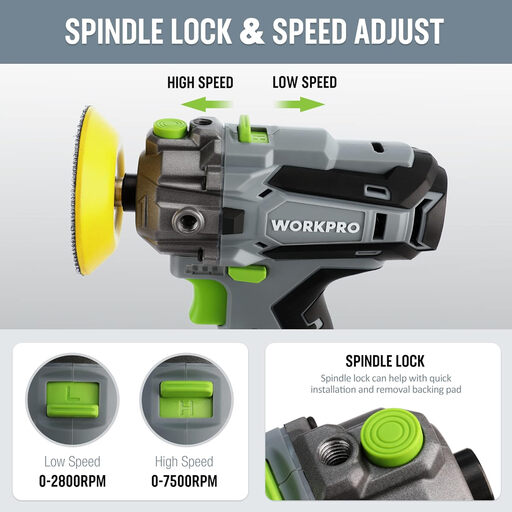
Why this product suits the profile: This compact machine is designed for occasional care jobs, smaller surfaces and a range of materials. The set includes two 2.0 Ah batteries and several polishing discs.
Two batteries reduce charging interruptions. The two speed ranges from 2,600 to 7,000 rpm allow beginners to select a more restrained setting.
Machine weight of 0.88 kg with battery, two 2.0 Ah batteries, a 75 mm polishing sponge and wool pad according to the product description.

Why this product suits the profile: The 125 mm backing plate and 8 mm orbit are aimed at users who want to work on larger painted surfaces with variable speed.
The LCD shows the speed and battery status. According to the specifications, two 5.0 Ah batteries are interchangeable, making runtime planning more transparent than with a single battery.
Six speed settings with soft start, 2 × 5.0 Ah lithium batteries and an LCD display according to the product data.
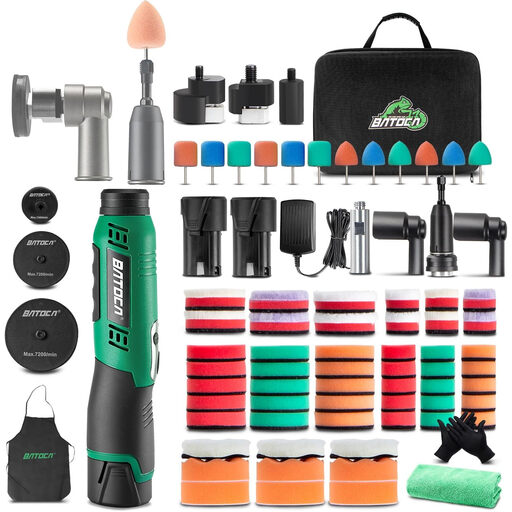
Why this product suits the profile: This mini system is designed for door handles, mirrors, badges, wheels, bumpers and polishing headlights, making it suitable for hard-to-reach areas.
Several backing-plate sizes from 25 to 75 mm prevent a large pad from sitting uncontrollably against small components. The DA and RO modes can be switched between.
Speed ranges of 1,000–5,000 and 4,200–21,000 rpm, 3 and 12 mm orbits, and two 12 V batteries according to the product description.
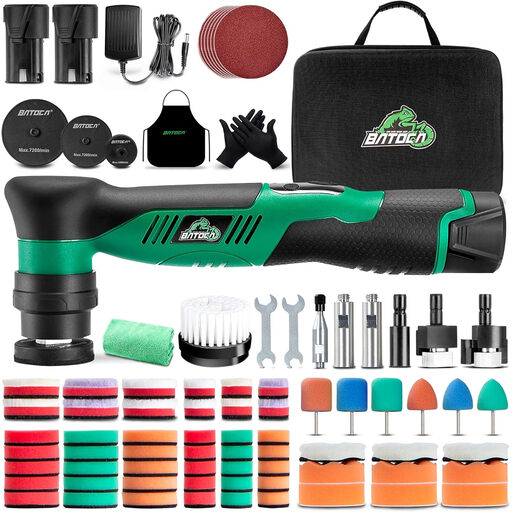
Why this product suits the profile: This model combines rotary and two dual-action functions, and is designed for detailing paintwork, headlights, wheels and bodywork contours.
The three drive types and three backing-plate sizes reduce the need for several separate machines. Two interchangeable batteries help with recurring detailing work.
3-in-1 system, six settings from 2,000–5,500 rpm, and 25, 50 and 75 mm backing plates according to the product specifications.
The pad hardness should match the task: harder foam pads are generally used for cutting, while softer pads are intended for finishing and evenly applying wax polish. A wool pad can cut more aggressively, but requires particularly careful control. Wash pads after use and allow them to dry completely.
To remove polish and wax, a clean microfibre cloth with a sufficiently high GSM weight is useful. The 600-GSM microfibre cloth measures 30 × 60 cm and is made from 80% polyester and 20% polyamide according to the product description. Remove sand and hard particles before use. Do not use fabric softener, as it can reduce absorbency.
We have put together a complete, regularly updated list of products that fully meet these strict selection criteria and the safety regulations applicable in the EU.
That depends on the battery capacity, speed, applied pressure and workload. Figures such as ‘30 or 60 minutes’ should be checked against the relevant test conditions. Two batteries allow you to swap one while the other is charging. For realistic planning, runtime under load is more important than the no-load figure alone.
A dual-action polisher is easier for many users to control because its additional movement supports even working. A rotary polisher can be useful for targeted corrections and small areas, but requires careful guidance. If you want to cover both tasks, choose a machine with a switchable DA and RO system.
In principle, small backing plates are suitable for headlights and other confined areas. However, check the material, pad, polish and speed. When working on plastic surfaces, start by treating a small test area. Do not stay in one place for too long and avoid heating the surface unnecessarily.