
Lieferung heute & morgen

Qualitätsgarantie

Willkommens-Angebote freischalten: KOSTENLOSE Lieferung | Bis zu 80 % RABATT | Kostenlose 30-Tage-JoyPlus-Testphase
App herunterladen
A cordless car polisher gives you the freedom to move around without an extension lead, making it particularly suitable for garages, parking spaces and mobile vehicle care. However, not every cordless device is automatically suitable for larger paintwork areas or delicate components. If you focus only on high speeds, a large battery capacity or an extensive range of accessories, you may end up buying a tool that quickly becomes impractical.
High speed alone says little about whether a machine is suitable for vehicle paintwork. For polishing and waxing a car, speed control, movement type, pad size and controllable power transfer are also crucial. A small rotary machine with a high maximum speed may be suitable for localised work, but it requires more experience on larger surfaces.
The specification in Ah describes the battery’s capacity, not its actual operating time. Speed, pressure, material and motor design all affect energy consumption. The following factors are therefore particularly relevant in practice:
A cordless polisher set with two batteries may be more practical for longer jobs than a nominally more powerful device with just one battery.
A 125-mm or 150-mm backing plate covers larger paintwork areas more efficiently. For door handles, areas around alloy wheels, headlights, badges or narrow bodywork gaps, however, a mini polisher with a diameter of 25 to 80 mm is easier to handle. Buyers should therefore check whether the supplied pads are compatible with the backing plate and the intended application.
A dual-action polisher moves the pad along an offset path as well as rotating it. This changes how heat and pressure are distributed. For DIY users, this principle can be easier to control when caring for large areas of paintwork. However, the precise effect depends on the orbit, speed, pad, polishing compound and applied pressure.
A rotary polisher turns the pad around a central axis. It is suitable for targeted work and experienced users, but requires controlled handling. Some models, such as those from the BATOCA S series, allow you to switch between rotary and dual-action operation.
Several settings make it easier to adapt the machine to the material and task:
The manufacturer’s specifications should always be considered in conjunction with pad size and movement type. A speed of 2,000 to 5,500 U/min cannot be directly compared with 4,200 to 21,000 U/min from a small precision head.
Larger pads save time when working on large bonnets or doors. Smaller backing plates, on the other hand, make a polisher for hard-to-reach areas easier to use. A set with several backing plates and matching foam pads offers greater flexibility, provided the accessories can be securely attached.
Before use, check the condition of the paintwork, material compatibility and the polishing compound manufacturer’s instructions. Headlights, plastic, metal and furniture surfaces may have different requirements from vehicle paintwork.
The following products differ in terms of their battery concept, movement type, pad size and range of accessories. The information is based on the respective product descriptions.
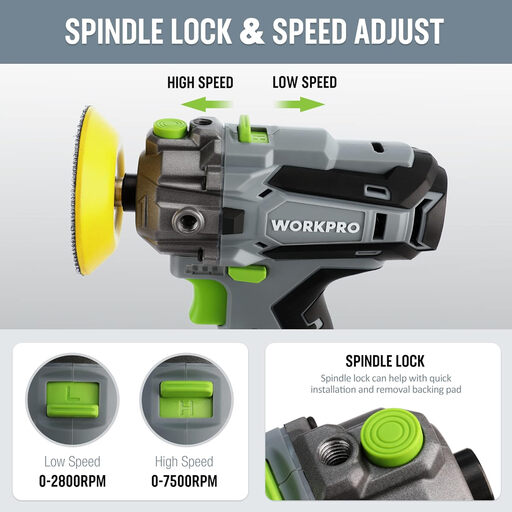
Why this product suits this profile: The set combines compact dimensions with two 2.0-Ah batteries, making it suitable for smaller areas of a vehicle, furniture, metal or occasional care work.
Two batteries reduce longer interruptions. The two speed settings and the listed equipment provide a clearer picture of what is included than a maximum speed specification alone.
12 V, two 2.0-Ah batteries, 75-mm polishing sponge, wool pad, several sponges and carrying bag according to the product description.
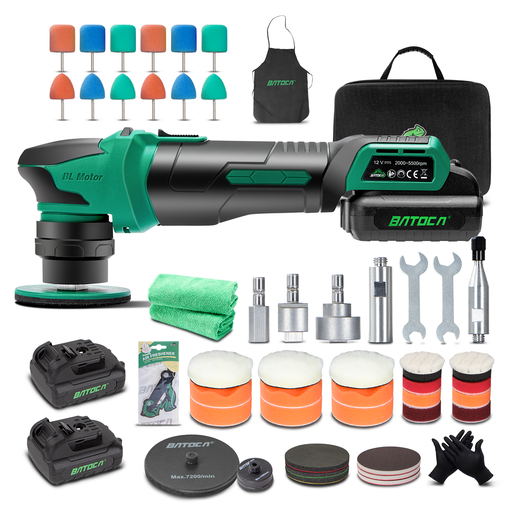
Why this product suits this profile: The switch between rotary and dual-action operation, together with 25- and 75-mm backing plates, is ideal for users who want to work on different detail areas with one machine.
The movement type can be adapted to the task. Two 2.5-Ah batteries and a speed display make it easier to plan work across several detail sections.
Brushless motor, 4 settings from 2,000 to 5,500 U/min, 3- and 12-mm dual-action drive and two batteries according to the product description.
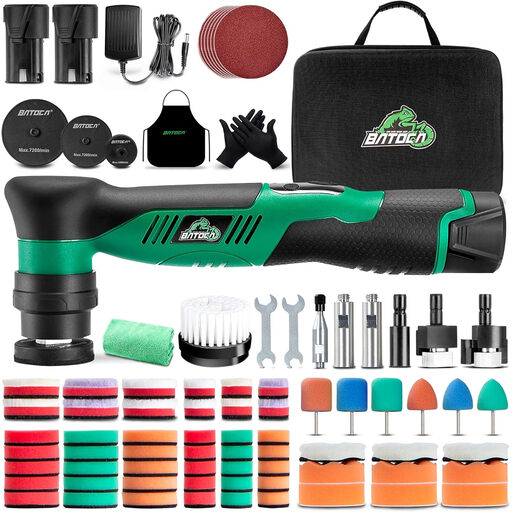
Why this product suits this profile: The 3-in-1 concept is designed for paintwork details, headlights, alloy wheels, badges and narrow areas of bodywork where large backing plates can be awkward to use.
The three operating modes and backing plates measuring 25, 50 and 75 mm prevent you from being restricted to just one working size. Spare batteries can be changed according to the product description.
Rotary operation plus 3- and 12-mm dual-action operation, six speed settings and two 12-V batteries with 2.0 Ah each according to the product description.
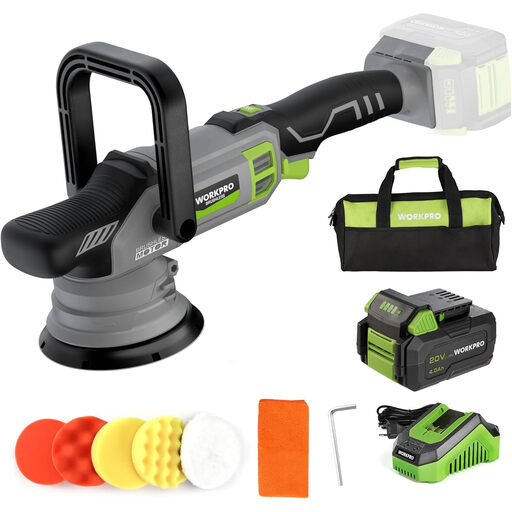
Why this product suits this profile: For larger paintwork areas, floors or tiles, this machine offers a 20-V battery with 4.0 Ah, seven speed settings and a dual-action system.
The 4.0-Ah capacity is clearly specified. Safety and accessory details, including the lock-off switch, quick-change base and carrying bag, are described as part of the package.
Brushless motor, dual-action movement, seven settings from 2,000 to 5,000 U/min and 4.0-Ah battery according to the product description.
We have put together a complete, regularly updated list of products that fully meet these strict selection criteria and the safety regulations applicable in the EU.
Before using a cordless car polisher, wash the vehicle thoroughly and allow it to dry completely. Otherwise, dust and sand may cause additional marks. The following sequence is recommended for DIY users:
When using rotary operation, pay particular attention to heat build-up and edges. Dual-action movement does not replace proper preparation of the paintwork. Deep scratches, damaged clear-coat layers or rust should be assessed by a professional beforehand.
Runtime depends on battery capacity, speed, applied pressure, pad size and material. Manufacturer specifications such as “up to 30 minutes without load” should not be equated with a guaranteed runtime during paintwork care. For longer jobs, two interchangeable batteries or a separately available spare battery are useful.
For beginners, controllable dual-action movement, low speed settings, manageable pad sizes and a clear battery indicator are all useful features. If you mainly want to wax or care for small areas of paintwork, you can start with a compact model. For larger surfaces, the machine should be stable enough to guide comfortably.
Running costs mainly consist of electricity, polishing pads, polishing compound and, where applicable, spare batteries. A complete car polishing set can reduce your initial accessory costs. Before buying, check whether pads and batteries can be reordered and are compatible with the relevant model.