
Lieferung heute & morgen

Qualitätsgarantie

Willkommens-Angebote freischalten: KOSTENLOSE Lieferung | Bis zu 80 % RABATT | Kostenlose 30-Tage-JoyPlus-Testphase
App herunterladen
A cordless car polisher can make car detailing easier when you choose one that suits the surface, the area you’re working on and the finish you want. Large body panels have different requirements from door handles, wheels, headlights or tight spaces on motorbikes and motorhomes.
If you focus only on speed, the amount of included accessories or marketing claims, you could quickly end up with a machine that’s impractical to use day to day. The following criteria can help you tell the difference between marketing promises and product features that really matter.
A high speed alone won’t guarantee an even shine or safe use. The type of movement, pressure control, backing plate size and the right polishing pad are also important. On delicate or thin paintwork, an overly aggressive combination of speed, pad and polish can put extra strain on the surface.
That’s why it’s useful to have several adjustable speed settings. This lets you use a cordless polisher differently when applying car wax than when working on small sanding marks.
A 125-mm backing plate can work efficiently on larger surfaces. For wing mirrors, areas around the wheels, door handles, panel creases or tight spots on bumpers, a mini car polisher is usually easier to control. Check whether the kit includes different backing plate sizes or an extension attachment.
A comprehensive kit is only practical if the pads are suited to the job. Firmer foam pads may be designed for more heavily marked surfaces or preparatory work, while softer pads are better suited to finishing and enhancing shine. A wool pad can tackle sanding marks, but it needs to be used with care.
Before use, pads must be clean and free from dust. Replace any damaged or badly worn attachments to avoid leaving additional marks on the paintwork.
A random orbital polisher moves the backing plate in an offset circular path as it rotates. This spreads the movement over a larger area. Depending on the model, a dual-action polisher combines orbital movement with rotation, and is often used for consistent polishing.
A rotary polisher spins the backing plate on a fixed axis. It can be useful for spot work and targeted correction, but requires careful handling. For beginners, a machine with a low starting speed and easy-to-control settings is often more manageable.
Speed is usually given in revolutions per minute. For random orbital machines, the orbit is also important, for example 3 mm, 5 mm or 12 mm. A larger orbit can cover a wider area with each movement, while a smaller orbit may be better suited to more precise work.
The highest individual figure isn’t what matters most. Look for a sufficiently wide range of speeds that can be adjusted in stages. For example, four to eight settings make it easier to match the speed to the polish, pad and condition of the paintwork.
When choosing a cordless polisher, look out for the following:
Two batteries can be more practical for longer jobs, as you can charge one while using the other. Actual run time depends on pressure, speed, pad, temperature and breaks during use. Treat manufacturers’ figures as a guide.
Before polishing, wash and dry the vehicle thoroughly. Then test the machine on an inconspicuous area. Start by trying a small working area with your chosen polish, pad, speed and pressure.
For a controlled detailing process:
A polisher can reduce certain fine scratches and sanding marks. It won’t reliably remove deep scratches, damaged clear coat or paint chips. Glass, plastic, headlights and wheels each have their own material requirements.
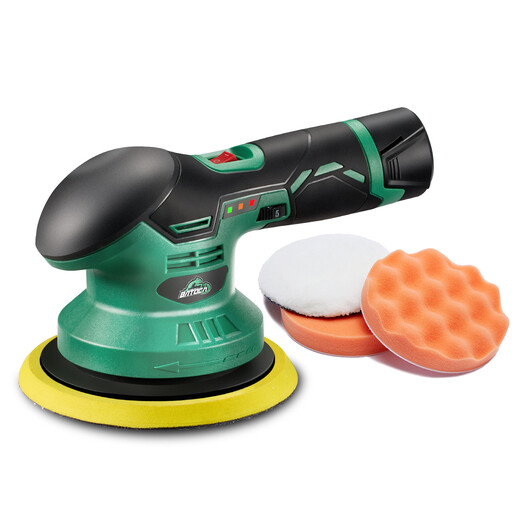
Why this product suits your needs: This machine offers six adjustable settings from 2500 to 5000 RPM, a 5-mm random orbital stroke and a 12-V battery. It’s suitable for basic paint care, waxing and polishing painted surfaces to a shine.
Adjustable speed means you don’t have to work at a high setting all the time. The battery indicator shows the charge level.
Cordless operation, a 2.0-Ah battery and 5-mm DA movement for consistent polishing on painted surfaces.
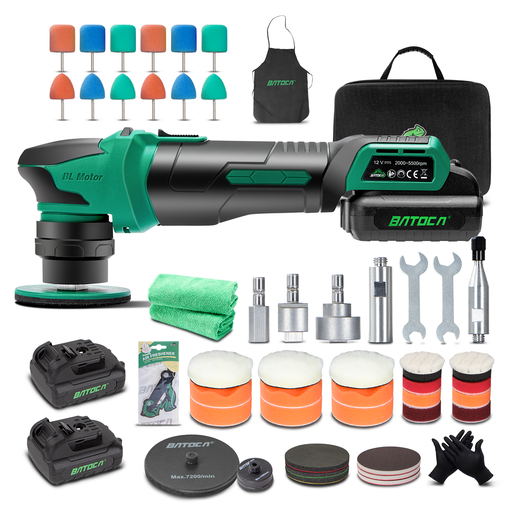
Why this product suits your needs: The set combines rotary and random orbital modes, two 12-V 2.5-Ah batteries, and 25-mm and 75-mm fittings. Its compact design makes it well suited to detailing wing mirrors, bumpers and wheels.
The different fittings mean you aren’t limited to using a single backing plate size. Four settings between 2000 and 5500 RPM allow you to adjust the speed in stages.
Brushless motor, two batteries, and 3-mm and 12-mm random orbital strokes, according to the product description.
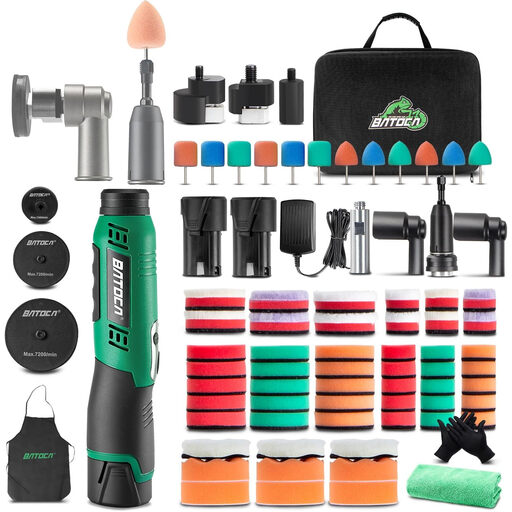
Why this product suits your needs: For motorbikes, motorhomes, boats and detailed work, it offers RO and DA modes, 25-, 50- and 75-mm backing plates, and different speed ranges.
Interchangeable systems and sizes mean you’re not reliant on a single polishing head. Two 2.0-Ah batteries help support longer detailing sessions.
RO/DA switching, six speed settings and a stated no-load run time of around 30 minutes per battery.
We’ve put together a complete, regularly updated list of products that meet these strict selection criteria and the safety regulations in force in the EU.
As well as the machine itself, consumables affect the overall cost. A 100-mm faux wool polishing pad with a hook-and-loop backing may be designed for compatible random orbital machines, electric polishers and drills. Clean it after each use and allow it to dry completely.
A set with several foam pads and an M10 adaptor can cover different levels of firmness. Make sure you stay within the accessory’s maximum speed rating, and don’t use pads on materials they’re not suited to. Carnauba wax also needs a clean applicator pad and a microfibre cloth. Treat stated protection times as manufacturers’ claims, as they depend on preparation, use and weather conditions.
A random orbital or DA model with several low-speed settings is usually easier to control than a rotary-only machine. Compact backing plates are useful for smaller areas. Always test the machine on an inconspicuous area before using it for the first time.
Run time depends on battery capacity, speed, pressure and the pad. With a model that comes with two batteries, you can keep working by swapping them over. Manufacturers’ figures measured under no-load conditions aren’t directly comparable with run time when polishing under load.
Depending on the condition of the paintwork and the polish used, some fine surface marks can be reduced. Deep scratches, paint chips or damage through to the primer usually require other repair methods. A cordless polisher isn’t a substitute for professional paintwork repairs.