
Lieferung heute & morgen

Qualitätsgarantie

Willkommens-Angebote freischalten: KOSTENLOSE Lieferung | Bis zu 80 % RABATT | Kostenlose 30-Tage-JoyPlus-Testphase
App herunterladen
A cordless car polisher makes it easier to care for your vehicle without a power cable getting in the way, especially when you need to reach awkward spots. However, cordless polishers vary considerably in their polishing action, battery capacity, pad size and accessories.
If you focus only on speed or a long list of accessories, you could easily end up buying a machine that isn’t suited to the job. Three things are particularly likely to lead to the wrong purchase:
A rotary polisher turns the backing plate directly around its central axis. This allows you to work precisely on specific areas. However, this type of movement requires a steady hand, particularly on delicate or thin paintwork.
A random orbital polisher, also known as a dual-action polisher, combines rotation with an orbital movement. The backing plate also moves in a circular orbit, helping you work evenly when applying wax, sealant or finishing polish. The orbit size matters: a 3 mm orbit is better suited to detail work, while 8 or 12 mm produces a wider working movement.
For a versatile car detailing polisher, a switchable system can be a good choice. It lets you choose between rotary and orbital action, depending on the area of paintwork.
Variable speed is more useful than a single top-speed figure. You’ll generally use a different setting to apply wax or work on plastic and glass than you would for more intensive paint correction. Product specifications should therefore give a clear speed range and several settings.
Also look for:
Always start a cordless polisher with pads on the lowest suitable setting. Keep the pad moving evenly. Applying too much pressure can generate heat and put unnecessary strain on the surface.
With a cordless polisher, battery voltage and amp-hours should be considered separately. Voltage helps indicate the system class, while capacity in Ah gives an idea of potential running time. Two interchangeable batteries are handy: you can charge one while using the other.
Pad size determines what the machine is best suited to:
A complete car polishing kit should include suitable pads in different grades, a secure backing-plate fitting and, where appropriate, extension bars and cleaning or storage accessories. Also check whether replacement pads and compatible batteries are available.
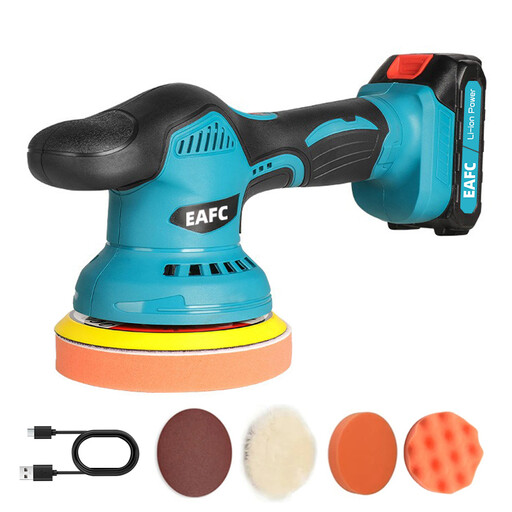
Why it suits this user: The 125 mm backing plate and eight speed settings make this a good choice if you want to apply wax or sealant and carry out light maintenance on larger areas of paintwork yourself.
The orbital movement and eight adjustable settings mean you’re not limited to a single working speed.
125 mm backing plate, 2,800–5,500 rpm according to the product specifications, and dual-action movement.

Why it suits this user: Two 5 Ah batteries, an LCD display and an 8 mm orbit make this a good fit if you want to work on several areas of your vehicle in one session.
According to the product description, the LCD display shows the speed and battery level. Two interchangeable batteries also help reduce longer breaks.
2 × 5 Ah, six settings, soft start and a stated charging time of around 2.5 hours.
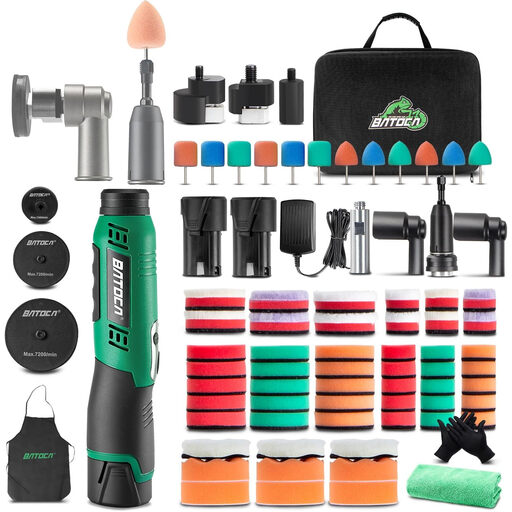
Why it suits this user: The dual system, with RO and DA modes, and 25, 50 and 75 mm backing plates make it suitable for detailers, wheel areas and hard-to-reach parts of the vehicle.
The range of backing-plate sizes means you don’t have to use a large plate on tight contours or small areas.
Switchable RO/DA function, 3 mm and 12 mm orbital drive, and two 12 V, 2.0 Ah batteries according to the product specifications.
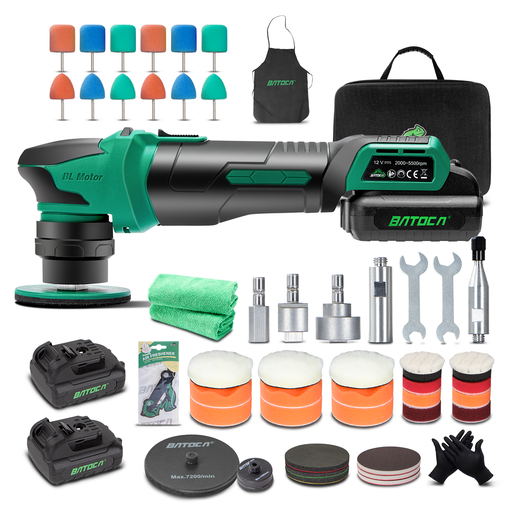
Why it suits this user: The 25 and 75 mm backing plates and extension bar are useful for working on mirrors, bumpers, wheels and inner edges.
The kit isn’t limited to one large backing plate. It offers rotary action as well as 3 mm and 12 mm orbital movement.
Brushless motor, 2 × 12 V/2.5 Ah batteries and four settings in the 2,000–5,500 rpm range according to the product specifications.
We’ve put together a complete, regularly updated list of products that meet these strict selection criteria and fully comply with the safety regulations in force in the EU.
Before polishing, clean the surface thoroughly and check for loose dirt. Use suitable pads and products for paintwork, plastic, glass and wheels. Make sure the polishing pad is clean, undamaged and securely attached to the backing plate.
Also remember to:
A mini car polisher for detail work is no substitute for using the right product or preparing the surface carefully. For deep scratches, damaged clear coat or uncertainty about material compatibility, professional car detailing may be the better option.
Running time depends on battery capacity, speed, pressure, pad size and material. Manufacturers’ figures sometimes refer to running the machine without a load or under ideal conditions. Two interchangeable batteries are more practical than a single battery for longer jobs. Check the charging time and availability of replacements too.
A random orbital or dual-action polisher can be used with control for many car-care jobs. However, you still need to match the speed, pad and polish. Start on a low setting, use light pressure and test a small area first.
125 mm pads are commonly used for larger body panels. Smaller 25, 50 or 75 mm pads are easier to handle on mirrors, wheels, edges and door handles. If you want to care for the whole vehicle as well as tackle detail work, a selection of compatible backing-plate sizes is a real advantage.