
Lieferung heute & morgen

Qualitätsgarantie

Willkommens-Angebote freischalten: KOSTENLOSE Lieferung | Bis zu 80 % RABATT | Kostenlose 30-Tage-JoyPlus-Testphase
App herunterladen
A cordless car polisher gives you the freedom to work wherever you need to, without having to find a nearby socket or work around cables while detailing. However, cordless car polishers vary considerably in their polishing action, pad size, battery system and accessories. If you focus only on speed or a long list of accessories, you could end up with a tool that isn’t right for the job you have in mind.
A high speed doesn’t automatically mean better polishing performance. Lower speeds are usually easier to control when applying wax or sealants and working on delicate surfaces. When polishing paintwork, the pad, polish, pressure and polishing action you choose all matter too. That’s why variable speed control is more important than the highest possible speed.
It’s not just the voltage that matters: battery capacity in Ah, charging time and the option to use a spare battery are also important. A single-battery tool may be enough for smaller jobs. If you regularly detail several vehicles, you’re more likely to benefit from two swappable batteries or a compatible battery system.
A 125 mm backing plate is suitable for larger bodywork panels. However, it’s often too big for alloy wheels, headlights, badges, door handles and tight areas around bumpers. A mini polisher with a 25, 50 or 75 mm backing plate can give you more control in these areas. Before buying, check whether different backing plates or extension shafts are included.
A rotary polisher spins the backing plate around a fixed axis. This design transfers the movement directly to the surface, making it suitable for precise work on small areas. However, it requires a steady hand, as heat and material removal depend more heavily on pressure and speed.
An eccentric polisher, also known as a dual-action or random orbital polisher, combines rotation with a side-to-side motion. This spreads the movement across a larger area. For beginners and larger paintwork panels, this type of polisher can be easier to control. Figures such as 3 mm, 5 mm or 12 mm throw describe the size of the eccentric movement and affect both its reach and how it feels to use.
Models that let you switch between rotary and eccentric action offer greater flexibility. You should be able to change the drive unit without complicated assembly.
Look for a clear speed range and several settings. The speed may be shown using LEDs, a scale or a display. Speed memory is useful if you want to pick up where you left off with the same setting after a quick battery change or a short break.
For a safe start:
When polishing headlights or working on plastic and glass, make sure the polish is specifically suitable for the material. A polisher doesn’t replace the manufacturer’s approval for use on a particular material.
A lightweight tool makes it easier to work on the roof, bonnet and side panels. For longer sessions, the grip position, vibration and balance between the battery and motor housing matter too. When comparing models, check:
A comprehensive kit is only worthwhile if its accessories are right for your vehicle and the surfaces you plan to work on.
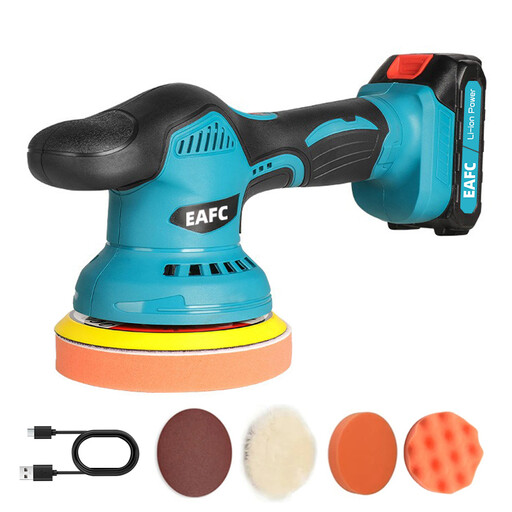
Why it’s a good match: The 125 mm dual-action design is made for larger paintwork panels, wax and sealants. Eight speed settings let you adjust the tool to suit the pad and the job.
The eight speed settings mean you’re not limited to simply switching the tool on or off. The 5 mm eccentric throw is designed for controlled movement on painted surfaces.
125 mm backing plate, 2,800–5,500 rpm, tool weight of 1.13 kg according to the product details, and dual-action movement.
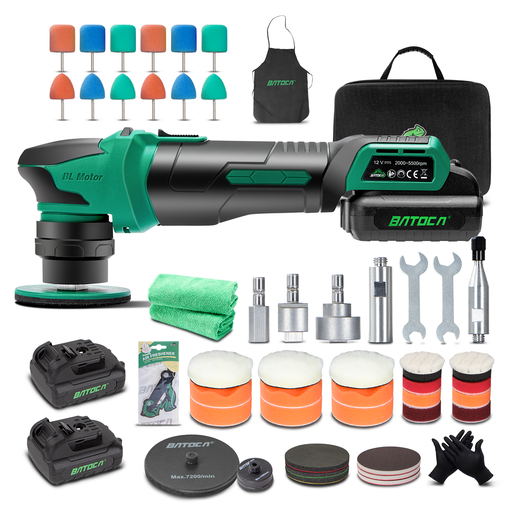
Why it’s a good match: This system combines rotary and eccentric polishing, making it a good choice for users who need different polishing actions for detailing.
The 25 and 75 mm backing plates mean you’re not limited to a single pad size. Two 12 V batteries help reduce interruptions during longer detailing jobs.
Brushless motor, four speed settings from 2,000 to 5,500 rpm, 3 and 12 mm eccentric throw, and accessories for detailed work.
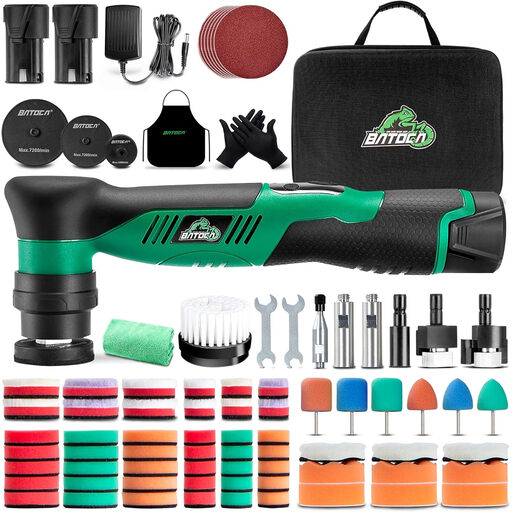
Why it’s a good match: Its compact design and choice of small backing plates make it suitable for headlights, alloy wheels, badges, window edges and other hard-to-reach areas.
The 25, 50 and 75 mm backing plates and interchangeable drive units mean you don’t have to use an oversized plate on smaller areas.
Three polishing functions, six speed settings from 2,000 to 5,500 rpm, and two 12 V batteries, each with a capacity of 2.0 Ah according to the product description.
We’ve put together a complete, regularly updated list of products that meet these strict selection criteria and the safety requirements in force in the EU.
For beginners, a dual-action polisher with several speed settings and a manageable pad size is often easier to control. Always start at a low speed, apply light pressure and test a small area first. A mini polisher is a good choice if you’ll mainly be working on headlights, alloy wheels or tight areas of bodywork.
Runtime depends on battery capacity, speed, pressure, pad size and material. Manufacturer figures often refer to specific operating conditions, so they may not reflect every type of use. If you regularly detail vehicles, two swappable batteries or a separately available spare battery can be useful. Also check whether the battery and charger are included.
As well as the purchase price, you’ll need to allow for electricity, spare batteries, polishing pads and consumables. The charger’s electricity use is usually a smaller expense than pads and polishes. So, pay particular attention to the accessories available, suitable replacement pads and compatibility with other batteries. This will make it easier to incorporate the polisher into your car care routine over the long term.