
Lieferung heute & morgen

Qualitätsgarantie

Willkommens-Angebote freischalten: KOSTENLOSE Lieferung | Bis zu 80 % RABATT | Kostenlose 30-Tage-JoyPlus-Testphase
App herunterladen
A cordless car polisher makes vehicle care easier without the hassle of extension leads and hunting for power sockets. However, not every battery-powered model automatically delivers an even finish. What really matters are the motor, speed control, backing plate, battery capacity and the right accessories.
The Joybuy Product Recommendation Officer provides a balanced overview of the key buying criteria, so car owners, DIY enthusiasts, workshops and vehicle detailers can better assess marketing claims.
A high RPM figure alone tells you little about how well a machine will perform in practice. For polishing and waxing a car, lower speeds are often used compared to working on more heavily weathered surfaces. That’s why a finely graduated speed control with soft start or a safety feature is important.
Excessively high speeds, too much pressure or a stationary backing plate can heat up the paintwork. This is especially true with a rotary machine. A dual-action polisher (also known as an orbital polisher) distributes the movement across an additional eccentric orbit, making it easier for many beginners to control.
Manufacturer claims about run time can vary depending on pressure, polish, speed and load. A single battery may not be enough for a full paint correction on larger vehicles. That’s why two batteries, a charge indicator or a battery system with separately available spare batteries are practical.
Voltage alone is not a direct comparison for actual working time. Also check the capacity in Ah, the charging time, and whether the battery and charger are included in the box.
A backing plate of around 125 or 150 mm is suitable for larger painted panels. For mirror housings, door handles, alloy wheels, headlights or tight bodywork edges, a mini polisher with 25, 50 or 75 mm is far more manoeuvrable.
What’s more, polishing won’t remove every scratch. Surface-level wash marks and light paint haze can be reduced depending on the paint condition. Deep scratches that reach the primer, however, require a different professional assessment and cannot be reliably removed by polishing alone.
An eccentric polisher moves the backing plate along an eccentric orbit in addition to its rotation. This can help achieve an even finish and is a well-controlled design for many home users. A rotary drive transfers the rotational movement more directly and is suitable for precise work, but requires controlled handling.
Models with a switchable DA and RO system offer greater flexibility. Check whether the changeover is tool-free, what stroke sizes are available, and whether the respective backing plates are included in the set.
Low speed settings are useful for wax, sealants and delicate work steps. Medium settings can be appropriate for polishing and cleaning. A higher setting may be intended for more heavily worn surfaces, but should always be matched to the pad and polish being used.
Look for:
A suitable backing plate diameter is more important than an especially long list of accessories. For larger areas, 125 mm or 150 mm pads are practical, while detail work requires smaller fittings. Different foam densities, wool pads and microfibre cloths should be clearly categorised according to their intended purpose.
When choosing a product, also check whether the battery is included, what charging connection is used, and whether spare batteries are available. For devices with a lithium-ion battery, follow the manufacturer’s instructions for the charger, storage and temperature. An existing battery system from other power tools is not automatically compatible.
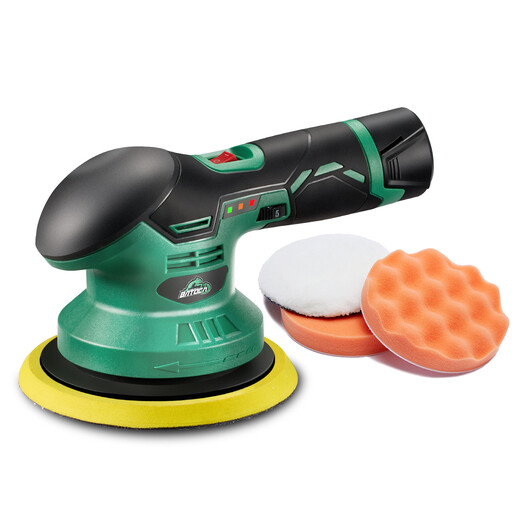
Why this product suits the profile: This cordless battery-powered car polisher features a 5 mm random orbit, six speed settings from 2500 to 5000 RPM and weighs around 3 lb. That makes it manageable for occasional care work on painted surfaces.
The six settings allow a lower speed for wax and sealant. A coloured battery indicator shows the charge level while you work.
2.0 Ah battery, fast charger, 5 mm DA movement and a 2500–5000 RPM control range.
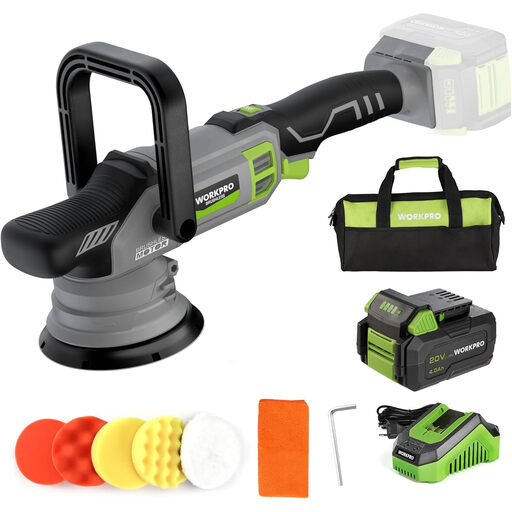
Why this product suits the profile: For larger vehicles, regular paint correction or longer working sessions, this model offers a 4.0 Ah battery, a brushless motor and seven speed settings.
The battery capacity is higher than many compact sets. A safety button reduces the risk of accidental start-up.
20 V, 4.0 Ah, 2000–5000 RPM, dual-action drive and accessories including a storage bag.
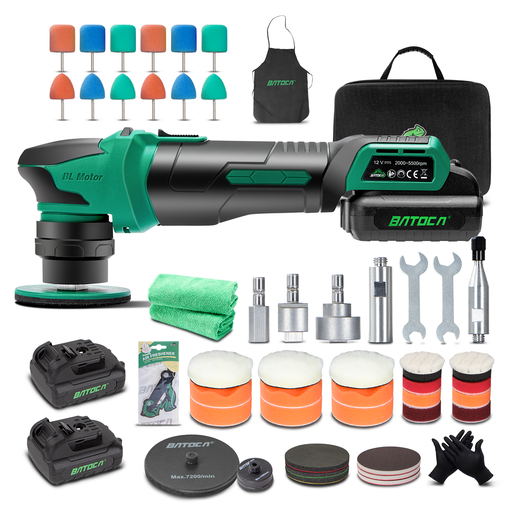
Why this product suits the profile: This set is designed for detail work on mirrors, bumpers, alloy wheels, plastic parts and tight bodywork areas. It combines rotary and eccentric functions.
Multiple backing plate sizes prevent having to use a large plate for hard-to-reach spots. Two 2.5 Ah batteries allow swapping during the job.
Brushless motor, 25 and 75 mm backing plates, 3 and 12 mm stroke, and four settings from 2000 to 5500 RPM.
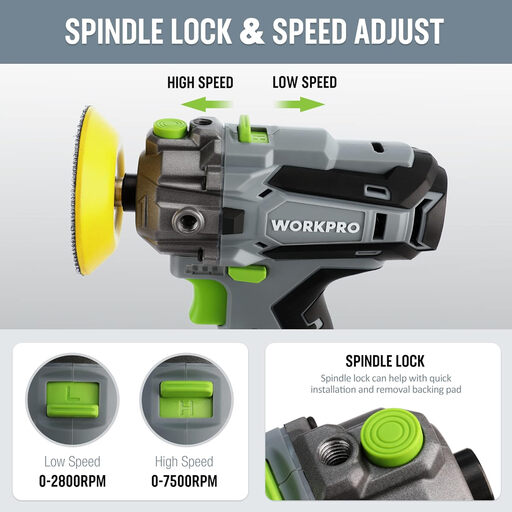
Why this product suits the profile: This compact tool with a 75 mm polishing disc is designed for tight spaces, smaller vehicles and varied tasks on cars, furniture or metal.
The smaller design reduces the space needed. Two 2.0 Ah batteries and a stated charging time of around one hour make longer work sessions easier.
Two speed settings from 2600 to 7000 RPM, 0.88 kg tool weight with battery, and several pads included.
We have put together a full, regularly updated list of products that fully meet these strict selection criteria and the safety regulations in force in the EU.
For headlights, plastic and alloy wheels, different material and product specifications apply. Do not automatically use paint polish on transparent plastic surfaces or sensitive interior surfaces.
The run time depends on battery capacity, speed, pressure and the surface. For longer jobs, two interchangeable batteries are more practical than a single high-capacity battery. Manufacturer figures should be taken as a guide, not a fixed working time.
For beginners, an eccentric or DA polisher with several low speed settings is a good choice. It should be easy to guide and have a clear battery indicator. Before the first use, try a test area with light pressure.
The ongoing costs mainly consist of electricity for the charger, replacement pads and possibly spare batteries. The power consumption per charge is usually modest. More important for the total cost are the availability of spare parts, compatible batteries and the quality of the included polishing pads.