
Lieferung heute & morgen

Qualitätsgarantie

Willkommens-Angebote freischalten: KOSTENLOSE Lieferung | Bis zu 80 % RABATT | Kostenlose 30-Tage-JoyPlus-Testphase
App herunterladen
A cordless car polisher gives you greater freedom of movement when working on your vehicle than a corded model. Sockets, extension leads and confined garage spaces are no longer obstacles. However, not every cordless polisher automatically delivers an even result. The design, battery capacity, speed control and suitable accessories all make a difference.
A high speed can be useful for removing material, but it also increases the risk of heat build-up and uneven treatment. Applying wax and light finishing work are usually carried out at lower speeds. When choosing a machine, therefore, a multi-stage speed control is more important than the highest possible maximum speed.
Capacity in Ah describes the amount of stored energy, but does not automatically indicate the actual runtime. Motor power, pressure, pad size and working speed all affect consumption. A cordless car polisher with two interchangeable batteries can be more practical day to day than a model with one larger battery if you want to work without a long charging break.
Polishing pads, backing plates and hook-and-loop attachments must be compatible in terms of diameter and fixing system. A pad of the wrong size may protrude or fail to sit evenly. Before buying, you should therefore check the backing plate diameter, stroke, attachment system and contents.
An orbital car polisher, also known as a dual-action polisher, combines a rotary movement with an additional orbital movement. This distributes the work over a larger area. For beginners, this design is often easier to control than a purely rotary machine.
Rotary movement can be useful for targeted material removal and certain detail tasks. However, it requires controlled handling, appropriate pressure and the right polish. If you regularly want to polish paintwork or correct surfaces, you should match the type of movement to the intended application.
Look for the speed specification in rpm and the number of settings. A machine with six speed settings can be adjusted for different stages of the work:
A soft-start function reduces sudden movements when the machine is switched on. An LCD display can also help you monitor the speed and battery status while working.
For a cordless car polishing machine, battery capacity, charging time and the option to change batteries are key considerations. A lighter device is easier to handle over longer periods, while a heavier weight can provide greater stability for certain applications. The handle position, non-slip surfaces and accessibility of the switch also affect control.
You should also consider the working environment: lithium-ion batteries should be stored in a dry place and protected from excessive heat. The charger and battery must belong to the relevant system. Damaged batteries or chargers should no longer be used.
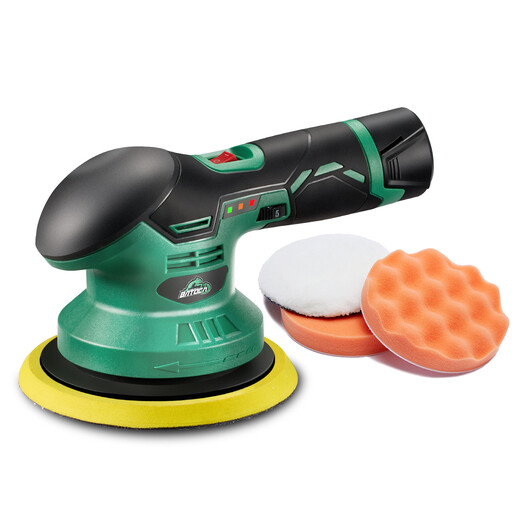
Why this product suits this profile: The compact 12-volt system with a 2.0-Ah battery is designed for private car-care sessions and occasional car polishing. The 5 mm orbital stroke supports smooth movement across painted surfaces.
Six speed settings from 2,500 to 5,000 rpm mean you are not limited to working at one fixed speed. A battery status display indicates the charge level.
Specified device weight of approximately 1.36 kg, 6-inch design, brushless motor and fast charger included in the set.

Why this product suits this profile: Two 5-Ah batteries and a 125 mm backing plate are aimed at users who want to work on several areas of a vehicle in one session.
The LCD display shows the speed and battery diagnostics. Six settings with soft start allow controlled adjustment to the polish and painted area.
Manufacturer specification: approximately 60 minutes of runtime per battery and around 2.5 hours of charging time. The package includes two batteries.
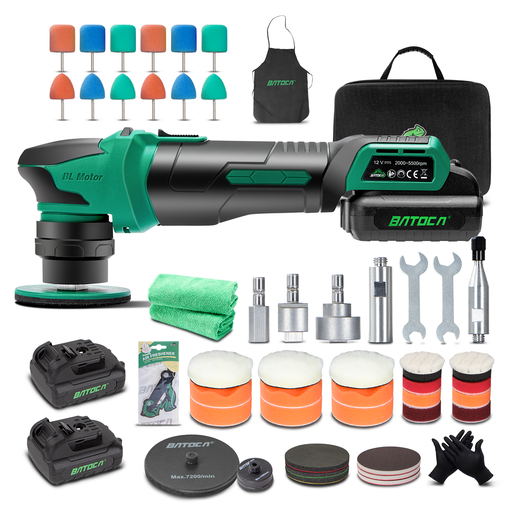
Why this product suits this profile: The mini design with 25 and 75 mm attachments is intended for tight areas around bumpers, mirrors, wheels and interior edges.
The system can operate in either rotary or orbital mode. This means it is not limited to a single type of movement for every detailing task.
Two 12-volt batteries with 2.5 Ah each, a brushless motor, four settings from 2,000 to 5,500 rpm and accessories for detailing work.
We have put together a complete, regularly updated list of products that fully meet these strict selection criteria and the safety regulations applicable in the EU.
Before using a cordless polisher, the vehicle should be thoroughly washed and dried. Small particles of dirt trapped between the pad and paintwork can cause additional marks. It is then advisable to test the machine on an inconspicuous area.
Your goal should be realistic: depending on the paintwork and process used, light surface residue can be reduced. However, attempting to remove deep scratches may require professional assessment or a different repair method. A polisher is not a substitute for painting or repair work.
Runtime depends on battery capacity, speed, pad size and applied pressure. Manufacturer specifications should be treated as a guide. Interchangeable batteries are practical when you need to work on several surfaces or vehicles without lengthy interruptions.
A cordless orbital polisher with several speed settings provides a flexible starting point. For beginners, soft start, low weight and an easy-to-understand battery status display are useful features. Always begin at a low speed and with a gentle pad.
Depending on how you use the machine, costs in addition to the purchase price may include electricity, replacement pads, polish and, where necessary, additional batteries. Washable pads can be reused, but must be thoroughly cleaned and dried after every use. A suitable backing plate and standardised hook-and-loop attachment make it easier to source replacement materials.