
Lieferung heute & morgen

Qualitätsgarantie

Willkommens-Angebote freischalten: KOSTENLOSE Lieferung | Bis zu 80 % RABATT | Kostenlose 30-Tage-JoyPlus-Testphase
App herunterladen
A cordless car polishing machine makes vehicle care easier without an inconvenient power cable. It is suitable for polishing painted surfaces, applying wax and working on small areas such as headlights, alloy wheels or trim. However, cordless car polishers vary considerably in terms of battery life, polishing action, speed and accessories.
It is therefore worth taking a close look at the technical specifications before buying. A high speed alone says little about how suitable a machine is in practice. What matters is whether it matches the area you want to work on, the condition of the paintwork and your own level of experience.
A wide speed range can initially sound convincing. However, lower speeds are often more suitable for waxing a car or spreading polish evenly. Excessive speed can generate heat and increase the risk of polishing marks. For beginners, finely adjustable speed settings with a soft start are often more practical than a machine with just one very high maximum speed.
A 125 mm backing plate efficiently covers larger body panels. On door handles, wing mirrors, badges, alloy wheels or headlights, however, a mini polishing machine with a 25, 50 or 75 mm plate is easier to control. If you focus solely on the maximum plate diameter, you may later need a second device for detailed work.
The stated capacity in Ah is an important comparison figure, but it does not by itself indicate the actual working time. The motor, speed and workload also affect energy consumption. A cordless car polisher with two interchangeable batteries may be more practical for longer jobs than a model with one larger battery if fast charging is not available.
A rotary polisher turns the backing plate directly around its central axis. It can be useful for localised correction work and stubborn paint defects, but it requires controlled handling and the correct speed.
A random orbital polisher also moves the backing plate along an eccentric orbit. This distributes the movement over a larger area. A dual-action polishing machine combines this technology with different stroke lengths, depending on the model, or with a switchable rotary mode. For regular maintenance and DIY applications, a random orbital or dual-action system is often easier to use gradually and safely. However, the result always depends on the pad, polish, pressure, temperature and condition of the paintwork.
Look out for:
Lower settings are usually best for waxes and sealants. Medium settings can be used to spread and buff car-care products. Higher settings should be reserved for experienced users and should not be applied to one area for too long.
With a car polishing kit, check which backing plates and pads are actually included. Small plates make detailed work easier, while 125 mm is suitable for larger painted surfaces. An orbital stroke of, for example, 5, 8 or 12 mm affects the movement and therefore how the machine works.
Other important features include:
Before use, check that the accessories are compatible with the backing plate diameter in question.

Why this product suits this profile: Two 12 V batteries with 5 Ah each and an LCD display make it easier to plan longer car-care jobs. The machine is suitable for users who want to work on painted surfaces with a 125 mm pad.
The six speed settings with soft start avoid the limitations of a single-speed machine. The battery level and speed can be read while working.
Two 5 Ah batteries, LCD display, six settings and a 125 mm polishing plate according to the product specifications.
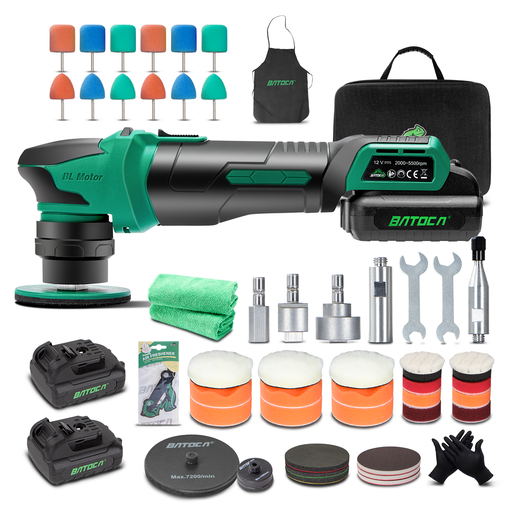
Why this product suits this profile: The switchable system combines rotary action with 3 and 12 mm random orbital strokes. This allows the machine to be adapted to different detailed areas.
Multiple backing plate sizes and two drive systems reduce the need to buy a separate device for tight spaces.
Brushless motor, two 12 V batteries with 2.5 Ah, four speed settings and 25/75 mm backing plates according to the product data.
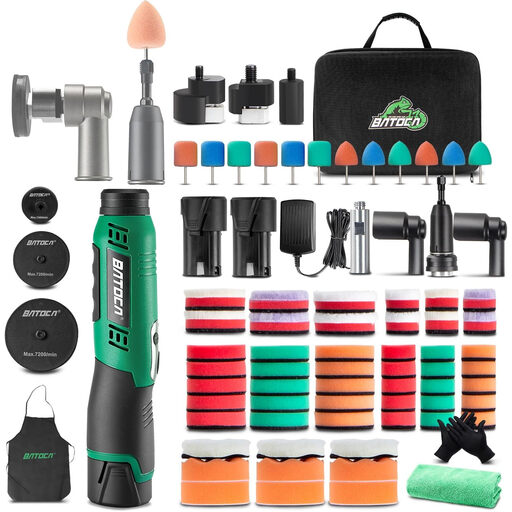
Why this product suits this profile: This kit is designed for detailed work on door handles, mirrors, alloy wheels, headlights and narrow bodywork areas.
The combination of a mini system, 25/50/75 mm plates and two drive types avoids the limitations of using one large polishing plate.
RO/DA system, 3 and 12 mm random orbital strokes, two 12 V batteries and speed ranges of up to 21,000 rpm in the mini system according to the product specifications.
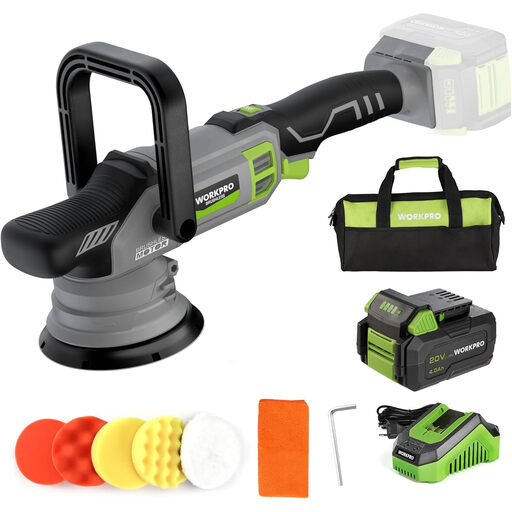
Why this product suits this profile: The 20 V model with a 4 Ah battery and 7 speed settings is aimed at users who want to work on floors, tiles or wood as well as vehicles.
The dual-action drive and adjustable settings allow more precise adjustment than a machine with a fixed speed.
Brushless motor, 20 V/4 Ah, 2,000–5,000 rpm, 7 settings and accessories with several pads according to the product description.
We have put together a complete, regularly updated list of products that fully meet these strict selection criteria and the safety regulations applicable in the EU.
Before polishing the paintwork, the vehicle should be thoroughly washed, dried and checked for visible contamination. Test the pad and polish on an inconspicuous area first. Move the machine evenly and do not hold it in one place with heavy pressure. With rotary models, pay particular attention to temperature and edges.
After use, we recommend:
Runtime depends on battery capacity, speed, contact pressure and workload. Product claims such as “30 minutes without load” cannot be directly equated with runtime under polishing conditions. For longer vehicle-detailing jobs, two interchangeable batteries or a separately available spare battery are useful.
A random orbital polisher or dual-action polishing machine is often considered easier to control than a purely rotary polisher. Nevertheless, you still need suitable pads, a low starting speed and even movements. It is still advisable to practise on a test area first.
For headlights, alloy wheels, badges and bodywork edges, small plates between 25 and 75 mm are practical. A mini polishing machine with interchangeable drives or an extension shaft can make access easier. For large bonnets and doors, however, a 125 mm system is generally more time-efficient.