
Lieferung heute & morgen

Qualitätsgarantie

Willkommens-Angebote freischalten: KOSTENLOSE Lieferung | Bis zu 80 % RABATT | Kostenlose 30-Tage-JoyPlus-Testphase
App herunterladen
A flat tire on the way to work or a deflated air mattress while camping – situations where a cordless air compressor is a huge relief. These portable devices promise quick, uncomplicated help without the hassle of cords or a trip to the nearest gas station. But the market is flooded with models whose performance claims often don't hold up in practice. Many buyers only discover their device is unsuitable when an emergency strikes.
As your Joybuy Product Recommendation Officer, I'll help you separate the wheat from the chaff. We'll highlight the most common pitfalls and show you which technical specifications truly matter, so you can make an informed decision and not waste money on useless gadgets.
Marketing claims can be misleading. Many devices fail to meet basic requirements, a fact that often only becomes apparent after the purchase. Pay special attention to these three points:
To avoid a bad buy, you should focus on objective, technical parameters. These three criteria are crucial for the performance and reliability of a cordless compressor.
Imagine a garden hose: pressure determines the force of the water stream, while the flow rate determines how quickly a bucket fills up. It's similar with a compressor.
The battery capacity, measured in milliampere-hours (mAh), determines how long the compressor can operate without recharging.
Modern devices offer more than just hot air. These features significantly increase utility and safety.
Not every user needs the same device. We have selected products for three typical use cases that meet the criteria mentioned above.
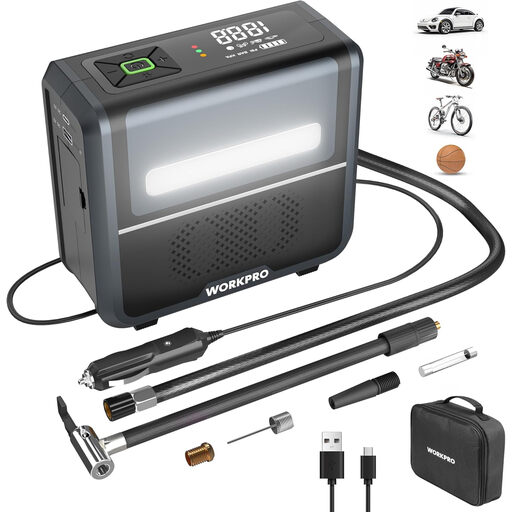
Why this model is a great fit: Ideal for drivers who need a reliable device for regular maintenance and emergencies. The dual power supply is the key feature for maximum operational security.
Solves the dead-battery problem with the included 12V cable for the cigarette lighter socket. The color-coded pressure display and auto-shutoff prevent inaccurate inflation.
Dual Power Supply: Operates via a 3x2500mAh battery or a 12V car adapter. Smart Modes: Presets for cars, motorcycles, bicycles, and balls simplify operation.

Why this model is a great fit: A highly specialized mini compressor for cyclists. Its compact size and low weight make it the ideal companion on tours, without compromising on the pressure performance needed for road or MTB tires.
This device doesn't try to be a jack-of-all-trades. It's explicitly designed for bicycles and delivers high performance (up to 150 PSI) for this purpose. It avoids the trap of insufficient air delivery by being optimized for the smaller volume of bike tires.
All-in-One Design: The hose and valves (Presta & Schrader) are integrated, which simplifies handling. Powerful Battery: According to the manufacturer, the 5000mAh battery can fill up to 8 tires on a single charge.
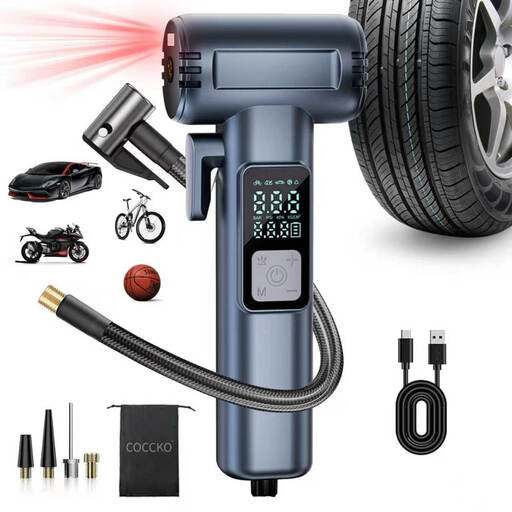
Why this model is a great fit: A true multi-tool for campers, families, and anyone who needs one device for various tasks – from car tires and bikes to air mattresses. The integrated emergency tools provide real added value on trips.
Avoids the trap of a limited use case. Thanks to 5 different modes and a high air delivery rate (35 L/min according to the manufacturer), the device is genuinely suitable for its advertised applications, from cars to balls.
High Versatility: 5 modes (Car, Motorcycle, Bicycle, Ball, Manual) and various nozzles included. Integrated Safety Features: Includes an emergency hammer to break windows and a seatbelt cutter.
We have compiled a complete, up-to-date list of products that fully meet these strict selection criteria and safety regulations.
1. How long does the battery of a cordless compressor last? The battery life heavily depends on the capacity (mAh) and the application. A model with 4000-5000 mAh can often top off 2-4 car tires by a few tenths of a Bar. Completely inflating a flat tire consumes significantly more energy. For reliability, a model with a dual power supply (battery and 12V port) is an excellent choice.
2. Can I inflate car tires with any cordless compressor? No. The crucial factors are the maximum pressure and, most importantly, the air delivery rate (L/min). A mini compressor designed primarily as an electric air pump for bike tires or balls often has too low a delivery rate to fill a car tire in a reasonable amount of time. Look for a specification of at least 20 L/min for use with cars.
3. How accurate is the pressure gauge on an electric air pump? The accuracy can vary. High-quality models with a digital display and automatic shut-off function generally offer high precision with minimal deviation. Nevertheless, it's good practice to check the pressure with a calibrated, separate tire pressure gauge after the first use to get a feel for the device's accuracy.